In today’s data-driven landscape, businesses across the United Kingdom are generating, processing, and storing more information than ever before. Whether you’re a fast-growing start-up in Manchester’s tech quarter or an established enterprise headquartered in the City of London, the ability to manage your data reliably and efficiently is no longer a luxury – it is a commercial necessity.
Yet, managing a database in-house is no small undertaking. It demands specialist expertise, round-the-clock monitoring, rigorous security protocols, and a significant investment in both infrastructure and talent. This is precisely where a Managed Database Service (MDS) steps in.
In this guide, we’ll walk you through what a managed database service actually is, how it works, the technologies underpinning it, and why more British businesses are choosing to hand over their database operations to a trusted specialist partner.
What Is a Managed Database Service?
A Managed Database Service is a fully outsourced database management solution in which a third-party provider takes responsibility for provisioning, configuring, monitoring, maintaining, securing, and optimising the performance of your database environment, so your internal teams don’t have to.
Think of it as having a dedicated team of database administrators (DBAs) and engineers working silently behind the scenes, ensuring your data infrastructure is always available, performant, and protected without the overhead of hiring and retaining that expertise in-house.
Managed database services can cover a broad range of database types and deployment models, including relational databases (RDBMS) such as PostgreSQL, MySQL, Microsoft SQL Server, and Oracle Database; NoSQL databases such as MongoDB, Cassandra, and Redis; cloud-native platforms such as Amazon RDS, Azure SQL Database, and Google Cloud SQL; data warehousing solutions such as Snowflake, Amazon Redshift, and Google BigQuery; and in-memory databases such as Redis and Memcached.
Whether your business runs on a single transactional database or a complex multi-region distributed architecture, a managed service can be tailored accordingly.
How Does It Differ from Self-Managed Databases?
With a traditional self-managed or on-premises setup, your internal IT or engineering team bears full responsibility for every layer of the stack from hardware provisioning and OS-level configuration to query optimisation, failover planning, and patch management.
With a managed service, those responsibilities are delegated to the provider. The division is typically governed by a clearly defined Service Level Agreement (SLA), which outlines uptime guarantees (commonly 99.9% or higher), incident response times, and the scope of support provided.
The contrast is stark. Hardware and infrastructure, database installation and configuration, patch and version management, performance tuning, backup and disaster recovery, scaling and capacity planning, and 24/7 monitoring all shift from the client’s plate to the provider’s — with security and compliance typically shared, though primarily led by the provider.
Core Components of a Managed Database Service
Provisioning and Configuration. Upon engagement, the provider sets up your database environment to match your specific requirements, selecting the appropriate engine (e.g., PostgreSQL 16, MySQL 8.0, or MongoDB 7.x), configuring parameters for optimal performance, and establishing network connectivity within your infrastructure, be it on-premises, cloud, or hybrid.
Automated Backups and Disaster Recovery. Managed services implement automated, scheduled backup strategies including full, incremental, and differential backups alongside robust point-in-time recovery (PITR) capabilities. Disaster recovery plans are tested regularly to ensure Recovery Time Objectives (RTO) and Recovery Point Objectives (RPO) are consistently met.
Performance Monitoring and Optimisation. Continuous monitoring is carried out using tools such as Datadog, pgAdmin, SolarWinds Database Performance Analyser, or Percona Monitoring and Management (PMM). DBAs analyse query execution plans, identify slow queries using EXPLAIN ANALYSE in PostgreSQL or the Slow Query Log in MySQL, and implement index optimisation and schema improvements to keep response times sharp.
Patch and Version Management. Routine patching and major version upgrades are handled with minimal disruption, typically scheduled outside peak business hours and communicated transparently to clients well in advance.
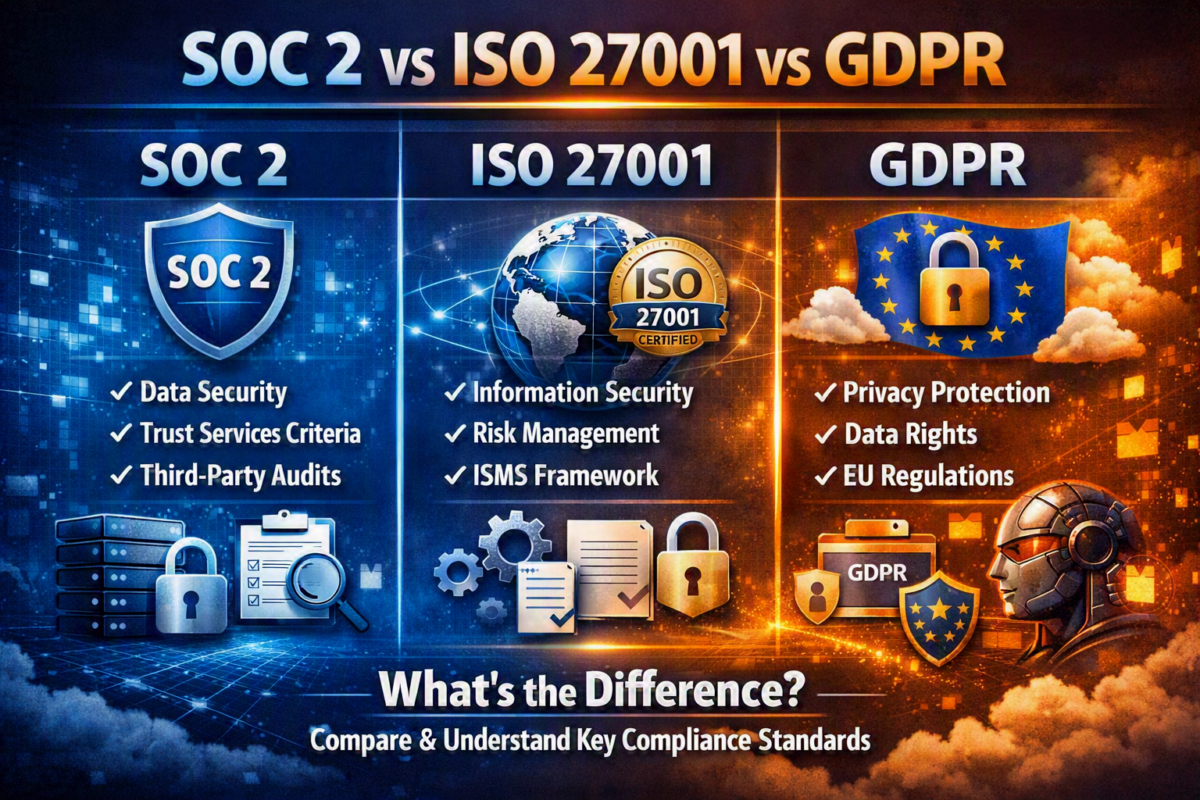
Security and Compliance. Data security is non-negotiable, particularly in the context of the UK’s Data Protection Act 2018 and UK GDPR. Managed services implement Role-Based Access Control (RBAC), encryption at rest and in transit via TLS/SSL, audit logging, vulnerability assessments, and penetration testing. Compliance alignment typically covers ISO/IEC 27001, SOC 2 Type II, PCI DSS, and Cyber Essentials Plus, the latter being a UK-specific government-backed certification.
High Availability and Failover. Providers leverage replication and clustering technologies to ensure continuity – primary-replica replication in MySQL and PostgreSQL, Always On Availability Groups in SQL Server, replica sets and sharding in MongoDB, and Multi-AZ deployments in cloud environments such as AWS RDS. These configurations enable automatic failover in the event of a node failure, dramatically reducing downtime.
Scalability. Managed services support both vertical scaling (upgrading instance size) and horizontal scaling (adding read replicas or sharding) without significant internal effort. Cloud-native databases further enable auto-scaling based on real-time demand, critical for businesses with fluctuating workloads.
Common Database Technologies in Managed Environments
Relational (SQL) Databases
PostgreSQL is an advanced, open-source RDBMS known for its ACID compliance, extensibility, and support for complex queries widely adopted for enterprise applications. MySQL and MariaDB remain highly popular for web applications, often forming the backbone of LAMP-stack environments. Microsoft SQL Server is prevalent where Microsoft ecosystem integration (Azure, .NET) is required, whilst Oracle Database is common in large-scale enterprise and financial services environments.
NoSQL Databases
MongoDB is a document-oriented database offering flexibility and scalability, well-suited to applications with variable or semi-structured data. Apache Cassandra is a distributed, wide-column store designed for high availability and linear scalability across commodity hardware. Redis serves as an in-memory key-value store, frequently used for caching, session management, and real-time applications.
Cloud Database Platforms
Amazon RDS and Aurora support PostgreSQL, MySQL, MariaDB, Oracle, and SQL Server in a fully managed AWS environment. Azure SQL Database offers intelligent performance features and seamless integration with the broader Microsoft Azure ecosystem. Google Cloud SQL and AlloyDB round out the major cloud offerings, with AlloyDB specifically designed for PostgreSQL-compatible high-performance workloads.
Data Warehousing
Snowflake’s cloud-native architecture separates compute from storage, making it popular for scalable analytics workloads. Amazon Redshift delivers petabyte-scale analytical query processing via columnar storage. Google BigQuery operates as a serverless, highly scalable warehouse well-suited for large-scale business intelligence and real-time data analytics.
Key Database Management Concepts You Should Know
When engaging with a managed database service, a working familiarity with the following concepts will help you have more productive, informed conversations with your provider.
ACID Compliance refers to Atomicity, Consistency, Isolation, and Durability, the four properties that ensure reliable database transactions. Normalisation is the process of structuring a relational database to reduce redundancy and improve data integrity. Indexing involves creating data structures (B-tree, hash, GIN, GiST) that accelerate data retrieval at the cost of additional storage.
Sharding is the horizontal partitioning of data across multiple database instances to improve scalability and performance. Replication is the copying and maintenance of database objects across multiple servers for redundancy and load distribution. Connection pooling managed via tools like PgBouncer or ProxySQL reduces connection overhead and improves concurrency under high load.
ETL (Extract, Transform, Load) pipelines move and transform data between systems, typically feeding a data warehouse for reporting and analytics. ORM (Object-Relational Mapping) frameworks such as SQLAlchemy, Hibernate, or Entity Framework abstract database interactions within application code. Finally, the CAP Theorem describes the fundamental trade-off in distributed systems between Consistency, Availability, and Partition Tolerance — essential for understanding how NoSQL databases are designed and why they behave as they do.
Why British Businesses Are Choosing Managed Database Services
Talent Shortages in the UK Tech Market. The UK faces a well-documented skills gap in data engineering and database administration. Recruiting a qualified DBA in London, Edinburgh, or Birmingham is both time-consuming and expensive. A managed service provides immediate access to seasoned professionals without the lengthy recruitment process or substantial salary overhead.
Cost Predictability. Managed services are typically offered on a subscription or retainer model, making expenditure predictable and straightforward to budget for a material advantage in the current economic climate. Capital expenditure on servers and licensing is replaced with transparent operational expenditure.
Focus on Core Business Objectives. Engineering and development teams are better deployed building features and driving product innovation than wrestling with backup schedules and replication lag. Offloading database management frees your people to focus on what genuinely moves the needle commercially.
Regulatory Peace of Mind. With UK GDPR enforcement by the Information Commissioner’s Office (ICO) carrying fines of up to £17.5 million or 4% of global annual turnover, the compliance credentials of your data infrastructure matter enormously. A reputable managed service provider will assist in maintaining the documentation, controls, and processes necessary to demonstrate compliance to regulators and auditors alike.
Business Continuity. Unplanned database outages are costly; industry benchmarks suggest the average cost of IT downtime for a mid-sized enterprise can run into tens of thousands of pounds per hour. Managed services reduce this risk substantially through proactive monitoring, automated failover, and rigorous disaster recovery planning.
Is a Managed Database Service Right for Your Business?
A managed database service is particularly well-suited for SMEs and scale-ups that lack the headcount for a dedicated DBA function; enterprises seeking to reduce operational burden and refocus internal teams on strategic data initiatives; businesses migrating to the cloud who require expert guidance through a complex transition; regulated industries including financial services, healthcare, and legal where compliance and audit-readiness are paramount; and organisations with 24/7 availability requirements who cannot afford database downtime outside normal working hours.
Final Thoughts
The question for most UK businesses today is no longer whether to invest in proper database management, it’s how. As data volumes grow, compliance requirements tighten, and the cost of downtime rises, the case for a managed database service becomes increasingly compelling.
By entrusting your database infrastructure to specialists, you gain not just operational reliability and security, but the freedom to direct your own teams towards the work that truly drives your business forward. In an environment where data is one of your most valuable commercial assets, that peace of mind is well worth having.