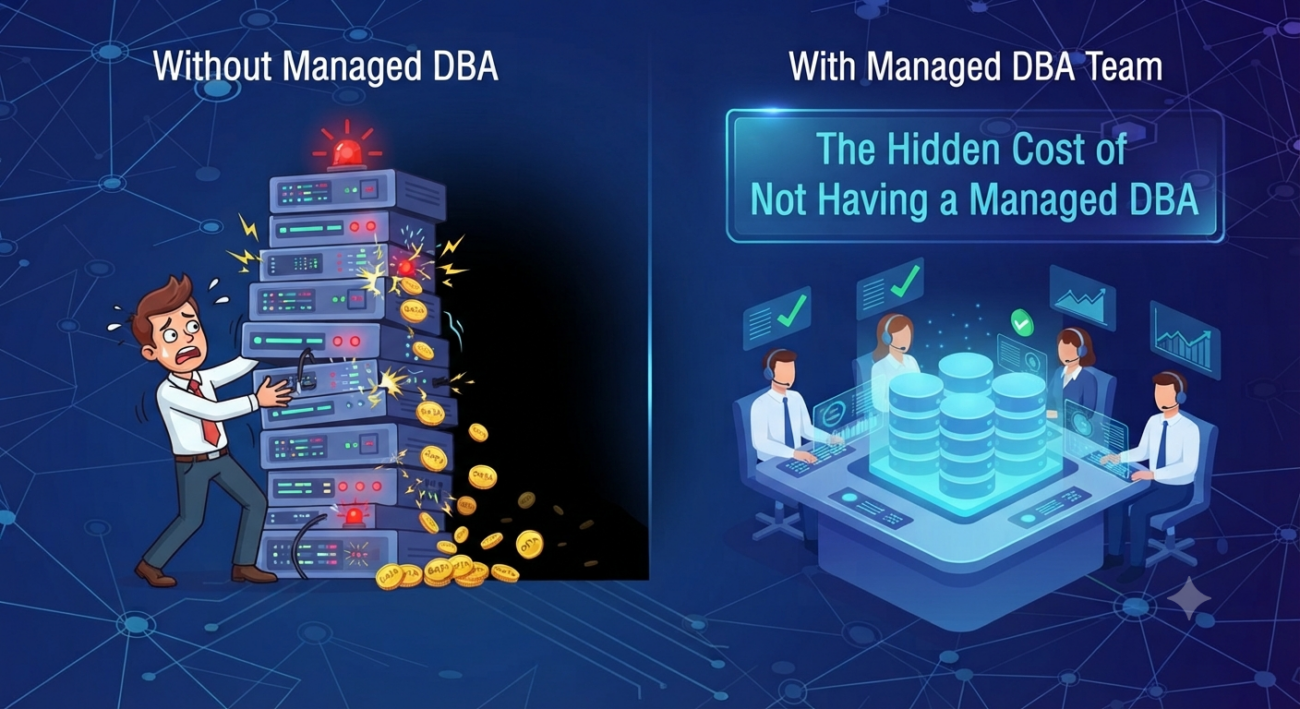
The Hidden Cost of Not Having a Managed DBA for Business Data
Meta description – Discover the hidden cost of not having a managed DBA. Protect your business data, reduce downtime risk, and stay compliant. Expert-managed DBA services for UK businesses.
The Cost You Cannot See on a Spreadsheet
Most business leaders know what they spend on database infrastructure. The server licences, the cloud bills, and the storage costs appear on invoices and sit neatly in budgets. What rarely appears, however, is the far greater cost of not having a dedicated, managed Database Administrator (DBA) overseeing your business data.
In today’s data-driven economy, your database is not merely a storage system; it is the operational backbone of your entire organisation. Customer records, transaction histories, compliance data, product catalogues, and financial reporting, all of it flows through your database. When that system is left without expert, proactive management, the hidden costs accumulate silently, until they surface at the worst possible moment.
This article sets out precisely what those hidden costs are, why UK businesses across sectors continue to underestimate them, and how a managed DBA service changes the financial and operational calculus entirely.
What Is a Managed DBA Service?
A managed DBA service provides your organisation with dedicated, expert database administration on an outsourced or co-managed basis. Rather than relying on a generalist IT team member to handle database tasks alongside a dozen other responsibilities, a managed DBA service assigns specialist professionals who monitor, optimise, secure, and maintain your databases continuously.
Managed DBA providers typically cover:
- Proactive performance monitoring and tuning
- Backup, recovery, and disaster preparedness
- Security patching and vulnerability management
- Capacity planning and scalability guidance
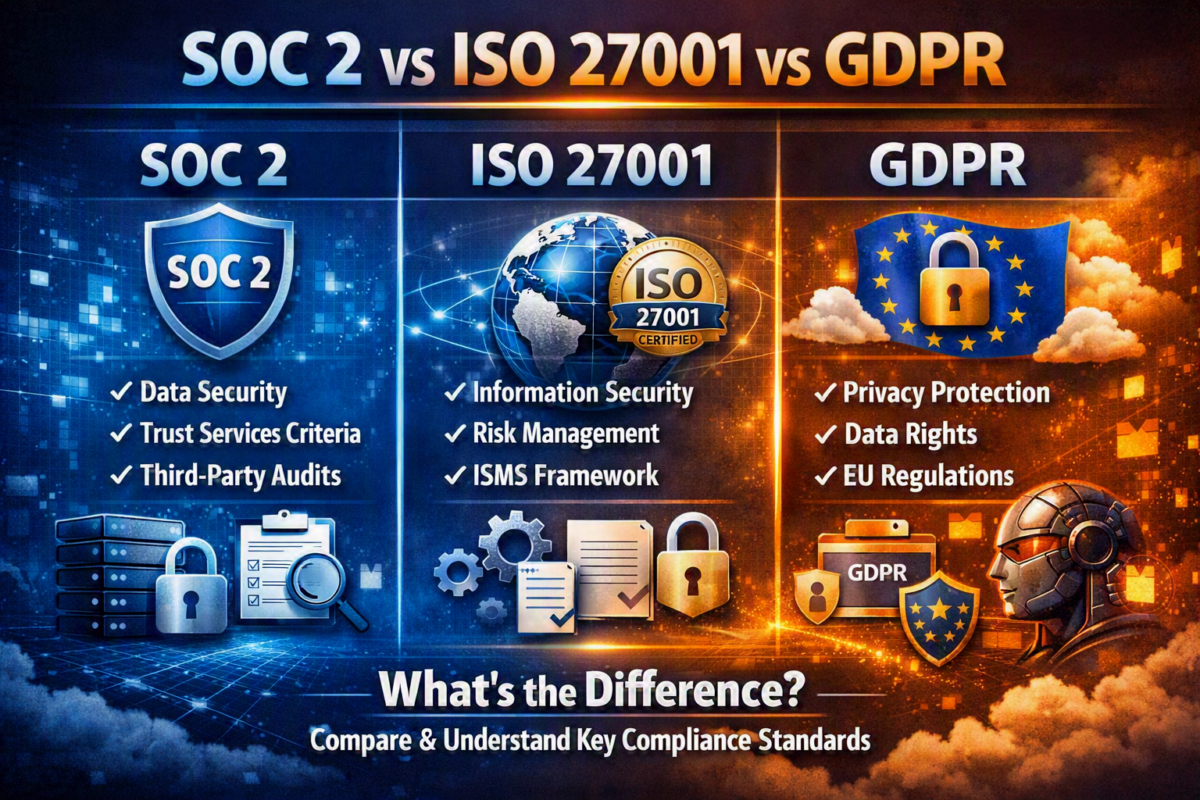
- Compliance and audit support (GDPR, ISO 27001, SOC 2)
- Query optimisation and index management
- Database migrations and upgrades
The question is not whether your business needs this expertise; it is whether the cost of not having it is one you can afford.
The Seven Hidden Costs of Operating Without a Managed DBA
1. Unplanned Downtime: The Costliest Line Item You Never Budgeted
Database failures do not announce themselves in advance. They occur during peak trading hours, at month-end close, or midway through a critical customer transaction. Without a managed DBA monitoring your systems proactively, small performance degradations go undetected until they become full-scale outages.
According to industry research, the average cost of IT downtime for mid-market businesses exceeds £4,000 per hour, and for e-commerce or financial services firms, that figure rises considerably. A managed DBA reduces this risk through continuous monitoring, alerting, and rapid incident response.
The hidden cost: Hours of downtime that could have been prevented with proactive query tuning, index rebuilding, or capacity alerts.
2. Data Loss and Incomplete Backup Strategies
Many organisations operate under the assumption that their backups work without ever validating that assumption. Without a dedicated DBA, backup schedules are often set once and never reviewed. Retention policies may be misconfigured. Recovery procedures may be untested for months or years.
When a data loss event occurs through hardware failure, human error, ransomware, or software corruption, the absence of a reliable, tested recovery strategy can be catastrophic. Beyond the immediate operational impact, there are regulatory consequences under the UK GDPR to consider. The Information Commissioner’s Office (ICO) can impose fines of up to £17.5 million or 4% of global annual turnover for serious data protection failures.
The hidden cost: Irrecoverable data, regulatory penalties, and reputational damage that no backup budget line can quantify.
3. Degraded Application Performance and Lost Productivity
Database performance does not collapse overnight. It degrades gradually, a slower query here, a timeout there, an increasingly sluggish CRM or ERP system that employees begin to work around rather than with. Without a DBA identifying and resolving performance bottlenecks, this silent erosion continues until it becomes unmistakable.
The productivity cost is high. If 50 staff members lose 10 minutes each day to slow systems, that equates to over 200 hours of lost productive time per month. Multiply that by average salary costs, and the figure quickly dwarfs what a managed DBA service would cost.
The hidden cost: Quantifiable staff productivity loss, compounded by employee frustration and disengagement.
4. Security Vulnerabilities and Exposed Business Data
Database security is a specialism. It requires an understanding of patch management cycles, access control configurations, encryption standards, privilege escalation risks, and SQL injection defences. Most generalist IT professionals are competent across many areas, but database security is a discipline in its own right.
Unpatched database vulnerabilities are one of the most common entry points for cybercriminals. The UK National Cyber Security Centre (NCSC) consistently highlights unpatched software as a primary attack vector. A managed DBA ensures that security patches are applied in a timely, tested manner, that access privileges follow the principle of least privilege, and that audit trails are maintained.
The hidden cost: The average cost of a data breach in the UK now exceeds £3 million when factoring in investigation, remediation, regulatory fines, and customer attrition.
5. Compliance Gaps That Emerge Only During Audits
Regulatory compliance is not a one-time exercise; it is an ongoing operational commitment. UK businesses subject to GDPR, PCI DSS, ISO 27001, or sector-specific frameworks such as FCA requirements must maintain continuous, demonstrable compliance at the database level. This includes data retention schedules, access logging, encryption at rest and in transit, and the ability to produce evidence rapidly in the event of an audit or regulatory enquiry.
Without a managed DBA, these controls frequently exist on paper but not in practice. Compliance gaps are typically discovered only during audits, at which point the remediation cost, the reputational exposure, and the potential for regulatory action all converge.
The hidden cost: Audit failures, emergency remediation projects, and regulatory penalties that could have been avoided through ongoing compliance management.
6. The True Cost of DIY Database Management
Many businesses respond to the DBA capability gap by assigning database responsibilities to existing IT staff, developers, system administrators, or infrastructure engineers. This approach carries high hidden costs that rarely appear in resource planning exercises.
First, it diverts skilled technical staff from their core responsibilities, reducing output across the board. Second, it creates a dependency on individuals rather than a structured, documented service, meaning knowledge walks out the door when that person changes role or leaves the business. Third, and perhaps most critically, it creates a false sense of security. Being able to manage a database day-to-day is not the same as being able to optimise it, secure it, recover it from failure, or scale it effectively.
The hidden cost: Opportunity cost of misallocated technical talent, knowledge concentration risk, and the compounding effect of decisions made without deep specialism.
7. Scalability Failures at Critical Growth Moments
Business growth is rarely linear, and databases that perform adequately under current load often fail spectacularly when traffic spikes, transaction volumes increase, or new integrations add complexity. Without proactive capacity planning from a DBA, businesses discover their database limits at the worst possible moment during a major campaign, a product launch, or an acquisition integration.
A managed DBA builds capacity planning into routine operations, ensuring that your database architecture evolves ahead of your business needs rather than behind them.
The hidden cost: Failed launches, lost revenue during high-demand periods, and expensive emergency infrastructure work carried out under time pressure.
The Comparison That Matters: Managed DBA vs the Cost of Doing Nothing
It is tempting to frame the managed DBA conversation as a straightforward cost decision. In reality, it is a risk management decision. The question is not “what does a managed DBA service cost?” but rather “what is the expected cost of the risks we are currently carrying without one?”
|
Risk Category
|
Estimated Annual Cost Without Managed DBA
|
|
Unplanned downtime (2–4 incidents per year)
|
£8,000 – £50,000+
|
|
Productivity loss from degraded performance
|
£20,000 – £80,000
|
|
Security incident or breach
|
£50,000 – £3,000,000+
|
|
Regulatory penalty (ICO, PCI, FCA)
|
£10,000 – £17,500,000
|
|
Emergency remediation and consultant fees
|
£15,000 – £100,000
|
|
Staff opportunity cost
|
£25,000 – £60,000
|
These figures vary significantly by business size and sector, but the pattern is consistent: the expected annual cost of not having a managed DBA substantially exceeds the cost of engaging one.
What to Look for in a Managed DBA Provider
Not all managed DBA services are equivalent. When evaluating providers, UK businesses should assess the following:
Breadth of platform expertise. Your provider should demonstrate deep capability across the database platforms you operate, whether that is Microsoft SQL Server, Oracle, PostgreSQL, MySQL, MongoDB, or cloud-native services such as AWS RDS or Azure SQL.
Response time commitments. Understand the SLA structure clearly. What constitutes a P1 incident? What is the guaranteed response time? What is the escalation process?
Proactive vs reactive orientation. A managed DBA service should be predominantly proactive, identifying and resolving issues before they become incidents. If a provider’s model is primarily reactive, you are paying for an expensive firefighting service rather than genuine risk reduction.
Compliance and governance support. Ensure your provider understands the UK regulatory landscape, including GDPR, and can provide evidence of compliance controls as part of their standard service.
Knowledge transfer and documentation. Your managed DBA provider should maintain up-to-date documentation of your environment, ensuring that no single point of knowledge dependency is ever created.
A Note on Cloud Databases: The Managed Services Misconception
A common misconception among businesses that have migrated to cloud-hosted databases AWS RDS, Azure SQL Managed Instance, Google Cloud SQL is that cloud providers handle the DBA function. They do not.
Cloud providers manage the underlying infrastructure: patching the OS, ensuring hardware availability, and providing backup facilities. They do not optimise your queries, design your indexing strategy, manage your access controls, tune your configuration parameters, or plan for your specific growth trajectory. The DBA function remains entirely the customer’s responsibility; the cloud simply changes where the database runs, not who manages it.
This misconception has led many cloud-migrated businesses to discover, often through a painful incident, that they have infrastructure reliability without operational expertise.
Conclusion: The Cost of Inaction Is Not Zero
Every organisation makes a choice about how to manage its business data. The choice is not between having a DBA and not having one; it is between having expert, proactive database management and bearing the full financial, operational, and reputational consequences of managing without it.
The hidden costs outlined in this article are not theoretical. They represent real financial exposures that UK businesses absorb quietly, attributing them to “system issues,” “IT problems,” or “bad luck” when in reality they are the predictable, preventable outcomes of an unmanaged database estate.
A managed DBA service converts unpredictable, potentially catastrophic risk into a fixed, plannable operational cost. For most mid-market and enterprise businesses, it is not simply a sensible investment; it is a foundational requirement for operating safely in a data-dependent world.