Understanding the Metrics That Define Business Continuity
In today’s data-driven economy, database downtime can have serious consequences. Whether caused by hardware failure, cyberattacks, human error or natural disasters, the inability to access critical business data can lead to lost revenue, operational disruption and reputational damage.
While many organisations invest in database backup solutions, far fewer fully understand two of the most important metrics in disaster recovery planning: Recovery Time Objective (RTO) and Recovery Point Objective (RPO).
These measurements play a crucial role in determining how quickly systems can be restored and how much data loss a business can tolerate following an incident. Understanding RTO and RPO is essential for building an effective database backup and recovery strategy that aligns with business objectives.
Why Backup and Recovery Matter
Databases underpin virtually every modern business application, from customer relationship management (CRM) platforms and e-commerce websites to financial systems and enterprise resource planning (ERP) solutions.
A database outage can interrupt business operations, impact customer service, delay transactions and expose organisations to regulatory risks. As cyber threats such as ransomware continue to increase, businesses must ensure their recovery capabilities are as robust as their preventative security controls. Effective backup and recovery planning is no longer simply an IT requirement; it is a critical component of business resilience.
What is Recovery Time Objective (RTO)?
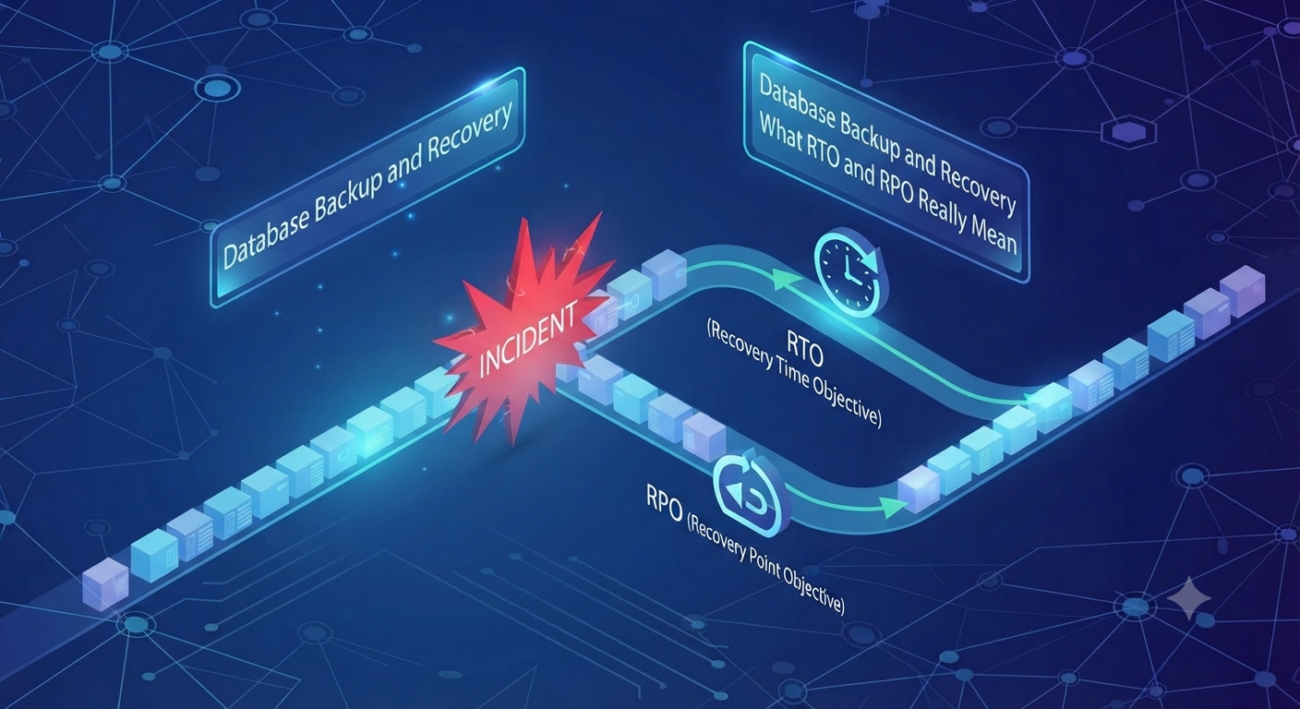
Recovery Time Objective refers to the maximum acceptable amount of time a system, application or database can remain unavailable after an outage before significant business impact occurs.
In simple terms, RTO answers the question:
“How quickly must we restore our systems?”
For example, if an online retailer determines that its ordering platform can only be unavailable for one hour before revenue losses become unacceptable, its RTO would be one hour.
A shorter RTO generally requires more sophisticated infrastructure, high-availability architectures and automated recovery processes. Achieving near-zero recovery times often involves technologies such as database clustering, failover groups, replication and cloud-based disaster recovery solutions.
Businesses with customer-facing applications, financial systems or mission-critical databases typically require much lower RTO targets than organisations with less time-sensitive workloads.
What is Recovery Point Objective (RPO)?
Recovery Point Objective measures the maximum amount of data a business can afford to lose following a disruption. In practical terms, RPO answers the question:
“How much data loss is acceptable?”
For instance, if a database backup is taken every four hours and a system failure occurs just before the next scheduled backup, up to four hours of data may be lost. In this scenario, the RPO would be four hours.
Organisations that process large volumes of transactions often require very low RPO values, sometimes measured in minutes or seconds. This typically necessitates technologies such as continuous data replication, transaction log shipping, database mirroring or real-time cloud synchronisation. The lower the RPO requirement, the more advanced and resilient the backup architecture must be.
Understanding the Difference Between RTO and RPO
Although often discussed together, RTO and RPO measure different aspects of disaster recovery. RTO focuses on how quickly systems can be restored and made operational again. RPO focuses on how much data can be lost during the recovery process. Consider a scenario where a database server fails at midday:
- An organisation with a one-hour RTO must restore services by 1:00 pm.
- An organisation with a fifteen-minute RPO can only afford to lose fifteen minutes of data.
Achieving both objectives simultaneously requires careful planning, appropriate technology investments and ongoing testing.
Factors That Influence RTO and RPO
Several factors affect an organisation’s recovery objectives.
- The criticality of business applications is often the primary consideration. Customer-facing platforms and transactional systems usually demand much lower RTO and RPO targets than internal reporting systems.
- Database size also influences recovery capabilities. Larger databases typically require more time to restore, particularly when traditional backup methods are used.
- Infrastructure design is another key factor. Organisations leveraging cloud platforms such as Microsoft Azure, Amazon Web Services (AWS) or Google Cloud Platform (GCP) often benefit from built-in redundancy, automated backups and faster recovery options.
- Regulatory and compliance requirements can also influence acceptable recovery thresholds. Industries such as finance, healthcare and e-commerce frequently operate under strict data protection and availability requirements.
Technologies That Support RTO and RPO Objectives
Modern database platforms provide numerous technologies designed to improve recovery capabilities.
For Microsoft SQL Server environments, organisations commonly utilise:
- SQL Server Always On Availability Groups
- Transaction Log Backups
- Database Mirroring
- Log Shipping
- Failover Clustering
For PostgreSQL and MySQL databases, common recovery technologies include replication, point-in-time recovery and automated backup solutions.
Cloud-based services such as Azure SQL Database, Amazon RDS and Google Cloud SQL further simplify backup management by providing automated snapshots, geo-redundancy and built-in disaster recovery capabilities.
These technologies help organisations achieve aggressive RTO and RPO targets while reducing administrative overhead.
Common Mistakes Businesses Make
Many organisations assume that having backups automatically guarantees successful recovery. Unfortunately, this is rarely the case. One of the most common mistakes is failing to regularly test backup restoration procedures. Backups that cannot be successfully restored provide little protection during an actual disaster. Another frequent issue is setting unrealistic recovery objectives without considering infrastructure limitations, budget constraints or operational requirements.
Businesses also underestimate the impact of ransomware attacks, which increasingly target backup repositories alongside production systems. Maintaining isolated, immutable backups has become an essential component of modern recovery strategies.
Best Practices for Database Backup and Recovery
- Successful backup and recovery planning begins with understanding business priorities.
- Organisations should conduct a comprehensive business impact analysis to identify critical systems and determine appropriate RTO and RPO requirements.
- Recovery procedures should be documented, tested regularly and reviewed whenever significant infrastructure changes occur. Backup strategies should include multiple recovery points, geographic redundancy and security controls to protect against cyber threats.
- Businesses should also monitor backup performance, storage utilisation and recovery readiness on an ongoing basis to ensure recovery objectives remain achievable.
Conclusion
Database backup and recovery planning is about far more than simply creating copies of data. It is about ensuring business continuity when unexpected disruptions occur. Understanding the difference between Recovery Time Objective (RTO) and Recovery Point Objective (RPO) enables organisations to make informed decisions about backup architectures, disaster recovery investments and operational resilience.
By aligning recovery objectives with business requirements and leveraging modern database technologies, organisations can minimise downtime, reduce data loss and maintain continuity even during major incidents. In an era where data is one of a company’s most valuable assets, a well-defined backup and recovery strategy is no longer optional—it is a fundamental business requirement.