Choosing a managed cloud database platform is one of the most consequential infrastructure decisions a business can make. The platform you select will sit beneath your applications for years, accumulate data that becomes progressively harder to migrate, and shape the operational model of your database team. Get the evaluation right, and the platform quietly supports growth without friction. Get it wrong, and you spend the next several years working around a misfit between your workload’s requirements and the platform’s strengths.
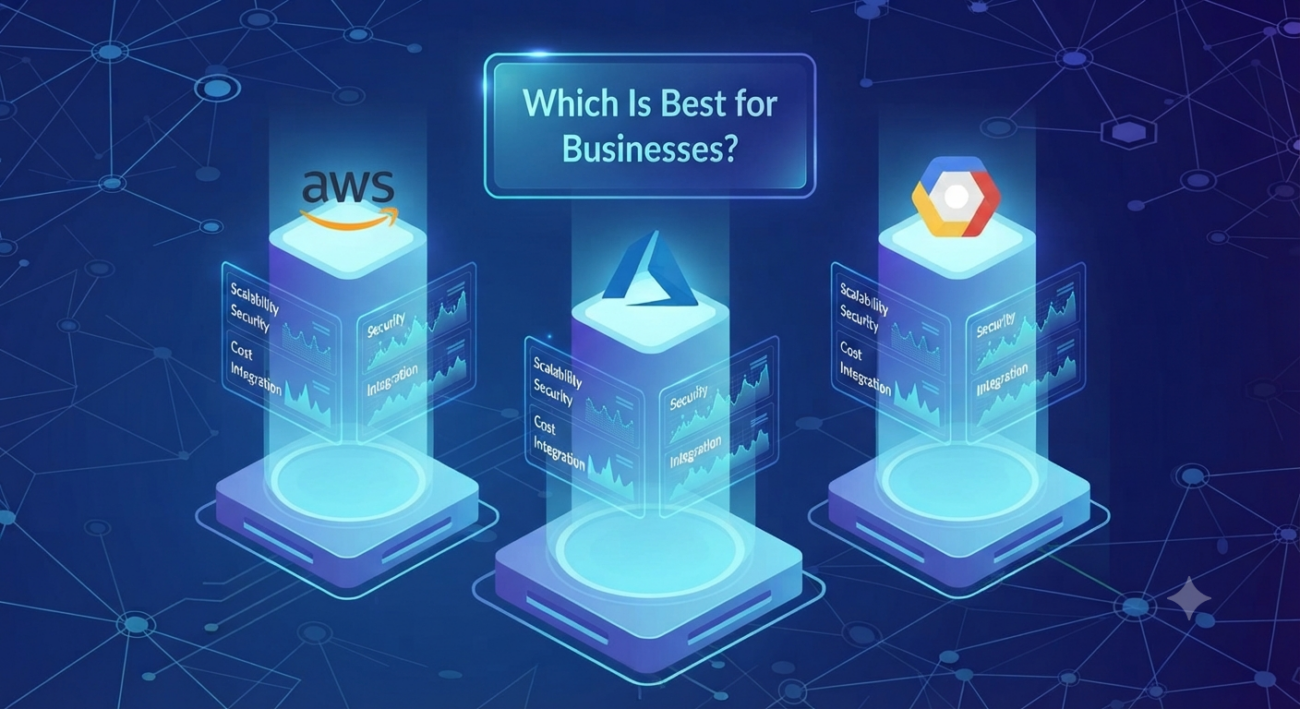
The three platforms that dominate the managed relational database market — Amazon Web Services’ Relational Database Service, Microsoft Azure SQL Database, and Google Cloud SQL — are all mature, enterprise-capable, and actively developed. None of them is universally superior. Each has genuine strengths in specific areas, natural alignments with particular technology ecosystems, and characteristics that make them better or worse suited to different types of businesses and workloads. The right choice depends on understanding those differences honestly rather than defaulting to the most familiar brand or following the market share leader.
This guide examines each platform on the dimensions that matter most to UK businesses: capability, performance, pricing, compliance, and ecosystem fit. It concludes with a decision framework for matching the platform to the workload rather than accepting a one-size-fits-all answer.
Section 1: Understanding the Three Platforms
1.1 Amazon RDS
Amazon Relational Database Service is the most established managed database offering in the public cloud, having launched in 2009 and accumulated more than fifteen years of refinement. It supports a broad range of database engines — MySQL, PostgreSQL, MariaDB, Oracle, and Microsoft SQL Server — alongside Amazon’s proprietary Aurora engine, which is arguably the most significant database innovation to emerge from any cloud provider in the past decade.
Aurora is available in MySQL-compatible and PostgreSQL-compatible variants and offers a fundamentally different storage architecture from standard RDS. Rather than storing data on volumes attached to individual instances, Aurora uses a distributed, fault-tolerant storage layer that spans multiple availability zones automatically. This architecture enables near-instantaneous failover — measured in seconds rather than minutes — and allows read replicas to be added and removed elastically without the replication lag that standard MySQL or PostgreSQL replicas introduce. For workloads that require high availability and horizontal read scaling, Aurora represents a genuine step change in capability relative to standard managed database offerings.
RDS sits within AWS’s extraordinarily broad ecosystem of services. For businesses that have built or are building on AWS — using Lambda for serverless compute, S3 for storage, Redshift for analytics, or any of the hundreds of other AWS services — RDS integrates naturally through shared networking, IAM-based authentication, and event-driven architecture patterns that the AWS ecosystem supports out of the box.
1.2 Azure SQL Database
Azure SQL Database is Microsoft’s flagship managed relational database service, built on the SQL Server engine and deeply integrated with the Microsoft technology ecosystem. It is not a generic managed database service in the way RDS is — it supports only SQL Server-compatible workloads — but within that scope, it is exceptionally capable and, for organisations running Microsoft-stack applications, it represents the path of least resistance for cloud database adoption.
The Azure SQL family encompasses several deployment models that are worth understanding distinctly. Azure SQL Database proper is the fully managed, cloud-native offering — abstracting the most infrastructure and providing the tightest integration with Azure’s managed services. Azure SQL Managed Instance provides near-complete SQL Server surface area compatibility in a managed environment, supporting SQL Server Agent, cross-database queries, and most SQL Server features that Azure SQL Database does not expose. Azure SQL on Virtual Machines is self-managed SQL Server running on Azure infrastructure, retaining full control at the cost of full operational responsibility.
For organisations with existing on-premise SQL Server estates, Microsoft’s Azure Hybrid Benefit allows them to apply existing SQL Server licences with Software Assurance to Azure SQL deployments, significantly reducing compute costs. Combined with the natural integration between Azure SQL and Microsoft Entra ID for identity management, Microsoft Defender for SQL for threat detection, and Microsoft Purview for data governance, Azure SQL Database is the dominant choice for organisations whose technology strategy is aligned with the Microsoft ecosystem.
1.3 Google Cloud SQL
Google Cloud SQL is the most focused of the three platforms — it supports MySQL, PostgreSQL, and SQL Server, without the proprietary engine innovation that Aurora represents on AWS or the deep Microsoft-stack integration that Azure SQL offers. What Cloud SQL does provide is excellent execution of managed database fundamentals: automated backups, high availability through synchronous replication across availability zones, read replicas, and straightforward scaling — all within Google Cloud’s infrastructure, which is widely regarded as among the most performant global networks available from any hyperscale provider.
Cloud SQL’s natural home is within the Google Cloud ecosystem, and organisations that have adopted Google Cloud for its analytics capabilities — particularly BigQuery for data warehousing — or for its Kubernetes and containerisation leadership through Google Kubernetes Engine will find that Cloud SQL integrates naturally within that environment. Its relative simplicity compared to the other two platforms is a feature as much as a limitation for teams that want a capable managed database without the extensive configuration surface area that RDS and Azure SQL present.
Google has also invested significantly in AlloyDB, its PostgreSQL-compatible managed database with a disaggregated storage architecture broadly analogous to AWS Aurora. AlloyDB is positioned as a high-performance alternative for demanding PostgreSQL workloads and represents Google’s response to Aurora’s capability advantage over standard managed PostgreSQL offerings.
Section 2: Capability Comparison
2.1 Database Engine Support
AWS RDS offers the broadest engine support of the three platforms, covering MySQL, PostgreSQL, MariaDB, Oracle, SQL Server, and Aurora. This breadth makes it the natural choice for organisations with heterogeneous database estates or those migrating from Oracle and SQL Server that want a managed cloud destination without re-engineering for a different engine. The ability to manage multiple engine types within a single cloud platform, under a consistent operational model, simplifies the management overhead of mixed estates considerably.
Azure SQL Database supports only the SQL Server engine, which is a significant constraint for organisations with non-Microsoft database workloads but largely irrelevant for those whose estate is already SQL Server-centric. The depth of SQL Server capability available through the Azure SQL family — including features such as Always Encrypted, Transparent Data Encryption, Advanced Threat Protection, and ledger tables — is unmatched on any other cloud platform, reflecting the fact that Microsoft both develops SQL Server and operates the cloud platform on which it runs.
Google Cloud SQL supports MySQL, PostgreSQL, and SQL Server, covering the three most widely used open-source and Microsoft relational engines without the Oracle support that RDS provides. For organisations standardising on open-source database engines, Cloud SQL’s engine coverage is sufficient for most purposes, and its PostgreSQL support is mature and performant.
2.2 Performance & Scalability
Aurora’s storage architecture gives AWS a performance advantage for high-throughput transactional workloads that is difficult to match on equivalent instance sizes with standard managed MySQL or PostgreSQL. Failover times measured in single-digit seconds, automatic storage growth without manual intervention, and the ability to add up to fifteen read replicas with minimal replication lag make Aurora the most capable option for applications that require both high availability and read scalability simultaneously.
Azure SQL Database’s Business Critical service tier uses an Always On Availability Group with three replicas under the covers, providing a built-in readable secondary and failover times comparable to Aurora. The Hyperscale tier, which supports databases up to 100 terabytes and provides rapid scale-out read replicas, addresses the very large database scenarios that most managed services handle poorly. For SQL Server workloads specifically, Azure SQL’s performance optimisation is deep — Microsoft’s ability to tune the database engine and the cloud platform together produces performance characteristics that third-party SQL Server hosting cannot replicate.
Google Cloud SQL’s performance is solid for standard workloads and is increasingly competitive with AlloyDB for demanding PostgreSQL use cases. Its global network infrastructure means that latency between application and database tiers within Google Cloud regions is consistently low, which benefits latency-sensitive applications hosted entirely within the Google Cloud ecosystem.
2.3 High Availability and Disaster Recovery
All three platforms provide built-in high availability within a single cloud region, using synchronous replication across availability zones to protect against zone-level failures. The differences emerge at the edges — failover speed, recovery point granularity, and cross-region disaster recovery architecture.
Aurora’s sub-ten-second automatic failover is the benchmark for managed database platforms. RDS Multi-AZ deployments for non-Aurora engines provide automatic failover in the one-to-two minute range, which is adequate for most workloads but slower than Aurora for applications with very tight availability requirements.
Azure SQL Database’s Business Critical tier provides failover in under thirty seconds, with a readable secondary available during the failover process — meaning read traffic can continue to be served even whilst write failover is occurring. Active geo-replication and auto-failover groups enable cross-region disaster recovery with automatic failover policies that can be configured to align with specific RTO requirements.
Google Cloud SQL’s high availability configuration provides automatic failover within the same region, with cross-region read replicas available for disaster recovery. Recovery time for a cross-region failover is longer than on the other platforms, reflecting Cloud SQL’s positioning as a general-purpose managed database rather than a high-availability specialist.
Section 3: Pricing & Total Cost of Ownership
3.1 Pricing Models
All three platforms charge for compute, storage, backup storage, and data transfer, but the pricing structures differ in ways that produce materially different bills depending on usage patterns. Understanding these differences requires modelling against actual workload characteristics rather than comparing list prices for equivalent instance sizes.
AWS RDS pricing is instance-based, with Reserved Instance commitments available for one or three years at discounts of up to 60% over on-demand rates. Aurora’s pricing differs from standard RDS in that it separates compute and storage charges — storage is billed per gigabyte consumed rather than pre-provisioned, which benefits workloads where storage utilisation is unpredictable. Data egress charges, particularly between AWS and on-premise environments or between AWS and other cloud providers, can be significant for workloads with high data transfer volumes.
Azure SQL Database uses a vCore-based model that enables straightforward mapping between on-premise SQL Server licence entitlements and cloud compute. The Azure Hybrid Benefit discount is particularly valuable for organisations with existing SQL Server licences covered by Software Assurance — it can reduce compute costs by over 40%, making Azure SQL Database significantly cheaper in practice for Microsoft-licensed organisations than list prices suggest. Azure’s reserved capacity pricing for SQL Database provides discounts comparable to AWS Reserved Instances.
Google Cloud SQL offers sustained use discounts automatically — without requiring upfront commitment — which benefits workloads that run continuously. Its list prices for equivalent compute configurations are broadly comparable to the other platforms, though the sustained use discount makes its effective pricing more competitive for always-on workloads than pay-as-you-go comparisons suggest.
3.2 Avoiding Unexpected Costs
The most reliable way to generate an unexpectedly large cloud database bill is to ignore data transfer costs until they appear on an invoice. Each platform charges for data leaving its network, and the charges vary by destination — transfers to the public internet, to other cloud regions, or to other cloud providers all carry different rates. For architectures involving cross-cloud data replication, real-time data synchronisation between cloud and on-premise environments, or high-volume analytical data movement, modelling egress costs explicitly before committing to an architecture is essential.
Backup storage is another area where costs accumulate without always being anticipated. Each platform provides a baseline of backup storage at no additional charge — typically equal to the size of the provisioned database — with charges applying to retention periods or backup volumes beyond that baseline. Organisations with long regulatory retention requirements for database backups should model backup storage costs explicitly for each platform.
Section 4: UK Compliance & Data Residency
4.1 UK GDPR and Data Sovereignty
All three platforms operate data centres in the United Kingdom and provide contractual data residency commitments that allow customers to specify that their data is stored and processed within the UK. AWS operates UK South (London) and, more recently, additional UK infrastructure. Microsoft operates UK South (London) and UK West (Cardiff). Google operates a UK region in London.
For most UK businesses, any of the three platforms can satisfy data residency requirements under UK GDPR when configured correctly. The critical caveat is that data residency must be explicitly configured — default deployments, particularly for backup storage and certain diagnostic telemetry, do not always result in all data remaining within the UK without deliberate configuration choices being made during platform setup.
Microsoft’s long-standing presence in the UK public sector and its EU Data Boundary commitments give some organisations additional confidence in Azure’s data handling commitments, particularly where public sector contracting or Crown Commercial Service frameworks are relevant considerations. AWS’s UK infrastructure expansion and Google’s growing UK presence have reduced but not eliminated this perception gap.
4.2 Regulated Industries
For financial services firms with FCA obligations, the operational resilience requirements of SS2/21 apply to cloud-hosted databases as much as to on-premise infrastructure. All three platforms provide the technical capability to demonstrate compliance — geo-redundant deployment, cross-region failover, audit logging, and contractual SLAs — but the responsibility for designing and evidencing a compliant architecture rests with the firm rather than the cloud provider.
Azure has historically had stronger representation in UK financial services, partly due to Microsoft’s established enterprise relationships and partly due to the depth of compliance documentation available through Microsoft’s compliance portal. AWS has significantly closed this gap in recent years, and both platforms are used by major UK financial institutions. Google Cloud’s financial services presence in the UK is growing but remains less established than the other two.
Section 5: Ecosystem Integration
5.1 AWS RDS and the AWS Ecosystem
RDS’s natural home is within applications built on AWS. The integration between RDS and AWS Lambda for event-driven processing, RDS Proxy for connection pooling in serverless architectures, AWS Secrets Manager for credential rotation, and IAM database authentication for passwordless connectivity are all capabilities that work seamlessly within the AWS ecosystem and require significant additional engineering to replicate in a multi-cloud context. For businesses whose primary cloud strategy is AWS-centric, RDS — and Aurora in particular — is the default database choice for most relational workloads.
5.2 Azure SQL and the Microsoft Ecosystem
Azure SQL Database’s integration with the Microsoft technology stack is unmatched. Organisations using Microsoft 365, Azure Active Directory and Entra ID, Microsoft Fabric for analytics, Power BI for reporting, and Azure DevOps for development pipelines find that Azure SQL connects to each of these services with minimal configuration and maximum capability. For organisations that have standardised on the Microsoft ecosystem — which describes a substantial proportion of UK enterprise — Azure SQL is not merely a convenient choice but the architecturally coherent one.
5.3 Google Cloud SQL and the Google Ecosystem
Cloud SQL’s strongest integration stories are with BigQuery, Google Kubernetes Engine, and Vertex AI. For organisations using Google Cloud primarily for analytics, machine learning, or containerised application workloads, Cloud SQL provides a managed relational database that connects naturally to these services. For organisations outside the Google Cloud ecosystem, Cloud SQL offers less distinctive integration value than its competitors provide within their respective ecosystems.
Section 6: Choosing the Right Platform
6.1 A Framework for the Decision
The most reliable decision framework is one that starts with the workload and the ecosystem rather than the platform. The database engine your application uses, the cloud environment the rest of your application runs in, and the specific availability and compliance requirements of your workload together narrow the realistic options considerably before any platform-level comparison is needed.
If your workload requires Oracle or SQL Server engine compatibility on AWS, RDS is the natural choice. If your organisation is Microsoft-stack aligned and your workload is SQL Server-based, Azure SQL is almost certainly the right answer. If your application is already running on Google Cloud and uses PostgreSQL or MySQL, Cloud SQL is the path of least resistance.
Where the decision is genuinely open — for new workloads being designed without legacy constraints — Aurora on AWS provides the best combination of performance, availability, and scalability for high-demand transactional workloads. Azure SQL Business Critical provides the best option for SQL Server workloads requiring maximum availability and deep Microsoft ecosystem integration. Cloud SQL provides a capable, straightforward option for teams that value simplicity and operate primarily within the Google Cloud environment.
6.2 When to Consider Multiple Platforms
For organisations with diverse workloads, the right answer may not be a single platform. A business that runs its transactional systems on Azure SQL alongside its Microsoft stack, uses AWS Aurora for a high-throughput customer-facing application, and leverages Google BigQuery for analytical workloads is making a reasonable set of workload-driven decisions — provided the operational complexity of managing multiple cloud database environments is adequately resourced and governed.
The multi-platform path requires investment in cross-cloud governance, unified monitoring, and team capability across multiple environments. For organisations with the maturity to manage that complexity, it provides access to the best capabilities each platform offers. For those without it, the complexity cost may outweigh the capability benefit of mixing platforms.
Conclusion
AWS RDS and Aurora, Azure SQL Database, and Google Cloud SQL are all capable platforms that serve their respective ecosystems well. The question of which is best for your business is not one with a universal answer — it depends on your existing technology commitments, your workload characteristics, your team’s expertise, and your regulatory environment.
For most UK businesses, the decision is less about choosing the objectively superior platform and more about choosing the platform that is the right fit for where the organisation already is and where it is heading. Aurora’s performance architecture gives AWS the edge for high-demand transactional workloads. Azure SQL’s Microsoft integration and Hybrid Benefit economics give it a compelling case for SQL Server-centric organisations. Cloud SQL’s simplicity and Google ecosystem integration make it the natural choice for teams already committed to Google Cloud.
Evaluate against your actual requirements, model costs against your real usage patterns, and weight compliance and ecosystem integration as heavily as raw capability. The platform that scores best on those dimensions is the right one for your business.