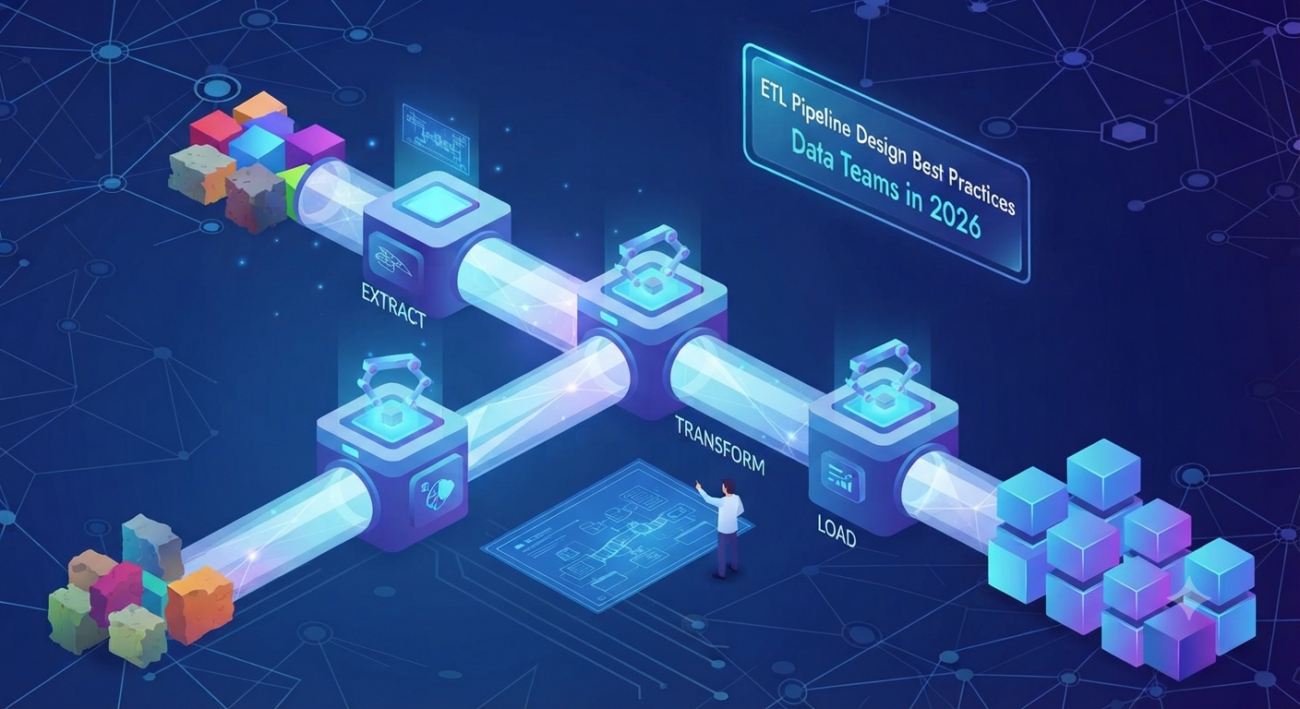
The Extract, Transform, Load pipeline is the foundational plumbing of the modern data stack. It is the mechanism through which raw operational data becomes analytical insight — the process by which records scattered across CRMs, ERP systems, marketing platforms, and event streams are consolidated, cleaned, and shaped into the consistent, queryable datasets that business intelligence and machine learning depend on. When ETL pipelines are well designed, they are invisible: data arrives where it is needed, in the right shape, on time, and without requiring intervention. When they are poorly designed, they are the source of most of the problems a data team spends its time managing.
The discipline has evolved considerably in recent years. The emergence of cloud-native data warehouses capable of transforming data at scale has made the ELT pattern — Extract, Load, Transform — the default architecture for many teams, shifting transformation logic from bespoke integration code into declarative SQL executed within the warehouse itself. The proliferation of real-time streaming architectures has extended the pipeline paradigm beyond batch processing into continuous data flows. And the growing emphasis on data observability, data contracts, and pipeline reliability as first-class engineering concerns has raised the standard against which ETL pipelines are designed and operated.
This article sets out the best practices that distinguish robust, maintainable, production-grade ETL pipelines from the brittle, undocumented workflows that accumulate technical debt silently until they fail at the worst possible moment.
Section 1: Design Principles Before Implementation
1.1 Understand the Data Before You Move It
The single most reliable predictor of ETL pipeline failure is attempting to design and build the pipeline before the source data is genuinely understood. Source systems in the real world rarely conform to the documentation that accompanies them. Fields described as mandatory contain nulls. Dates stored as strings include values that are not dates. Referential integrity that is enforced in documentation is not enforced in the database. Categorical fields contain values that were never anticipated when the system was designed.
Before writing a single line of pipeline code, data engineers should conduct a thorough source data profiling exercise. This means examining the actual data — not the schema, not the documentation, not what the application vendor says it stores — and characterising the real distribution of values, the frequency and patterns of nulls and outliers, the consistency of formats across different time periods, and the relationships between fields and tables. Anomalies discovered during profiling are far cheaper to address at design time than anomalies discovered in production when downstream consumers are already depending on the pipeline’s output.
1.2 Design for Failure, Not for the Happy Path
A pipeline that works when everything goes right is not a production pipeline — it is a prototype. Production ETL pipelines operate in environments where source systems go offline without warning, network connections timeout mid-transfer, upstream schema changes break downstream assumptions, and data arrives late, out of order, or in volumes that differ dramatically from historical norms. Pipelines that are not designed to handle these scenarios fail in ways that are difficult to diagnose and that propagate errors silently into downstream datasets.
Designing for failure means building explicit handling for every foreseeable error condition: what happens when a source API returns an error response, when a file arrives with zero rows, when a duplicate record is encountered in a source that is supposed to contain unique keys, when a transformation produces a null in a field that the downstream schema declares non-nullable. It means ensuring that failures are surfaced loudly through alerting rather than suppressed silently, and that the pipeline’s state at the point of failure is preserved in a way that allows the failed run to be resumed or replayed rather than requiring a full restart from the beginning.
1.3 Idempotency as a Non-Negotiable Property
An idempotent pipeline is one where running the same pipeline job multiple times with the same inputs produces exactly the same output — with no duplicate records, no accumulated side effects, and no dependency on the order or number of times the pipeline has run. Idempotency is not an optional enhancement; it is the property that makes pipeline failures recoverable without data quality consequences.
When a non-idempotent pipeline fails partway through a run and is restarted, the records that were processed before the failure may be processed again, producing duplicates or incorrect aggregations in the destination. When an idempotent pipeline is restarted, it can safely reprocess the same data without risk. Achieving idempotency typically requires writing to staging areas before promoting data to production tables, using upsert logic that handles both new and existing records correctly, and ensuring that any aggregations or derived calculations are deterministic with respect to the input data.
Section 2: Extraction Best Practices
2.1 Incremental Extraction Over Full Loads
Full extraction — copying the entirety of a source table on every pipeline run — is the simplest approach to implement and the most expensive to operate at scale. As source tables grow, full extraction times increase proportionally, consuming source system resources, network bandwidth, and processing capacity in ways that become operationally unsustainable long before the data volumes involved are genuinely large.
Incremental extraction, which identifies and extracts only the records that have changed since the last successful run, should be the default approach for any source table beyond a trivial size. The most reliable incremental extraction pattern uses high-watermark tracking — maintaining a record of the maximum value of an audit column (typically a created-at or updated-at timestamp) from the last successful run, and extracting only records where that column exceeds the watermark. Change Data Capture is a more sophisticated alternative that reads directly from the source system’s transaction log, capturing every insert, update, and delete event without placing any additional query load on the source database.
The choice between high-watermark and CDC depends on source system capabilities and requirements. High-watermark extraction requires that source tables have reliable audit columns and that soft-deleted records are handled — rows that are logically deleted without being physically removed may not be captured by a timestamp-based incremental unless the deletion timestamp is tracked. CDC captures deletes natively and with lower source system overhead, but requires access to the database transaction log and introduces additional infrastructure complexity.
2.2 Respect Source System Constraints
ETL pipelines that extract data without regard for the operational impact on source systems are a persistent source of friction between data engineering teams and the application teams whose systems they extract from. A poorly throttled extraction job that runs at peak business hours can degrade the performance of a production CRM or ERP system for the users who depend on it. A pipeline that opens hundreds of concurrent connections to a database with a limited connection pool can trigger timeouts across the application tier.
Extraction jobs should be scheduled to run during low-activity windows wherever possible, with connection limits and query concurrency constrained to values that the source system can absorb without impact. Rate limiting for API-based extractions should be implemented to respect the rate limits specified by API providers — not just to avoid errors, but because exceeding rate limits for sustained periods can result in access being suspended entirely. Treating source systems as shared resources that must be protected rather than as unlimited data taps is a discipline that distinguishes mature data engineering practice from amateur extraction scripts.
Section 3: Transformation Best Practices
3.1 Declarative Transformation Over Procedural Code
The dominant pattern for data transformation in 2026 is declarative SQL executed within the data warehouse, managed through a transformation framework such as dbt (data build tool). The shift from procedural ETL code — Python scripts or stored procedures that imperatively describe how to transform data step by step — to declarative SQL models that describe what the transformed data should look like has been one of the most significant improvements in data engineering practice of the past several years.
Declarative transformations are easier to read, easier to test, easier to version-control, and easier to debug than their procedural equivalents. When a transformation is expressed as a SQL model that says “this table is the result of joining these sources with these conditions and these business rules,” any analyst or engineer familiar with SQL can understand it without needing to trace through procedural logic. When the same transformation is expressed as a hundred lines of Python that builds the same result through a series of intermediate data frames, the cognitive overhead of understanding, maintaining, and modifying it is substantially higher.
Transformation frameworks such as dbt provide dependency management, incremental materialisation, source freshness checks, and built-in testing capabilities alongside the declarative SQL model. They represent the current best practice for transformation layer design and should be the default choice for teams building new transformation pipelines.
3.2 Separate Transformation Stages
Complex transformations that attempt to perform multiple conceptual operations in a single step — joining sources, cleaning data, applying business rules, and aggregating results simultaneously — are difficult to test, difficult to debug, and difficult to modify without unintended side effects. The transformation layer should be structured in clear, distinct stages, each with a well-defined purpose and a stable interface between stages.
A common and effective pattern structures the transformation layer in three tiers. The staging tier contains minimally processed representations of each source dataset — data types cast to their correct forms, column names standardised, and basic null handling applied, but business logic deliberately absent. The intermediate tier contains entities and relationships that reflect how the business conceptually understands its data — customers, orders, transactions — assembled from staging models through joins and business rule application. The presentation tier, often called the marts layer, contains the aggregated, business-facing models that power dashboards, reports, and analytical queries. Each tier depends only on the tier above it, creating a dependency structure that is easy to reason about and safe to modify at one level without cascading unexpected changes into others.
3.3 Data Quality Tests as Part of the Transformation
Data quality checks should be built into the transformation pipeline, not bolted on afterwards as a monitoring afterthought. Every transformation model should carry tests that validate the properties the model is expected to have — uniqueness of key columns, absence of nulls in non-nullable fields, referential integrity between related models, and value distributions that fall within expected ranges. These tests should run as part of every pipeline execution and should be configured to block promotion to downstream consumers when they fail.
Treating data quality as a pipeline concern rather than a reporting concern means that quality problems are caught as close to their source as possible — at the transformation layer, where the cost of investigation and remediation is lowest — rather than being discovered by a business user who notices that a dashboard metric does not look right. The cultural shift this represents, from data quality as someone else’s problem to data quality as an engineering responsibility, is one of the most valuable changes a data team can make.
Section 4: Loading Best Practices
4.1 Upsert Patterns for Reliable Loading
Writing pipeline output to destination tables requires a loading strategy that handles both new records and updates to existing records correctly and without producing duplicates. Append-only loading — simply inserting every record from the current pipeline run into the destination table — is appropriate for immutable event streams but produces incorrect results for any dataset where records can be updated at the source. Full table replacement — truncating and reloading the destination table on every run — avoids duplicates but is expensive for large tables and loses the ability to query historical states.
The upsert pattern — inserting new records and updating existing ones in a single atomic operation, identified by a natural key or surrogate key — is the correct default loading strategy for most pipeline destinations. It is idempotent, handles source updates correctly, and does not require truncating the destination table. Most modern data warehouses provide native merge or upsert operations that execute efficiently at scale, making the implementation straightforward without requiring complex staging and swap logic.
4.2 Partitioning for Query Performance
Destination tables that will be queried by date range — the vast majority of analytical tables — should be partitioned on a date or timestamp column that reflects the primary query access pattern. Partitioning allows the query engine to skip entire partitions that are not relevant to a given query, reducing the volume of data scanned and therefore the cost and latency of analytical queries against the table.
Partition granularity should be matched to query patterns. Tables queried primarily by month benefit from monthly partitions; tables with frequent day-level queries benefit from daily partitions. Over-partitioning — creating very fine-grained partitions on tables that are typically queried over long date ranges — can paradoxically degrade performance by requiring the query engine to open many small partitions rather than a smaller number of larger ones. The right partition granularity is determined by the query patterns of the table’s consumers, not by a default.
Section 5: Orchestration and Reliability
5.1 Workflow Orchestration
Individual pipeline jobs that run in isolation, triggered by cron schedules without awareness of dependencies on other jobs, are a common source of pipeline reliability problems. When a pipeline job depends on the successful completion of an upstream job that has not yet finished, or that has failed silently, the downstream job processes stale or incomplete data and produces results that are incorrect without any visible error.
Workflow orchestration platforms — Apache Airflow, Prefect, Dagster, and their managed cloud equivalents — provide dependency-aware scheduling that ensures pipeline jobs run only when their upstream dependencies have completed successfully. They provide visibility into pipeline execution history, failure rates, and duration trends through a unified interface. And they provide retry logic, alerting, and failure handling that individual cron-based scripts cannot replicate.
The choice between orchestration platforms is less important than the discipline of using one. Any team managing more than a handful of pipeline jobs that have dependencies between them should be using a proper orchestration framework rather than independent cron schedules, and the investment in establishing orchestration infrastructure pays dividends immediately in reduced operational complexity and improved reliability visibility.
5.2 Data Observability
Data observability is the discipline of monitoring the health of data as it flows through the pipeline — detecting anomalies in volumes, distributions, freshness, and schema that indicate something has gone wrong before downstream consumers encounter the consequences. It is the data engineering equivalent of application performance monitoring: the capability that allows a team to know the data is healthy without manually checking it, and to be alerted when it is not.
Modern data observability platforms — Monte Carlo, Bigeye, and Soda, alongside the native data quality monitoring capabilities built into platforms like dbt Cloud — monitor dimensions including freshness (is the data being updated at the expected frequency), volume (is the number of rows arriving within normal historical ranges), distribution (are the statistical properties of key columns behaving as expected), and schema (have any columns been added, removed, or changed in a way that was not anticipated). Anomalies detected in any of these dimensions trigger alerts that allow the team to investigate and resolve the issue before it propagates into reports and decisions.
Section 6: Security, Compliance, and Data Governance
6.1 Personal Data in Pipelines
ETL pipelines that handle personal data are subject to UK GDPR requirements throughout the pipeline lifecycle — from extraction through transformation to loading and retention in the destination. The principle of data minimisation applies: pipelines should extract only the personal data fields that are genuinely required for the analytical purpose they serve. Extracting full customer records including all personal data fields into an analytics environment because it is easier than scoping the extraction is not compliant practice, and it creates unnecessary exposure in the event of a breach of the analytics environment.
Pseudonymisation and anonymisation should be applied at the earliest practical stage in the pipeline — ideally in the staging or intermediate transformation layer — so that personal data is not propagated further through the transformation stack than necessary. Where full anonymisation is not achievable for the intended analytical purpose, access controls on destination tables containing personal data must be enforced at the warehouse level, with role-based access restricting personal data visibility to the team members who have a documented legitimate need for it.
6.2 Secrets and Credential Management
Connection strings, API keys, database passwords, and service account credentials used by pipeline jobs must never be hardcoded in pipeline code or stored in source control repositories. The frequency with which database credentials are inadvertently committed to version control repositories — including public ones — makes this one of the most common and most easily exploited security failures in data engineering environments.
All pipeline credentials should be stored in a secrets management platform — HashiCorp Vault, AWS Secrets Manager, Azure Key Vault, or Google Cloud Secret Manager — and injected into pipeline jobs at runtime through environment variables or direct secrets manager integration. Rotation policies should be configured to ensure that credentials are refreshed on a defined cycle, limiting the exposure window if a credential is compromised.
6.3 Pipeline Lineage and Documentation
Data lineage — the documented record of where each data element originated, what transformations it underwent, and where it flows — is both a data governance best practice and an increasingly important compliance capability. When a data quality issue is identified in a downstream report or dataset, lineage documentation allows the problem to be traced back to its source quickly, reducing the time to resolution. When a source system changes its schema, lineage documentation identifies every downstream pipeline and dataset that is potentially affected.
Transformation frameworks such as dbt generate lineage documentation automatically as a by-product of the dependency graph they maintain between models, making this documentation available without additional effort for teams using them. For teams using other approaches, maintaining lineage documentation requires deliberate practice — and the investment is consistently repaid when issues arise.
Conclusion
The mark of a mature ETL pipeline is not its technical sophistication but its reliability, its transparency, and its resilience under the conditions that production inevitably produces. Pipelines built on the principles covered in this article — thorough source data understanding, idempotent design, incremental extraction, declarative transformation, embedded data quality tests, dependency-aware orchestration, and active observability — deliver data that downstream consumers can trust without needing to verify it themselves.
The investment in building pipelines to this standard is not trivial. It requires discipline in the design phase, rigour in testing, and ongoing attention to the monitoring and observability tooling that keeps the health of the pipeline visible over time. But the alternative — brittle pipelines that work until they do not, fail silently when they do, and require constant firefighting to maintain — is considerably more expensive in operational effort and business consequence than the upfront investment in doing it well.