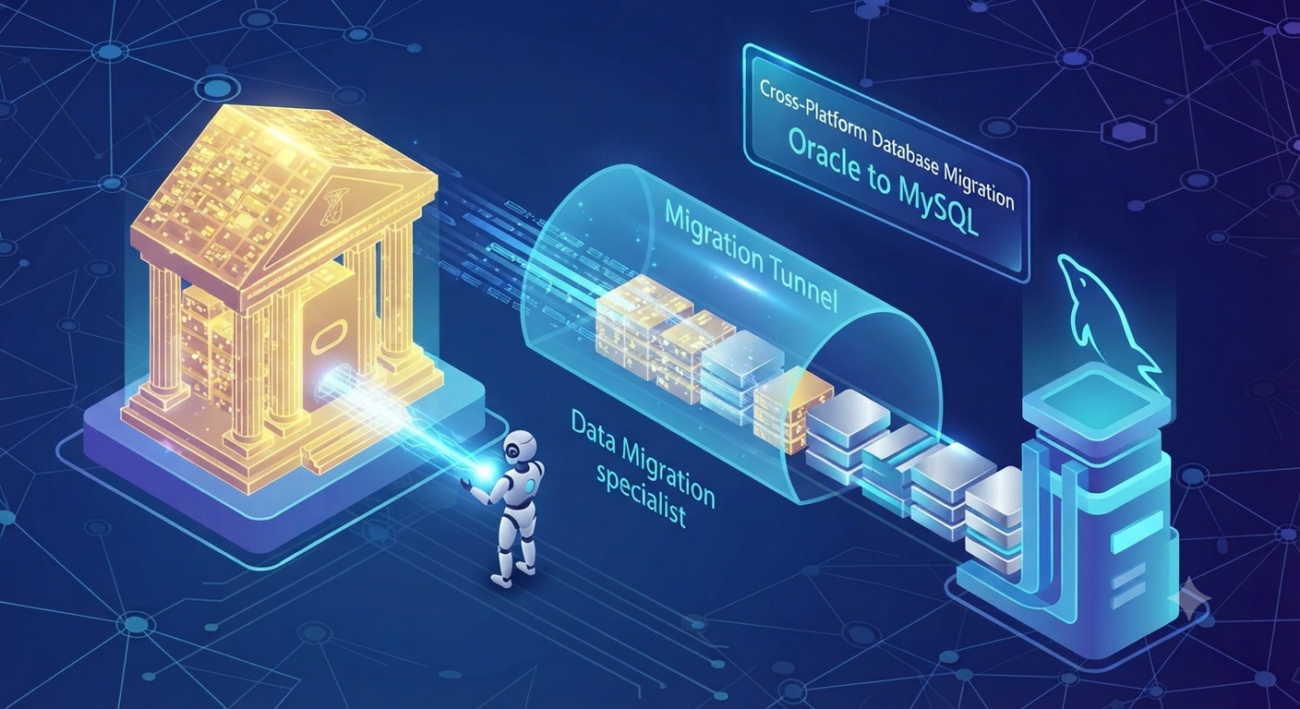
Cross-Platform Database Migration: Oracle to MySQL — What You Need to Know
Oracle has long been the database of choice for large enterprises — robust, feature-rich, and battle-tested across decades of mission-critical deployments. Yet a growing number of UK businesses are making the strategic decision to migrate from Oracle to MySQL, driven by a compelling combination of cost reduction, open-source flexibility, and cloud-native compatibility.
The decision itself is often straightforward. The execution is anything but.
Cross-platform database migration is one of the most technically complex undertakings in enterprise IT. Moving data from Oracle to MySQL is not simply a matter of exporting one and importing the other. The two platforms differ fundamentally in architecture, syntax, data types, stored procedure language, and behavioural defaults. Without expert planning and execution, a migration project can result in data corruption, application failures, extended downtime, and costs that far exceed the savings the migration was intended to deliver.
This guide sets out everything your organisation needs to know before, during, and after an Oracle to MySQL migration — written for technical and business decision-makers alike.
Why Migrate from Oracle to MySQL?
Understanding the business drivers behind a migration is essential to scoping it correctly and measuring its success. The most common motivations include:
Licence Cost Reduction Oracle’s licensing model is notoriously complex and expensive. Costs scale with processor cores, and Oracle’s audit practices are well-documented. For many mid-market businesses, Oracle licences represent one of the largest items in the IT budget. MySQL, as an open-source platform (with commercial support available via MySQL Enterprise Edition), eliminates or dramatically reduces this overhead.
Cloud Migration Alignment Organisations migrating workloads to AWS, Azure, or Google Cloud frequently find that MySQL-compatible managed services — Amazon Aurora, Azure Database for MySQL, Google Cloud SQL — offer a more cost-effective and operationally simpler path than Oracle on cloud infrastructure.
Modernisation and Flexibility MySQL’s open-source ecosystem supports a broader range of modern development frameworks, microservices architectures, and DevOps toolchains than Oracle, making it a natural fit for businesses undergoing digital transformation.
Vendor Independence Reducing dependency on a single proprietary vendor is a strategic priority for many IT leaders, particularly in the context of Oracle’s licensing enforcement and support cost trajectory.
The Core Technical Challenges You Must Plan For
This is where many migration projects encounter difficulty. The differences between Oracle and MySQL are deep-rooted and numerous. Each one requires deliberate assessment, a resolution strategy, and thorough testing.
1. Data Type Incompatibilities
Oracle and MySQL handle data types differently, and several Oracle-native types have no direct MySQL equivalent.
|
Oracle Data Type
|
MySQL Equivalent
|
Key Consideration
|
|
VARCHAR2
|
VARCHAR
|
Behavioural differences in trailing space handling
|
|
NUMBER
|
DECIMAL / INT / FLOAT
|
Precision mapping must be assessed per column
|
|
DATE
|
DATETIME
|
Oracle DATE includes time component; MySQL DATE does not
|
|
CLOB
|
LONGTEXT
|
Maximum size limits differ
|
|
BLOB
|
LONGBLOB
|
Review size constraints
|
|
RAW
|
VARBINARY
|
Binary data handling differences
|
|
NVARCHAR2
|
VARCHAR (utf8mb4)
|
Character set configuration critical
|
|
XMLTYPE
|
LONGTEXT / JSON
|
No native XML type in MySQL
|
Each data type mapping must be assessed individually in the context of your application’s usage. A NUMBER(10,2) storing financial data has very different implications to a NUMBER(1) used as a boolean flag.
2. SQL Syntax Differences
Oracle uses a superset of SQL with numerous proprietary extensions. MySQL is ANSI SQL-compliant but does not support all Oracle-specific syntax. Common areas requiring rewriting include:
Sequences vs AUTO_INCREMENT Oracle uses sequences as independent objects to generate unique identifiers. MySQL uses AUTO_INCREMENT column attributes. All sequence-dependent logic — both in the database and in application code — must be identified and refactored.
ROWNUM vs LIMIT Oracle uses ROWNUM for row limiting; MySQL uses LIMIT. Any pagination logic, top-N queries, or row-limiting procedures must be rewritten.
DUAL Table Oracle requires SELECT statements without a table to reference the DUAL pseudotable (SELECT SYSDATE FROM DUAL). MySQL supports SELECT NOW() without a table reference. All DUAL references must be removed.
Outer Join Syntax Oracle’s legacy (+) outer join syntax is not supported in MySQL. All such joins must be rewritten using ANSI JOIN syntax.
NVL vs IFNULL / COALESCE Oracle’s NVL() function must be replaced with MySQL’s IFNULL() or COALESCE().
String Concatenation Oracle uses the || operator for string concatenation. MySQL uses CONCAT().
3. Stored Procedures, Functions, and Triggers
This is frequently the most labour-intensive element of an Oracle to MySQL migration. Oracle’s procedural language — PL/SQL — is a rich, mature language with constructs that have no direct equivalent in MySQL’s stored procedure syntax.
Key areas requiring complete rewriting include:
- Exception handling blocks — Oracle’s EXCEPTION construct behaves differently from MySQL’s condition handlers
- Package structures — Oracle organises related procedures into packages; MySQL has no equivalent construct
- Cursors — Syntax and behaviour differ significantly
- Bulk operations — Oracle’s BULK COLLECT and FORALL have no MySQL equivalent; logic must be restructured
- Autonomous transactions — Oracle supports autonomous transactions within PL/SQL; MySQL does not
- Complex data types — Oracle’s associative arrays, nested tables, and VARRAYs require complete refactoring
There is no automated tool that reliably converts PL/SQL to MySQL stored procedures. This work requires experienced DBA resource with expertise in both platforms.
4. Transaction and Locking Behaviour
Oracle and MySQL handle transactions and locking differently by default, and these differences can produce subtle, hard-to-diagnose application errors post-migration.
Oracle uses a multi-version concurrency control (MVCC) model where readers never block writers. MySQL’s InnoDB storage engine also uses MVCC, but the implementation details — particularly around read consistency, isolation levels, and lock timeout behaviour — differ sufficiently that applications with complex transaction logic require careful validation.
Additionally, Oracle’s default transaction isolation level is READ COMMITTED. MySQL’s InnoDB default is REPEATABLE READ. This difference in isolation level can produce different query results for the same application logic, and must be assessed and configured explicitly.
5. Character Set and Collation
Oracle defaults to the character set specified at database creation, often WE8ISO8859P1 or AL32UTF8. MySQL’s default character set has historically been latin1, though modern versions default to utf8mb4.
For any database storing non-ASCII characters — including accented characters common in European business names and addresses — character set migration must be handled with precision. An incorrectly handled character set migration can result in data corruption that is difficult to detect and costly to remediate.
The recommendation for all new MySQL deployments is utf8mb4 with the utf8mb4_unicode_ci collation, which provides full Unicode support including emoji and supplementary characters.
6. Triggers and Constraints
MySQL supports triggers, but with a more limited feature set than Oracle. Notably, MySQL does not support statement-level triggers (only row-level), and compound triggers available in Oracle have no direct equivalent. All trigger logic must be reviewed, assessed for compatibility, and rewritten where necessary.
Foreign key constraint behaviour also differs. Oracle defers constraint checking by default in certain scenarios; MySQL enforces constraints immediately by default. Applications that rely on deferred constraint evaluation require particular attention.
The Migration Methodology: A Structured Approach
A successful Oracle to MySQL migration follows a structured, phased methodology. Shortcutting any phase increases risk disproportionately.
Phase 1: Discovery and Assessment
Before any migration work begins, a comprehensive assessment of the source Oracle environment is essential. This covers:
- Full inventory of schemas, tables, indexes, views, stored procedures, functions, triggers, and sequences
- Identification of all Oracle-specific features in use
- Assessment of data volumes and growth rates
- Review of application dependencies and integration points
- Identification of third-party tools or reporting platforms with direct database connectivity
- Compliance and data governance requirements
The output of this phase is a Migration Assessment Report that quantifies the scope, identifies risk areas, and informs the project plan and resource requirements.
Phase 2: Schema Conversion
With the assessment complete, schema conversion can begin. This involves:
- Converting Oracle DDL to MySQL-compatible DDL
- Resolving all data type mappings
- Recreating indexes (noting that Oracle’s bitmap indexes have no MySQL equivalent)
- Converting constraint definitions
- Establishing naming conventions (MySQL on Linux is case-sensitive for table names by default; Oracle is not)
Automated schema conversion tools — such as the AWS Schema Conversion Tool (SCT) or MySQL Workbench Migration Wizard — can assist with straightforward schema elements, but should not be relied upon for complex objects. All automated output must be reviewed and validated by an experienced DBA.
Phase 3: Data Migration
Data migration strategy depends on several factors: total data volume, acceptable downtime window, real-time replication requirements, and the complexity of the transformation rules required.
Common approaches include:
Bulk Export and Import Suitable for smaller databases or migrations with a defined maintenance window. Oracle data is exported (via Data Pump, SQL*Plus SPOOL, or third-party tools), transformed, and imported into MySQL.
ETL Pipeline For larger or more complex migrations, an Extract, Transform, Load pipeline provides greater control over data transformation, validation, and error handling. Tools such as Apache NiFi, Talend, or AWS Glue are commonly used.
Change Data Capture (CDC) For migrations requiring minimal downtime, CDC tools replicate ongoing Oracle transactions to MySQL in near real-time, allowing the MySQL environment to be brought up to date before a final cutover switchover.
Data validation — row counts, checksums, referential integrity verification, and business logic spot-checks — is essential at the conclusion of data migration and must not be omitted under time pressure.
Phase 4: Code Conversion and Application Testing
All application code, stored procedures, functions, triggers, and reporting queries must be converted and validated against the MySQL environment. This phase typically requires close collaboration between the DBA team and application development teams.
Regression testing must cover:
- Functional correctness of all application features
- Performance benchmarking against baseline Oracle metrics
- Edge case and boundary condition testing
- Integration testing across all connected systems
- User acceptance testing with representative business users
Performance testing deserves particular emphasis. A query that performs well on Oracle may perform poorly on MySQL due to differences in the query optimiser, available index types, or execution plan selection. Query tuning on MySQL requires specific expertise.
Phase 5: Cutover Planning and Execution
The cutover plan defines precisely how the migration will move from the Oracle source to the MySQL target in production. It must include:
- A detailed runbook with step-by-step instructions and assigned responsibilities
- A defined cutover window with stakeholder agreement
- Rollback criteria and rollback procedures
- Communication plan for internal and external stakeholders
- Post-cutover monitoring and hypercare period definition
The rollback plan is not optional. Even well-executed migrations encounter unexpected issues in production. The ability to revert to Oracle within a defined timeframe is an essential risk management control.
Phase 6: Post-Migration Optimisation
The migration is not complete at cutover. A structured post-migration period — typically four to eight weeks — of intensive monitoring, performance tuning, and issue resolution is essential. During this period:
- Query performance is monitored and tuned in the MySQL context
- Index strategy is validated against production query patterns
- Storage and memory configuration is optimised
- Backup and recovery procedures are validated in the new environment
- Monitoring and alerting are calibrated to MySQL-specific metrics
Common Mistakes That Derail Oracle to MySQL Migrations
Underestimating PL/SQL Conversion Scope Teams consistently underestimate the volume and complexity of stored procedure conversion. A thorough assessment before project initiation is non-negotiable.
Insufficient Testing Time Time pressure frequently leads to compressed testing phases. This is where post-migration defects originate. Testing must be adequately resourced and protected from project timeline pressure.
Ignoring Application Code Database migration and application code conversion must be treated as a single project, not sequential activities. Organisations that migrate the database first and address application code second typically encounter significant re-work.
Assuming Tools Do the Heavy Lifting Automated migration tools are valuable aids — not replacements for expert DBA judgement. Every tool output requires expert review.
No Rollback Plan Proceeding to cutover without a tested, executable rollback plan is a risk that no business should accept.
Character Set Neglect Character set and collation decisions made hastily at the beginning of a migration create data integrity issues that are disproportionately costly to resolve later.
The Role of a Managed DBA in Migration Success
Oracle to MySQL migration is not a project for generalist IT resource. The technical depth required — across two distinct database platforms, SQL syntax variants, procedural languages, performance tuning approaches, and data migration tooling — demands specialists.
A managed DBA provider with cross-platform migration experience brings:
- Structured methodology developed across multiple migration engagements
- Deep expertise in both Oracle and MySQL environments
- Tooling and automation built for migration efficiency and accuracy
- Risk management experience to identify and mitigate project-specific issues
- Post-migration support to stabilise and optimise the new environment
Attempting this migration without specialist support is possible — but the risk of project overrun, data quality issues, performance problems, and extended business disruption is substantially higher. For most organisations, the cost of specialist managed DBA support is recovered many times over in reduced project risk and faster time to stable operation.
Key Questions to Ask Before Starting Your Migration
Before committing to an Oracle to MySQL migration project, your team should be able to answer the following:
- What is the total volume of PL/SQL code, and has it been fully inventoried?
- Which Oracle-specific features are in active use, and what is the conversion strategy for each?
- What is the acceptable downtime window, and does the proposed migration approach fit within it?
- Have all application dependencies and integration points been mapped?
- Is there a tested rollback plan, and has it been reviewed by all stakeholders?
- Who owns post-migration support, and for how long?
- How will performance in the MySQL environment be validated against Oracle baselines?
Conclusion: Plan Thoroughly, Execute Precisely
Oracle to MySQL migration can deliver substantial and lasting benefits — reduced licensing costs, greater flexibility, improved cloud compatibility, and reduced vendor dependency. These benefits are real and achievable. But they are only achievable through rigorous planning, specialist expertise, and disciplined execution.
The organisations that succeed in cross-platform database migration treat it as a strategic programme, not an IT project. They invest in proper assessment, resist the temptation to cut testing phases under time pressure, and engage specialist managed DBA resource to navigate the considerable technical complexity involved.
Those that underestimate the challenge frequently find that the hidden costs of a poorly executed migration — data quality remediation, performance firefighting, application defects, and extended downtime — exceed the savings they set out to achieve.
With the right preparation and the right expertise, your Oracle to MySQL migration can be executed safely, on schedule, and with the outcomes your business needs.