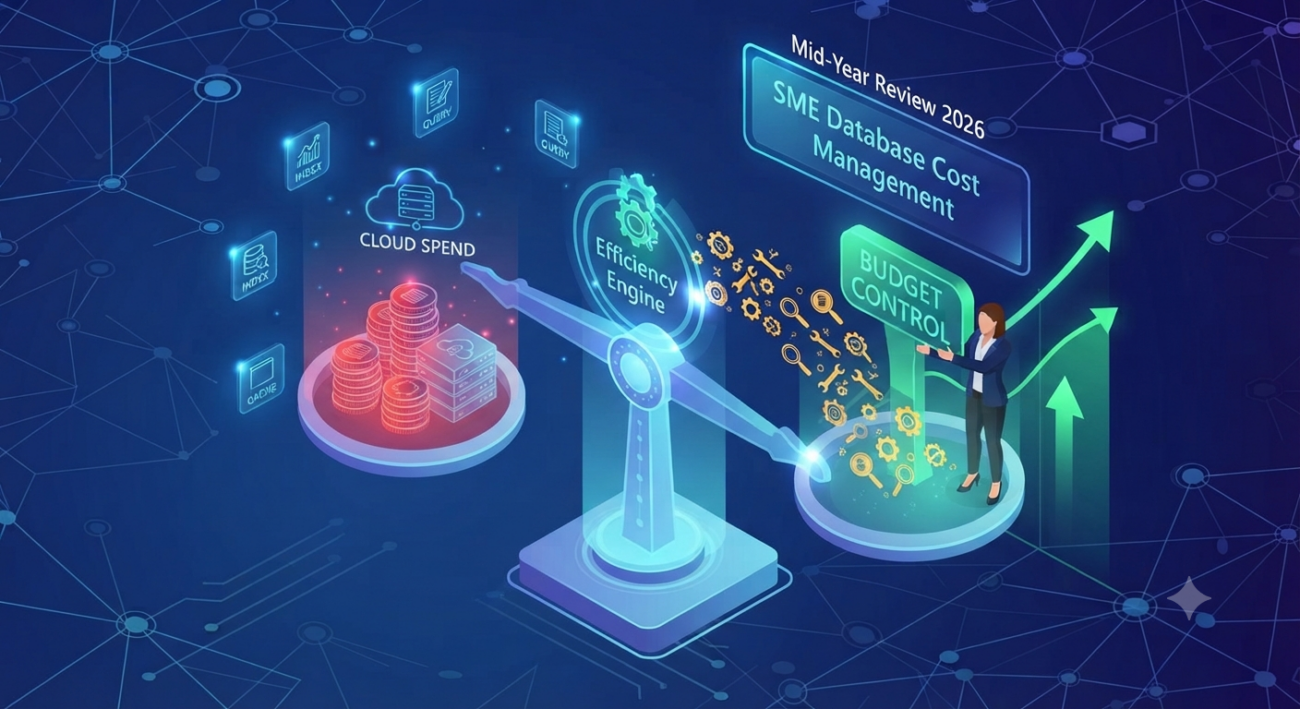
Mid-Year Review: How SMEs Are Managing Database Costs in 2026
Halfway through 2026, the conversation among UK SMEs about database and cloud spending has changed noticeably compared with 12 months ago. The “cloud-at-any-cost” mindset that defined much of the early 2020s has given way to a far more disciplined approach. Finance directors are asking sharper questions. IT teams are being held accountable for spend, not just uptime. And database costs, long treated as an unavoidable fixed cost, are now firmly on the table for active management.
This shift has not happened in isolation. It follows a run of unexpected cloud bill shocks, high-profile outages, and growing scrutiny of where data physically resides. For SMEs operating on tight IT budgets, typically growing by less than 3% year on year while demands for AI adoption, security, and analytics continue to climb, every pound spent on database infrastructure now has to justify itself.
This mid-year review looks at how SMEs are actually managing database costs in 2026: where the spending pressure is coming from, what strategies are proving effective, and what the second half of the year is likely to bring.
The State of Database Spending Halfway Through 2026
A few clear patterns have emerged from how SMEs are approaching database and infrastructure costs this year.
Budgets Are Flat, but Expectations Are Not
IT budgets across UK SMEs are growing only marginally this year, even as expectations around AI adoption, cyber security, and data analytics continue to rise sharply. The result is intense internal competition for every pound of IT spend, and database costs, often one of the largest recurring line items, are receiving far more scrutiny than in previous years.
Cloud Spend Has Become a Boardroom Topic
For many small and mid-sized technology, fintech, and professional services firms, cloud infrastructure now represents a substantial share of total revenue. This level of spend has moved cloud and database cost management out of the IT department and into regular finance and board-level conversations. Where cloud spend was once treated as a fixed operational cost, it is now actively interrogated each quarter.
FinOps Has Arrived in the SME Market
FinOps, the discipline of actively managing and forecasting cloud financial performance, was, until recently, associated mainly with larger enterprises. In 2026, SMEs are adopting lightweight FinOps practices of their own: regular cost reviews, tagging and attribution of database spend by project or department, and clearer ownership of cost decisions that were previously left unmanaged.
Data Residency Is Influencing Cost Decisions
Concerns over where data is physically stored, driven by compliance requirements and a desire for greater control, are prompting some SMEs to reconsider their infrastructure mix. Several UK businesses are moving steady-state database workloads to UK-based hosted environments, in some cases alongside continued use of public cloud for more variable or scalable workloads. This hybrid approach is increasingly common among businesses balancing cost control with data sovereignty requirements.
Why Database Costs Keep Climbing: The Root Causes
Before reviewing what SMEs are doing well, it is worth being clear-eyed about why database costs continue to be a persistent pressure point.
Provisioning for Peak, Paying for Average
Many SMEs provision database capacity for their busiest period a seasonal peak, a major campaign, a month-end processing window nd then pay for that capacity every single day of the year, regardless of actual demand. Without active right-sizing, this single habit alone can account for a significant proportion of unnecessary spend.
Unused and Orphaned Resources
Development databases that were spun up for a project and never decommissioned. Test environments were left running long after testing concluded. Backup snapshots are retained indefinitely without a clear retention policy. These resources accumulate quietly, and without regular auditing, they represent pure waste sitting on every monthly invoice.
Inefficient Queries Driving Compute Costs
In consumption-based pricing models, poorly written or unoptimised queries do not just slow down applications; they directly increase cost. A query that scans an entire table when an index would suffice, or a report that runs a heavy aggregation daily when weekly would do, translates directly into avoidable compute spend.
Licensing Complexity
For SMEs still running commercial database platforms such as Oracle or SQL Server, licensing structures remain a significant and often confusing cost driver. Core-based pricing, edition tiers, and support renewal costs can escalate without warning, particularly during infrastructure changes or audits.
Lack of Visibility and Ownership
Perhaps the most fundamental issue: many SMEs simply lack clear visibility into what is driving their database costs from month to month. Without tagging, attribution, and regular review, cost increases are noticed only when the invoice arrives, at which point the spending has already happened.
How SMEs Are Successfully Managing Database Costs This Year
The businesses managing database costs effectively in 2026 share a common set of practical strategies. None of these requires enterprise-scale resources; they require discipline and the right expertise applied consistently.
1. Right-Sizing Database Instances
Rather than provisioning for worst-case demand permanently, SMEs are increasingly matching database instance sizes to actual, measured usage patterns, adjusting compute and storage allocations based on real consumption data rather than historical guesswork or default settings carried over from initial setup.
2. Reserved Capacity and Commitment-Based Discounts
For predictable, steady-state workloads, committing to reserved instances or savings plans with cloud providers can deliver substantial discounts compared to on-demand pricing. SMEs with stable database usage patterns are increasingly using this lever, while keeping more variable workloads on flexible, pay-as-you-go pricing.
3. Tiered Storage Strategies
Not all data needs to sit on premium, high-performance storage. SMEs are adopting tiered storage approaches, keeping frequently accessed, business-critical data on fast storage, while archiving historical or infrequently accessed data to lower-cost storage tiers. This single change can meaningfully reduce storage costs without any impact on day-to-day performance.
4. Query and Index Optimisation
Proactive query tuning and index management remain among the most cost-effective levers available. Optimising a handful of frequently run, resource-intensive queries can produce a disproportionately large reduction in compute spend, often with no additional infrastructure investment required.
5. Regular Cost Audits and Resource Cleanup
SMEs that have brought their database costs under control typically run structured, recurring audits identifying orphaned instances, unused snapshots, over-provisioned environments, and redundant licences. This is not a one-off exercise; it is a habit built into ongoing operations.
6. Hybrid Infrastructure for Cost and Compliance Balance
As noted earlier, a growing number of SMEs are placing steady-state, sensitive, or compliance-sensitive database workloads on UK-based hosted infrastructure, while retaining public cloud for workloads that genuinely benefit from elasticity and scale. This hybrid model is proving effective both for cost control and for data residency assurance.
7. Vendor and Licence Consolidation
SMEs are reviewing their database and infrastructure vendor relationships more critically, consolidating where multiple overlapping tools or licences exist, and negotiating renewal terms more assertively rather than accepting automatic uplifts.
8. Engaging Managed Database Expertise
Perhaps most significantly, a growing number of SMEs without in-house database specialists are turning to managed DBA services specifically to drive cost optimisation, ot only reliability and security. A managed DBA brings the technical depth to identify inefficiencies that generalist IT teams typically do not have the time or specialist knowledge to find, turning cost management from a reactive invoice review into a proactive, ongoing discipline.
The Mistake Many SMEs Are Still Making
Despite this progress, a common mistake persists: treating cost optimisation as a one-time project rather than an ongoing discipline. Businesses run a cost review, make a round of changes, and then leave the environment unmonitored for another year, at which point usage patterns have shifted, new resources have been provisioned, and the savings achieved have quietly eroded.
Database costs are not static. They respond to changes in business activity, application updates, data growth, and usage patterns continuously. Sustainable cost management requires continuous monitoring and periodic review, not a single corrective exercise.
What This Means for the Second Half of 2026
Several trends from the first half of the year are likely to continue shaping how SMEs manage database costs through the remainder of 2026.
Continued pressure on flat budgets. With IT budget growth remaining modest and demand for AI and analytics investment continuing to rise, database cost discipline will remain a priority rather than a one-off initiative.
Greater scrutiny of AI-related database workloads. As SMEs experiment further with AI and machine learning applications, the database infrastructure required to support these workloads often data-intensive and compute-heavy, will come under closer cost and ROI scrutiny, particularly given growing questions about whether AI investment is delivering proportionate business value.
More hybrid and UK-based infrastructure decisions. Data residency and cost predictability concerns are likely to drive further moves towards hybrid infrastructure models, particularly for SMEs in regulated sectors.
Increased adoption of lightweight FinOps practices. Expect more SMEs to formalise basic cost attribution, tagging, and review processes, even without dedicated FinOps headcount, often supported by managed service providers offering this as part of a broader database management engagement.
A Practical Mid-Year Checklist
For SMEs looking to act on this review, the following checklist provides a practical starting point for the second half of 2026:
- Review current database instance sizing against actual usage data from the last six months
- Identify and decommission unused development, test, or orphaned database environments
- Audit storage tiers and migrate infrequently accessed data to lower-cost storage where appropriate
- Review the top ten most resource-intensive queries running against production databases
- Assess current licence agreements for consolidation or renegotiation opportunities
- Establish basic cost tagging and attribution if not already in place
- Evaluate whether reserved capacity or commitment-based pricing would benefit stable workloads
- Confirm whether current infrastructure placement meets data residency and compliance requirements
- Schedule a recurring quarterly cost review rather than treating this as a one-time exercise
Cost Discipline Without Sacrificing Performance
The defining theme of database cost management among UK SMEs in 2026 is balance: reducing unnecessary spend without compromising the performance, reliability, and security that the business depends on. The SMEs managing this successfully are not simply cutting costs; they are managing their database estate more intelligently, with better visibility, more proactive optimisation, and a clearer link between spend and business value.
For SMEs without the in-house specialism to drive this kind of disciplined, continuous cost management, partnering with experienced database management expertise is increasingly the difference between database costs that are merely tolerated and database costs that are genuinely under control.
As the second half of 2026 unfolds, the businesses that treat database cost management as an ongoing operational discipline rather than an annual scramble will be the ones best positioned to keep their technology spend aligned with their actual business needs.