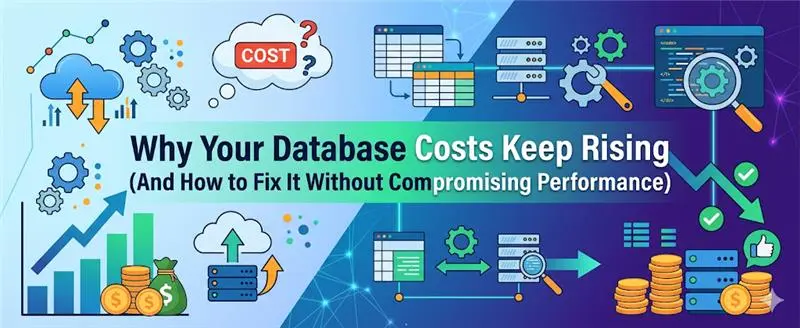
Database costs have a habit of creeping up quietly until suddenly they become a major line item in your IT budget. Whether you’re running traditional SQL systems, cloud-managed databases, or modern NoSQL platforms, rising costs are a common challenge for growing businesses.
The frustrating part is that many organisations believe reducing costs will negatively impact performance. In reality, the opposite is often true. With the right strategy, you can lower costs while improving efficiency and speed.
Why Database Costs Keep Rising
Overprovisioned Infrastructure
A significant contributor to rising costs is overprovisioning. Many businesses allocate resources based on peak demand scenarios, but rarely operate at that level. As a result, they end up paying for idle CPU, unused memory, and excess storage capacity. This creates inflated cloud bills without delivering any real performance benefit.
Inefficient Queries and Poor Optimisation
Poorly optimised queries are another hidden cost driver. When queries are not properly structured or indexed, they consume more compute power than necessary. Issues such as full table scans, missing indexes, and redundant queries force systems to work harder, increasing both latency and operational costs.
Data Growth Without Governance
Data naturally grows over time, but without proper governance, it quickly becomes unmanageable and expensive. Organisations often store duplicate records, outdated data, and unnecessary backups. While storage may seem inexpensive initially, at scale it significantly contributes to overall database costs.
Incorrect Database Architecture
Using the wrong database type for your workload can lead to inefficiencies and unnecessary expenses. For instance, relying on relational databases for highly unstructured data or forcing scalability on systems not designed for it can increase complexity and infrastructure demands. Choosing the wrong architecture often results in higher costs and reduced performance.
Lack of Monitoring and Cost Visibility
Without proper monitoring, it’s difficult to understand where your resources and money are going. Many organisations lack real-time insights, workload-based cost tracking, and alerts for unusual spikes. This lack of visibility allows inefficiencies to persist and costs to escalate unnoticed.
How to Reduce Database Costs Without Hurting Performance
Right-Size Your Resources
Instead of provisioning for peak demand, modern systems should leverage auto-scaling and usage-based models. This ensures that resources expand and contract based on actual workload requirements, helping you avoid unnecessary spending while maintaining performance during high-demand periods.
Optimise Queries and Indexing
Improving query performance is one of the fastest and most effective ways to reduce costs. By refining queries, implementing proper indexing, and eliminating redundant operations, you can significantly reduce compute usage. Efficient queries not only lower costs but also enhance application responsiveness.
Implement Data Lifecycle Management
Not all data needs to remain in high-performance storage indefinitely. By introducing data lifecycle strategies such as archiving older data, removing redundant datasets, and using tiered storage, you can reduce storage costs without affecting active workloads or performance.
Choose the Right Database Model
Aligning your database technology with your use case is critical. Structured transactional workloads benefit from SQL databases, while scalable and flexible applications often perform better with NoSQL or distributed systems. The right choice simplifies operations and minimises unnecessary resource consumption.
Automate Monitoring and Cost Control
Implementing monitoring tools provides the visibility needed to control costs effectively. With real-time dashboards, workload-based cost tracking, and automated alerts, you can quickly identify inefficiencies and address them before they become expensive problems.
Leverage Managed Services Strategically
Managed database services can reduce operational overhead, but they must be configured carefully. Over-allocation, constant use of high-performance tiers, and ignoring pricing optimisations can drive up costs. When used correctly, managed services provide a balance between efficiency, scalability, and cost control.
The Key Insight: Cost Optimisation Improves Performance
A common misconception is that cutting costs means compromising performance. In reality, cost optimisation often leads to better performance. When you eliminate inefficiencies, optimise queries, and properly size your infrastructure, you’re not cutting corners; you’re removing waste. This results in faster, more reliable systems that cost less to operate.
Final Thoughts
Rising database costs are not inevitable; they are usually a symptom of inefficiency rather than necessity. By taking a strategic approach that combines optimisation, better architecture, and proactive monitoring, organisations can significantly reduce costs while improving overall performance.
The goal isn’t simply to spend less.
It’s to spend smarter.