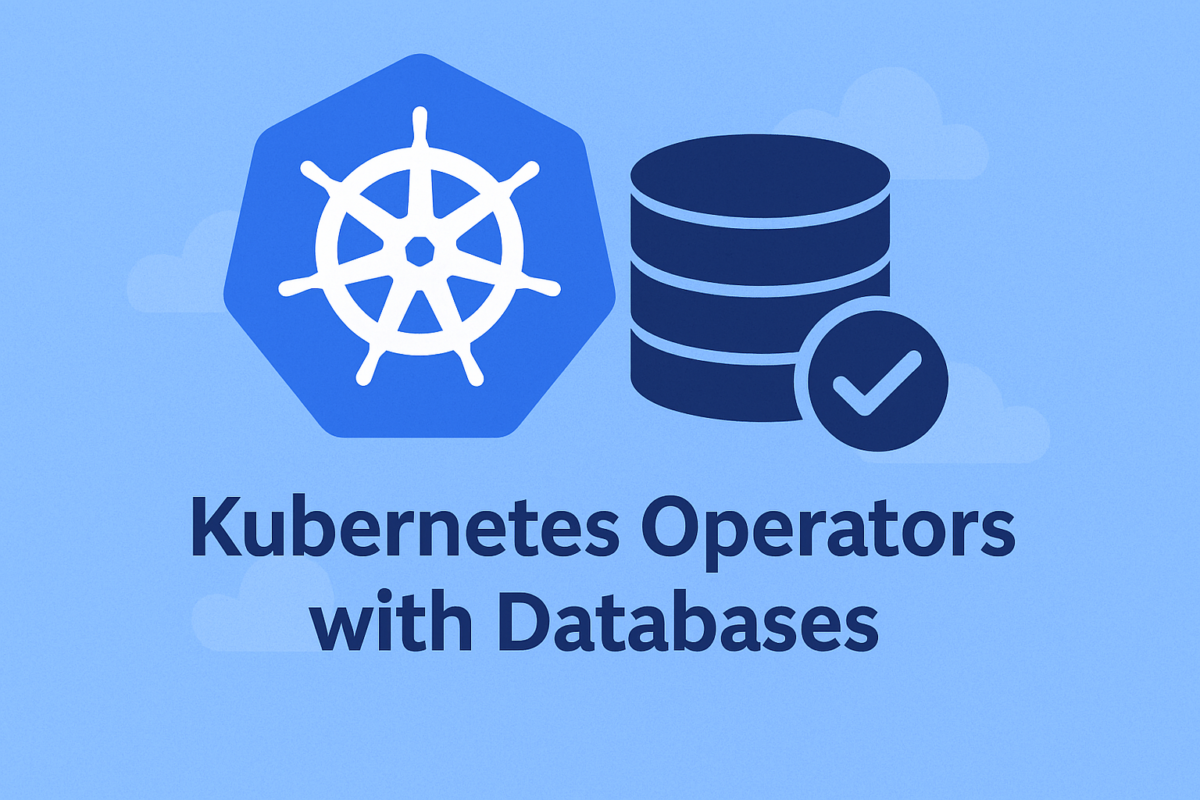
Kubernetes transformed modern infrastructure by making applications easier to deploy, scale, and manage across cloud environments. As container adoption increased, organizations naturally started exploring ways to run databases inside Kubernetes as well. But databases are very different from stateless applications. They require persistent storage, stable networking, replication management, backup coordination, and reliable failover handling. Managing these operations manually inside Kubernetes quickly became complicated, which led to the rise of Kubernetes Operators for databases.
A Kubernetes Operator is essentially a controller that automates database management tasks inside a Kubernetes cluster. Operators continuously monitor the state of a database and attempt to maintain its desired configuration automatically. Instead of manually handling deployments, backups, replication, scaling, and recovery procedures, teams can define configurations declaratively while the operator manages the operational side behind the scenes. This idea became highly attractive for organizations heavily invested in cloud-native infrastructure because it promised automation, consistency, and simplified operations.
One of the biggest reasons database operators gained popularity is automation. Operators can automatically handle tasks such as deploying database clusters, restarting failed nodes, configuring replication, scheduling backups, and managing failovers. In large-scale environments where engineering teams manage multiple database clusters, this level of automation can significantly reduce operational workload. Instead of manually responding to every infrastructure issue, operators continuously monitor the system and attempt to self-correct failures when problems occur.
Another major advantage is deployment consistency. Traditional database deployments often vary across environments, especially in fast-moving organizations. Operators standardize database deployment processes using Kubernetes manifests and infrastructure-as-code practices. This improves reproducibility across development, testing, and production environments. Teams can deploy database clusters more quickly and maintain greater consistency without relying heavily on manual configuration steps.
Self-healing infrastructure is another feature that attracts teams toward database operators. Kubernetes itself is designed around self-healing principles, and operators extend those capabilities to databases. If a database pod crashes or a node becomes unavailable, the operator can automatically recreate workloads, restore cluster state, reconnect storage volumes, and rebuild replicas. In theory, this improves resilience and reduces downtime without requiring immediate manual intervention from database administrators.
However, despite these advantages, Kubernetes Operators also introduce challenges that many organizations underestimate. Kubernetes is already a complex orchestration platform, and operators add another layer of abstraction on top of it. Engineering teams are no longer responsible for understanding only the database itself. They must now understand Kubernetes behavior, operator logic, reconciliation loops, custom resources, storage orchestration, and distributed system interactions. Troubleshooting becomes significantly more difficult because failures can originate from multiple infrastructure layers simultaneously.
Automation itself can also become a source of risk. Operators continuously attempt to reconcile system state based on configuration rules. If configurations are incorrect or the operator behaves unexpectedly, automation can trigger unintended consequences such as unnecessary failovers, replication issues, or service instability. In production environments, automated systems making incorrect decisions can sometimes create larger outages than manual operational mistakes. This is why blind trust in automation without strong operational visibility can become dangerous.
Debugging operator-managed databases is often far more complicated than traditional deployments. When performance issues occur, teams may need to investigate Kubernetes events, operator logs, networking layers, storage performance, StatefulSet behavior, persistent volumes, and replication systems simultaneously. This level of complexity can overwhelm teams that lack deep Kubernetes expertise. In many cases, organizations discover that running databases inside Kubernetes requires significantly more operational maturity than they originally expected.
Another important challenge is operator maturity. Not all database operators are equally stable or production-ready. Some operators are highly mature and widely adopted, while others are still evolving rapidly. Less mature operators may suffer from weak documentation, limited recovery capabilities, upgrade instability, or insufficient observability tooling. Choosing the wrong operator can introduce operational instability rather than improving reliability.
It is also important to understand that operators do not eliminate the fundamental challenges of database management. Databases still require careful attention around storage performance, replication consistency, backup validation, capacity planning, security, and disaster recovery. Operators automate certain workflows, but they do not remove the complexity of running stateful systems at scale.
For organizations with mature Kubernetes environments, experienced DevOps teams, strong monitoring systems, and cloud-native operational practices, database operators can provide significant value. They improve deployment consistency, automate repetitive operational tasks, and simplify large-scale infrastructure management. Companies managing many database clusters across multiple environments often benefit the most from this approach.
On the other hand, smaller teams or organizations without deep Kubernetes expertise may find operators unnecessarily complicated. In some situations, traditional managed database services offered by cloud providers may provide better reliability with far less operational overhead. Managed services handle backups, scaling, patching, monitoring, and failover management without requiring teams to operate complex orchestration systems themselves.
Ultimately, Kubernetes Operators for databases are neither inherently good nor bad. They are powerful tools designed for specific operational environments. When implemented correctly within mature infrastructure ecosystems, they can improve automation, scalability, and consistency. But for teams lacking the operational maturity to manage Kubernetes effectively, operators may introduce more complexity than value.
The real question is not whether database operators are worth it universally. The question is whether your organization is prepared to handle the operational complexity that comes with them.