Every company depends on databases. Whether it’s customer information, financial records, analytics, or application performance, databases sit at the center of modern business operations.
But many organizations make one critical mistake without realizing it: they allow one person to become the “database hero.”
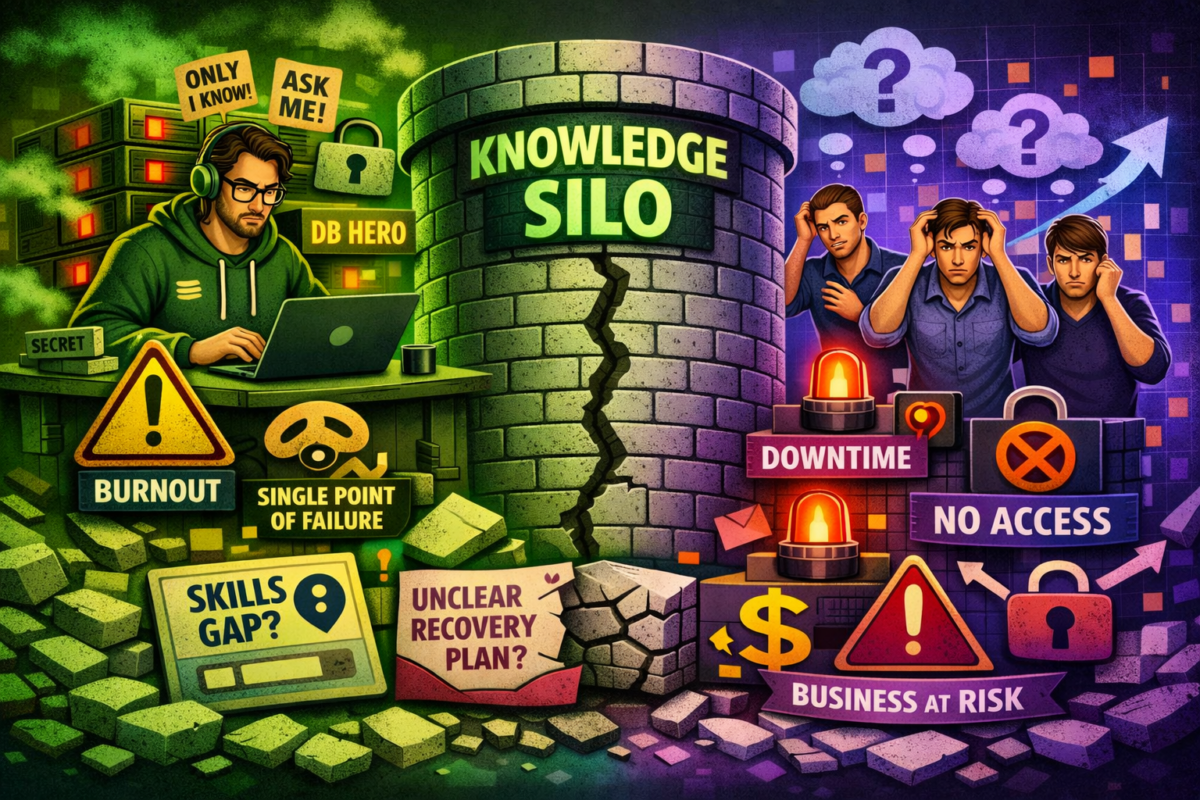
That single database administrator or engineer becomes the only person who truly understands the system — how it was built, how it behaves under pressure, and how to fix it when things go wrong.
At first, this may seem efficient. In reality, it creates a dangerous database knowledge silo that can expose the entire business to operational and financial risk.
What Is a Database Knowledge Silo?
A database knowledge silo happens when critical database expertise is concentrated in one individual instead of being shared across the team.
This person often becomes responsible for:
- Database architecture
- Performance tuning
- Backup and recovery
- Security management
- Replication setup
- Troubleshooting production issues
- Disaster recovery planning
Over time, everyone else depends on that expert for even minor database-related decisions.
The problem? If that person becomes unavailable, the organization suddenly loses access to years of operational knowledge.
Why Relying on One Database Expert Is Risky
Business Continuity Becomes Fragile
When only one employee understands the database environment, they become a single point of failure.
If they:
- Leave the company
- Take unexpected leave
- Experience burnout
- Become unreachable during an outage
the business may struggle to recover quickly.
Critical systems can remain down longer simply because nobody else knows how the infrastructure works.
Incident Response Slows Down
Database problems rarely happen at convenient times.
Performance bottlenecks, replication failures, storage issues, and corrupted queries require immediate action.
In organizations with knowledge silos:
- Teams hesitate to troubleshoot
- Engineers wait for the expert to respond
- Recovery takes longer
- Downtime increases
This directly impacts customers, revenue, and reputation.
Innovation Gets Bottlenecked
When one person controls all database knowledge, every technical decision flows through them.
This creates delays in:
- Infrastructure upgrades
- Cloud migration projects
- Automation initiatives
- Database optimization
- Scaling strategies
Instead of moving quickly, teams become dependent on one individual’s availability and priorities.
Burnout Becomes Inevitable
The “go-to database person” often carries enormous pressure.
They handle:
- Emergency calls
- Production outages
- Maintenance windows
- Performance complaints
- Security concerns
Eventually, constant dependency leads to stress and burnout.
Ironically, the more indispensable they become, the greater the organizational risk.
Common Signs of a Database Knowledge Silo
Many companies already have this problem without recognizing it.
Here are some warning signs:
Only One Person Handles Critical Issues
If production incidents always go to the same individual, knowledge is likely concentrated.
Documentation Is Missing or Outdated
Important procedures exist only in someone’s memory instead of shared systems.
Team Members Avoid Database Tasks
Other engineers may lack confidence because they were never trained properly.
Recovery Processes Are Unclear
If disaster recovery depends on one expert’s instructions, the organization is vulnerable.
Database Decisions Lack Collaboration
Architecture and operational decisions happen without broader team involvement.
What Causes Database Knowledge Silos?
Knowledge silos usually develop gradually over time.
Rapid Company Growth
Fast-moving teams often prioritize delivery speed over documentation and training.
Legacy Infrastructure
Older systems may rely heavily on historical knowledge accumulated by one employee.
Lack of Cross-Training
Organizations sometimes fail to invest in database education for broader teams.
Resource Limitations
Smaller companies may assign all database responsibilities to a single specialist.
Poor Knowledge-Sharing Culture
Some workplaces unintentionally reward information ownership instead of collaboration.
How to Eliminate Database Knowledge Silos
Reducing dependency on one expert requires intentional effort.
Build Detailed Documentation
Create centralized documentation for:
- Database architecture
- Access controls
- Backup procedures
- Recovery workflows
- Monitoring systems
- Performance optimization practices
Good documentation transforms individual knowledge into organizational knowledge.
Cross-Train Team Members
Database operations should never rely on one person alone.
Train multiple engineers in:
- Query optimization
- Troubleshooting
- Failover handling
- Backup restoration
- Security practices
Shared knowledge creates operational resilience.
Use Runbooks and Playbooks
Runbooks provide step-by-step instructions for handling common incidents.
This helps teams respond faster during:
- Outages
- Replication failures
- Storage issues
- Performance degradation
Clear operational guides reduce panic and uncertainty.
Encourage Collaborative Ownership
Database infrastructure should become a team responsibility rather than an isolated role.
Encourage:
- Peer reviews
- Shared maintenance tasks
- Collaborative troubleshooting
- Internal technical workshops
This creates stronger engineering culture and improves long-term stability.
Automate Repetitive Tasks
Automation reduces reliance on tribal knowledge.
Automate processes like:
- Backups
- Monitoring alerts
- Health checks
- Scaling operations
- Patch management
The fewer manual processes depend on one expert, the lower the operational risk.
The Long-Term Benefits of Breaking Knowledge Silos
Organizations that distribute database knowledge experience major advantages:
- Faster incident resolution
- Improved uptime
- Better onboarding
- Reduced operational risk
- Stronger collaboration
- Easier scalability
- Lower employee burnout
Most importantly, the business becomes resilient instead of dependent.
Final Thoughts
Database knowledge silos are one of the most overlooked risks in modern IT operations.
While having a highly skilled database expert is valuable, relying entirely on one person creates serious vulnerabilities that can impact business continuity, system reliability, and team productivity.
The solution is not replacing experts — it is spreading knowledge across the organization.
By improving documentation, encouraging collaboration, and investing in cross-training, companies can build database environments that are scalable, resilient, and far less dependent on a single individual.