Introduction
One of the most frustrating experiences for developers and database engineers is hearing the phrase: “It worked perfectly in development.”
Applications that perform flawlessly in development environments often behave completely differently once deployed to production. Queries become slower, indexes behave unexpectedly, transactions begin timing out, and performance bottlenecks suddenly appear under real-world workloads.
This disconnect between development (dev) and production (prod) databases is extremely common in modern software systems. While development environments are designed for speed, convenience, and rapid iteration, production environments operate under entirely different conditions involving large datasets, high concurrency, unpredictable traffic patterns, and strict reliability requirements.
Understanding why dev and prod databases behave differently is critical for building scalable, reliable, and high-performing applications.
The Biggest Misconception: “A Database Is Just a Database”
Many teams assume that if the same database engine is used in both environments, behaviour should remain consistent.
For example:
- PostgreSQL in dev should behave like PostgreSQL in prod
- MySQL queries should perform similarly everywhere
- Identical schemas should produce identical results
In reality, database behaviour depends far more on workload conditions than the database software itself.
Even if the database engine is identical, everything else may differ:
- Data volume
- Query concurrency
- Hardware resources
- Network latency
- Index fragmentation
- Caching behaviour
- Traffic patterns
- Transaction frequency
These differences dramatically affect database performance and reliability.
Data Volume Changes Everything
The most obvious difference between dev and prod environments is dataset size.
Development databases are usually small, clean, and easy to manage. Production databases may contain:
- Millions of records
- Historical archives
- Complex relationships
- Years of accumulated data
Queries that execute instantly on small datasets may perform poorly at scale.
For example, a query scanning 5,000 rows in development may seem efficient. In production, scanning 50 million rows becomes a serious performance issue.
Why This Happens
Database query optimisers make decisions based on data distribution and table size. As datasets grow:
- Execution plans change
- Index usage changes
- Disk I/O increases
- Memory pressure rises
- Sorting operations become expensive
A query that appears perfectly optimised in development may become highly inefficient in production.
Production Has Real Concurrency
Development environments rarely simulate true production concurrency.
In dev:
- One developer may use the application at a time
- Queries run sequentially
- Transactions are limited
- Resource contention is minimal
In production:
- Thousands of users may interact simultaneously
- Transactions overlap constantly
- Multiple services compete for resources
- Lock contention increases dramatically
This changes database behaviour entirely.
Common Production-Only Problems
Under concurrency, systems experience issues such as:
- Deadlocks
- Lock waits
- Connection pool exhaustion
- Transaction contention
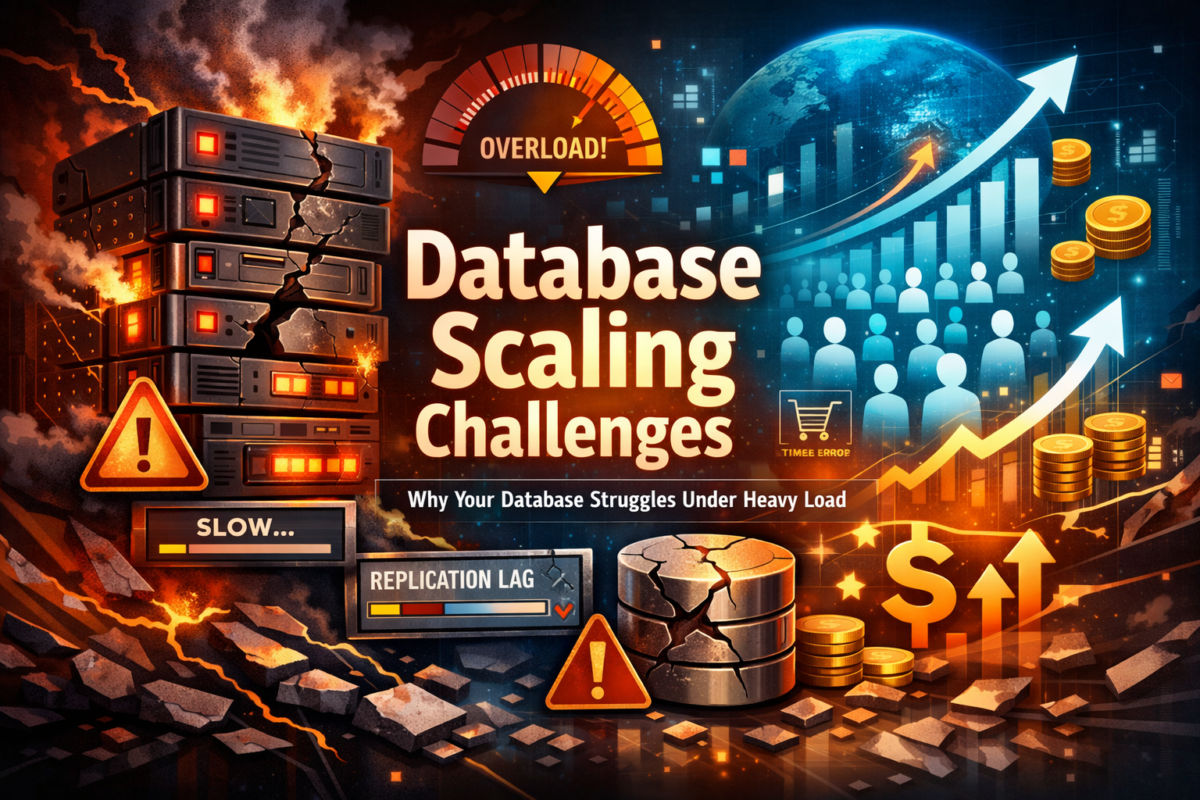
- Replication lag
These problems are often invisible during development testing.
Caching Behaves Differently in Production
Caching layers are another major reason dev and prod environments differ.
Development systems often:
- Run with warm caches
- Use limited datasets
- Avoid realistic traffic bursts
Production systems experience:
- Cache invalidation storms
- Cold starts
- Uneven traffic spikes
- Distributed cache inconsistencies
A query that appears fast in development may actually depend heavily on cached data.
Once production cache behaviour changes, database load increases unexpectedly.
Query Optimisers React Differently at Scale
Modern databases use sophisticated query optimisers to determine the fastest execution strategy.
However, optimisers rely heavily on:
- Table statistics
- Data distribution
- Cardinality estimates
- Index selectivity
Production data distributions are often completely different from development datasets.
For example:
- Dev databases may contain evenly distributed data
- Production data may contain hotspots, skewed values, or highly repetitive patterns
This causes databases to generate entirely different execution plans.
The result:
- Queries that were fast become slow
- Indexes are ignored unexpectedly
- Joins become inefficient
- CPU usage spikes under load
Infrastructure Differences Matter
Development databases often run on lightweight environments optimised for convenience.
Production databases operate within more complex infrastructure ecosystems involving:
- Distributed storage
- Replication clusters
- Load balancers
- High-availability configurations
- Cloud networking
- Backup systems
Infrastructure itself influences database behaviour.
For example:
- Network latency may affect transaction speed
- Replication delays may create stale reads
- Shared cloud resources may introduce variability
- Backup operations may increase I/O contention
These operational realities rarely exist in development environments.
Background Processes Affect Production Performance
Production databases continuously perform background operations that developers rarely notice in dev environments.
These include:
- Replication
- Index rebuilding
- Backup snapshots
- Vacuuming and compaction
- Log rotation
- Data synchronisation
- Monitoring collection
Whilst these processes are essential for reliability and maintenance, they consume resources and affect query performance.
Development databases often avoid these overheads entirely.
Test Data Rarely Matches Real Data
One of the most underestimated problems is unrealistic development data.
Dev datasets are often:
- Smaller
- Cleaner
- Better structured
- Missing edge cases
- Missing historical complexity
Production data is messy.
It contains:
- Duplicate records
- Null values
- Irregular relationships
- Inconsistent formatting
- Unexpected usage patterns
Applications tested only against idealised development data frequently fail when exposed to real production conditions.
Production Traffic Is Unpredictable
Development testing usually follows controlled workflows.
Production traffic does not.
Real-world systems experience:
- Sudden traffic spikes
- Seasonal demand surges
- Unpredictable user behaviour
- API abuse
- Retry storms
- Long-running transactions
These conditions expose weaknesses that never appear during isolated development testing.
Why Monitoring in Dev Isn’t Enough
Many teams monitor production systems extensively but overlook realistic monitoring in development environments.
Without visibility into:
- Query execution plans
- Lock contention
- Resource utilisation
- Slow query logs
- Transaction behaviour
developers struggle to predict production failures accurately.
Observability must exist before production deployment — not after incidents occur.
How High-Performing Teams Reduce Dev vs Prod Gaps
Modern engineering teams use several strategies to minimise environmental differences.
1. Use Production-Like Test Data
Teams create anonymised datasets that better reflect:
- Production scale
- Data distribution
- Realistic edge cases
This improves query testing accuracy significantly.
2. Simulate Real Workloads
Load testing and concurrency testing help expose:
- Lock contention
- Resource bottlenecks
- Query instability
- Connection exhaustion
before production deployment.
3. Monitor Query Plans Continuously
Comparing execution plans across environments helps identify:
- Optimiser inconsistencies
- Index issues
- Cardinality estimation problems
before performance degrades in production.
4. Build Observability Into Development
High-performing teams integrate:
- Query tracing
- Performance monitoring
- Slow query analysis
- Resource profiling
directly into development workflows.
5. Treat Production Behaviour as a Design Constraint
Instead of assuming production will behave like development, modern teams design systems expecting:
- Large-scale concurrency
- Uneven traffic
- Data growth
- Infrastructure variability
This mindset leads to more resilient architectures.
Final Thoughts
Development and production databases behave differently because they operate under completely different realities.
Development environments are controlled, lightweight, and predictable. Production systems are dynamic, distributed, heavily concurrent, and constantly evolving.
Most production database failures are not caused by broken code alone. They emerge when real-world scale, concurrency, data complexity, and infrastructure behaviour expose weaknesses that development environments failed to simulate.
Understanding these differences is essential for building applications that remain stable, scalable, and performant under real production conditions.