Growth is exciting for any business. More users, more transactions, and more data usually mean success. But behind the scenes, rapid growth can quietly place enormous pressure on your database infrastructure.
What works perfectly for 1,000 users may completely fail at 1 million.
Many organizations focus heavily on scaling applications, servers, and customer acquisition while underestimating one critical component — the database. Eventually, the database becomes the bottleneck that slows everything down.
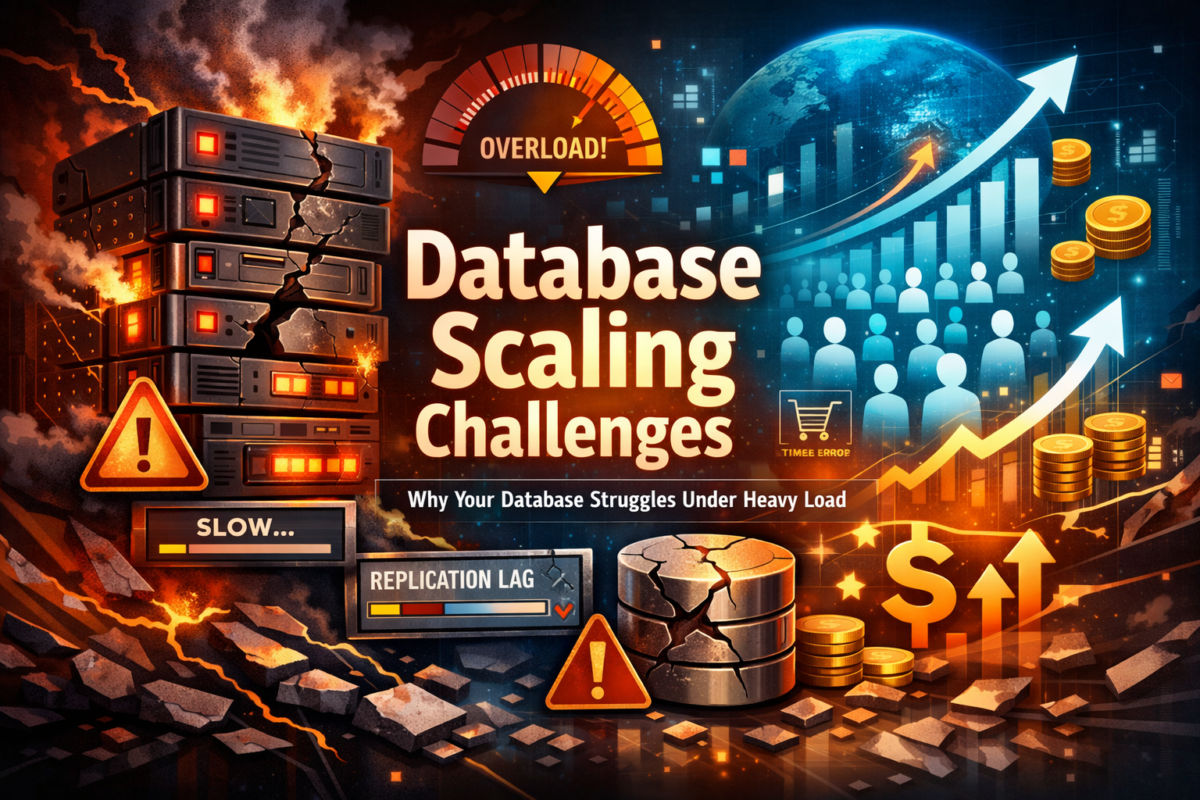
Slow queries, downtime, replication lag, failed transactions, and rising infrastructure costs are often the first signs that scaling is starting to break the system.
The truth is simple: databases do not fail overnight. They fail gradually under scaling pressure that was never properly planned for.
Why Databases Struggle During Scaling
Databases are designed to store, organize, and retrieve information efficiently. But as traffic grows, the workload becomes increasingly complex.
Scaling introduces challenges such as:
- Massive increases in read and write operations
- Higher concurrent user activity
- Larger datasets
- Complex query execution
- Increased replication traffic
- More demanding analytics workloads
Without proper optimization, the database eventually reaches performance limits.
Common Signs Your Database Is Breaking Under Scale
Slow Query Performance
One of the earliest warning signs is slower query execution.
Queries that once completed in milliseconds may suddenly take seconds or even minutes. This often happens because:
- Tables become too large
- Indexes are poorly optimized
- Queries become more complex
- Resources become overloaded
Slow queries impact application responsiveness and user experience almost immediately.
Increased Database Downtime
As workloads grow, unstable systems become harder to maintain.
Databases may begin experiencing:
- Connection failures
- Crashes during peak traffic
- Resource exhaustion
- Lock contention issues
Unexpected downtime becomes more frequent when infrastructure is pushed beyond its limits.
Replication Lag
Many organizations use read replicas to improve scalability.
However, under heavy write traffic, replicas can fall behind the primary database. This creates replication lag, where users may receive outdated or inconsistent data.
Replication delays become especially problematic for:
- Real-time applications
- Financial systems
- E-commerce platforms
- Analytics dashboards
Rising Infrastructure Costs
Scaling inefficient databases often leads to excessive infrastructure spending.
Instead of optimizing queries and architecture, companies sometimes continue increasing:
- CPU resources
- Memory allocation
- Storage capacity
- Cloud instances
This approach may temporarily reduce performance issues, but costs quickly become unsustainable.
Frequent Timeouts and Failed Transactions
When databases become overloaded, applications start experiencing:
- API timeouts
- Failed writes
- Transaction rollbacks
- Connection pool exhaustion
These failures directly affect customer trust and operational reliability.
The Most Common Reasons Scaling Breaks Databases
Poor Database Design
Bad schema design becomes increasingly painful at scale.
Common design issues include:
- Excessive normalization
- Missing indexes
- Large unpartitioned tables
- Poor relationship structures
Small inefficiencies multiply dramatically as datasets grow.
Inefficient Queries
Even powerful databases struggle with poorly written queries.
Common performance killers include:
- Full table scans
- N+1 query problems
- Unoptimized joins
- Excessive sorting operations
- Large result sets
Query optimization becomes essential as traffic increases.
Lack of Horizontal Scaling Strategy
Many systems rely entirely on vertical scaling — simply adding more CPU and RAM to a single server.
While this works temporarily, every machine eventually reaches physical limits.
Without horizontal scaling strategies like:
- Sharding
- Read replicas
- Distributed databases
growth eventually outpaces infrastructure capacity.
Ignoring Monitoring and Observability
Some teams only discover database problems after users complain.
Without proper monitoring, organizations miss early warning signs such as:
- Increasing query latency
- Replication delays
- Resource saturation
- Lock contention
- Storage bottlenecks
Proactive monitoring is critical for scaling safely.
Sudden Traffic Spikes
Unexpected growth events can overwhelm databases quickly.
Examples include:
- Viral campaigns
- Product launches
- Holiday sales
- Marketing promotions
- Breaking news traffic
Without autoscaling and load distribution strategies, systems can fail under sudden demand.
How to Prevent Database Scaling Failures
Optimize Queries Early
Performance tuning should begin before problems appear.
Focus on:
- Proper indexing
- Query analysis
- Reducing unnecessary joins
- Limiting large result sets
- Caching frequent queries
Small optimizations can dramatically improve scalability.
Invest in Database Monitoring
Real-time visibility helps teams detect problems before outages occur.
Monitor metrics such as:
- Query execution time
- CPU utilization
- Memory usage
- Disk I/O
- Replication lag
- Connection counts
Strong observability improves operational stability.
Use Caching Strategically
Not every request needs to hit the database directly.
Caching layers such as Redis or Memcached can reduce database load by storing:
- Frequently accessed data
- Session information
- API responses
- Query results
Effective caching significantly improves scalability.
Plan for Horizontal Scaling
Modern applications should prepare for distributed architectures early.
Common scaling strategies include:
- Database sharding
- Read/write splitting
- Multi-region replication
- Distributed SQL databases
Horizontal scaling reduces dependency on single-server performance.
Implement Load Testing
Many scaling failures happen because systems were never tested under realistic workloads.
Load testing helps teams identify:
- Bottlenecks
- Breaking points
- Capacity limits
- Query weaknesses
Testing before growth is always cheaper than recovering after failure.
Why Scalability Requires Continuous Planning
Scaling is not a one-time task.
As businesses evolve:
- User behavior changes
- Data volume increases
- Application complexity grows
- Traffic patterns shift
Database infrastructure must continuously adapt to support growth reliably.
Organizations that treat scalability as an ongoing process are far more likely to maintain stability during expansion.
Database scaling problems rarely appear suddenly. Most failures begin as small performance issues that gradually worsen as growth accelerates.
Ignoring these warning signs can lead to:
- System instability
- Customer frustration
- Revenue loss
- Operational downtime
- Expensive infrastructure costs
The key to successful scaling is preparation.
By optimizing queries, improving architecture, monitoring performance, and planning for distributed growth, businesses can build databases that remain stable even under massive demand.
Because when scaling breaks your database, it doesn’t just affect infrastructure — it affects the entire business.