build resilient, scalable, and reliable data systems for modern analytics.
In the early stages of growth, data pipelines often appear deceptively simple. A handful of sources, a basic ETL process, and a reporting layer are usually enough to keep things running. However, as organisations scale, adding more data sources, users, and real-time demands, those same pipelines begin to fracture.
What once worked reliably becomes fragile, slow, and increasingly difficult to maintain. For high-growth companies, this is not just an inconvenience; it is a direct threat to decision-making, operational efficiency, and competitive advantage.
The Illusion of “Working Fine”
Most pipelines do not fail overnight. Instead, they degrade gradually.
Initially, minor delays or inconsistencies are brushed aside. A dashboard takes a bit longer to load, or a batch job occasionally fails. Over time, these small issues compound, leading to missed SLAs, unreliable analytics, and frustrated teams.
The root of the problem is simple: pipelines designed for small-scale workloads are rarely built to handle exponential growth.
Why Data Pipelines Break at Scale
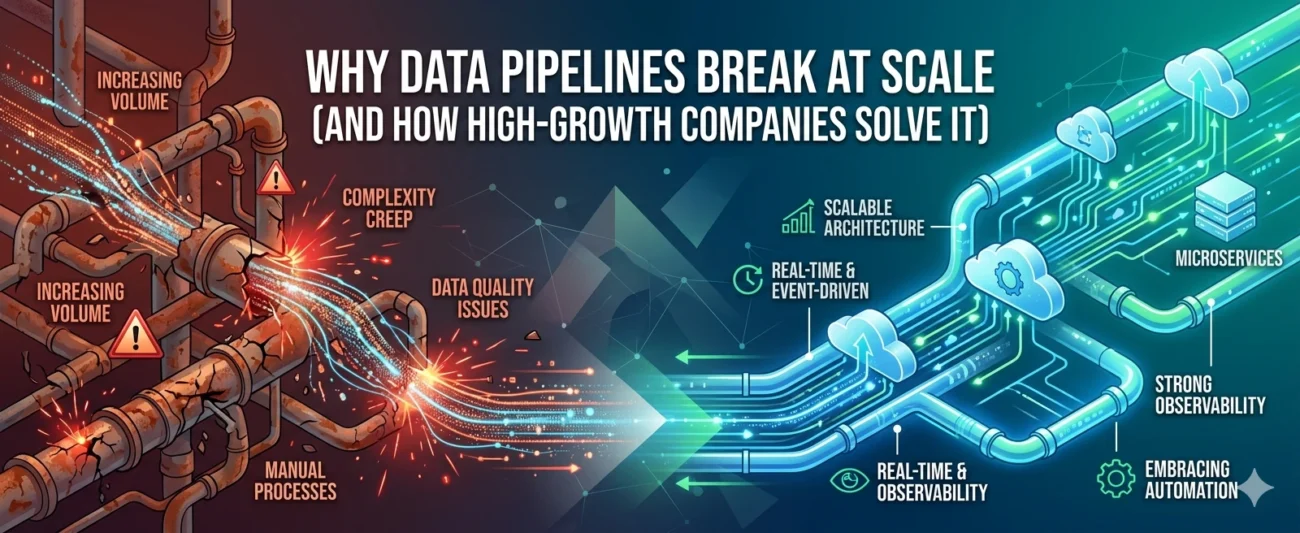
Increasing Data Volume and Velocity
As organisations grow, the volume of data expands rapidly. What was once gigabytes becomes terabytes or even petabytes. At the same time, the demand for near-real-time insights increases.
Traditional batch processing struggles to keep up, leading to bottlenecks and delayed outputs.
Complexity Creep
New tools, integrations, and business requirements introduce layers of complexity. Pipelines evolve into tangled systems with multiple dependencies, making them harder to debug and maintain.
A single upstream failure can cascade across the entire data ecosystem.
Lack of Observability
Many pipelines operate as “black boxes”. When something goes wrong, teams often lack the visibility to quickly identify the issue.
Without proper monitoring, failures are detected too late, sometimes after business decisions have already been impacted.
Schema Drift and Data Quality Issues
As data sources evolve, schemas change. Fields are added, removed, or modified without warning.
Without robust validation mechanisms, pipelines can silently ingest bad or inconsistent data, leading to inaccurate reporting.
Inefficient Resource Management
Pipelines that are not optimised for scale often consume excessive compute and storage resources. This not only increases costs but also affects performance and reliability.
Over-Reliance on Manual Processes
Manual interventions such as restarting jobs or fixing broken transformations do not scale. They introduce human error and slow down recovery times.
The Real Cost of Broken Pipelines
When pipelines fail at scale, the consequences extend far beyond technical inconvenience:
- Delayed Decision-Making: Leaders rely on timely data. Delays reduce agility and responsiveness.
- Loss of Trust in Data: Inconsistent or incorrect data erodes confidence across the organisation.
- Operational Inefficiency: Engineering teams spend more time firefighting than innovating.
- Increased Costs: Inefficient pipelines drive up infrastructure and maintenance expenses.
In high-growth environments, these costs can quickly become unsustainable.
How High-Growth Companies Solve It
Successful organisations recognise that scaling data pipelines requires a fundamental shift in architecture, tooling, and mindset.
Designing for Scalability from the Start
Rather than retrofitting solutions, high-growth companies adopt scalable architectures early. Distributed processing frameworks and cloud-native designs allow pipelines to handle increasing workloads without degradation.
Moving Towards Real-Time and Event-Driven Models
Modern pipelines increasingly rely on streaming and event-driven architectures. These systems process data continuously, reducing latency and eliminating the limitations of batch processing.
Building Strong Observability
Comprehensive monitoring, logging, and alerting are essential. High-growth teams invest in observability platforms that provide end-to-end visibility across pipelines.
This enables faster detection, diagnosis, and resolution of issues.
Implementing Data Quality Controls
Automated validation checks ensure data integrity at every stage of the pipeline. Schema enforcement, anomaly detection, and testing frameworks help prevent bad data from propagating.
Embracing Automation
Automation reduces reliance on manual processes. From deployment to error handling and recovery, automated workflows improve consistency and resilience.
Adopting Modular and Decoupled Architectures
Breaking pipelines into smaller, independent components makes them easier to manage and scale. Decoupling reduces the risk of cascading failures and improves flexibility.
Leveraging Managed Cloud Services
Cloud-native tools and managed services provide built-in scalability, reliability, and security. High-growth companies use these solutions to reduce operational overhead and focus on innovation.
The Role of Culture and Collaboration
Technology alone is not enough. High-growth companies foster a culture where data engineering, DevOps, and business teams collaborate closely.
Clear ownership, shared accountability, and continuous improvement practices ensure pipelines evolve alongside the organisation.
Data is treated as a product maintained, monitored, and continuously refined.
Preparing for the Future
As data continues to grow in volume and importance, pipelines must evolve to meet new demands. Trends such as data mesh, serverless architectures, and AI-driven optimisation are reshaping how pipelines are built and managed.
Organisations that invest in scalable, resilient data infrastructure today will be better positioned to adapt to tomorrow’s challenges.
Conclusion
Data pipelines rarely fail because of a single issue. They break under the weight of growth, complexity, and outdated design choices.
High-growth companies succeed by anticipating these challenges and building systems that are scalable, observable, and resilient from the outset.
In a data-driven world, reliable pipelines are not just a technical necessity; they are a strategic advantage.