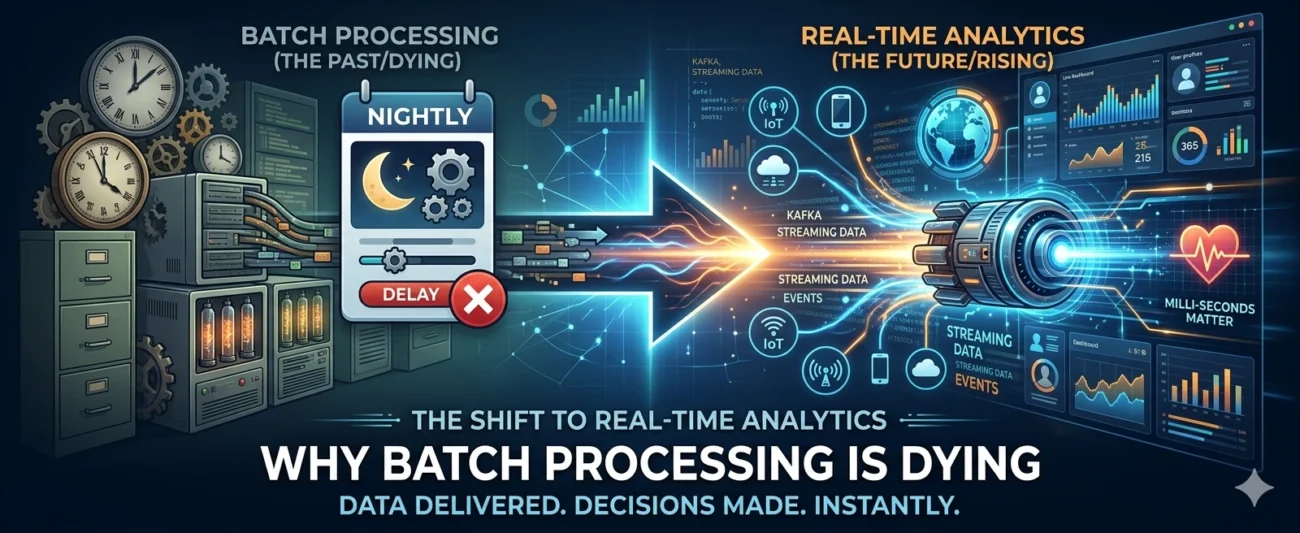
For decades, batch processing has been the backbone of enterprise data systems. Data was collected, stored, and processed in scheduled intervals hourly, nightly, or even weekly. It worked well enough in a world where decisions could wait.
That world no longer exists. Modern organisations operate in an environment where milliseconds matter. Customer expectations are immediate, markets move in real time, and operational inefficiencies can escalate within minutes. In this landscape, real-time analytics is not a luxury it is becoming the default.
The gradual decline of batch processing is not merely a technological trend; it reflects a fundamental shift in how businesses think about data, decisions, and value.
What Batch Processing Got Right and Where It Falls Short
Batch processing was designed for stability and scale. It excels at handling large volumes of data efficiently, often at lower operational cost. Financial reporting, payroll systems, and historical data aggregation still benefit from this model.
However, its limitations are becoming increasingly apparent. The most critical issue is latency. By definition, batch systems introduce a delay between data generation and insight delivery. In many modern use cases fraud detection, personalised recommendations, supply chain optimisation this delay renders the data less valuable, if not entirely obsolete. Moreover, batch pipelines tend to be rigid. Changes in data structure or business logic often require significant re-engineering, making them ill-suited to fast-moving digital environments.
The Rise of Real-Time Analytics
Real-time analytics flips the traditional model. Instead of processing data after it accumulates, it processes data as it arrives. This enables organisations to act on insights immediately, rather than retrospectively.
The shift is being driven by several converging forces. Firstly, the explosion of streaming data from IoT devices, mobile applications, and digital platforms demands continuous processing. Secondly, advances in cloud computing and distributed systems have made real-time architectures more accessible and scalable. Finally, competitive pressure is forcing organisations to become more responsive and data-driven. Real-time analytics is no longer confined to niche applications. It is now central to industries such as finance, retail, healthcare, and logistics.
Key Business Drivers Behind the Shift
Instant Decision-Making
In sectors like e-commerce and fintech, decisions must be made in real time. Whether it is approving a transaction, detecting fraud, or recommending a product, delays translate directly into lost revenue or increased risk.
Enhanced Customer Experience
Modern customers expect highly personalised, context-aware interactions. Real-time analytics enables businesses to tailor experiences, dynamically adjusting content, pricing, or recommendations based on live behaviour.
Operational Efficiency
From predictive maintenance in manufacturing to route optimisation in logistics, real-time insights allow organisations to respond proactively rather than reactively.
Competitive Advantage
Companies that can act on data faster gain a measurable edge. Real-time capabilities are increasingly becoming a differentiator rather than an innovation.
Technologies Powering Real-Time Analytics
The shift away from batch processing has been enabled by a new generation of technologies designed for streaming and low-latency processing. Distributed streaming platforms allow continuous ingestion and processing of data streams. Modern data processing frameworks support event-driven architectures, where each data event triggers immediate computation. Cloud-native data warehouses and lakehouses now offer near real-time query capabilities, bridging the gap between streaming and analytics. Equally important is the evolution of data architectures. Concepts such as event streaming, data mesh, and serverless computing are redefining how data systems are designed and operated.
Is Batch Processing Truly Dying?
Declaring the death of batch processing would be an overstatement. It remains relevant for specific use cases, particularly where real-time processing offers little added value.
Historical analysis, regulatory reporting, and large-scale data transformations are often more cost-effective when handled in batches. In fact, many organisations are adopting hybrid approaches, combining real-time pipelines with batch systems to balance performance and cost. What is changing, however, is the default assumption. Where batch processing was once the norm, real-time is now the starting point for system design.
Challenges in Adopting Real-Time Systems
The transition to real-time analytics is not without complexity. Building and maintaining streaming architectures requires specialised skills. Ensuring data consistency across distributed systems can be challenging. Monitoring and debugging real-time pipelines is inherently more difficult than managing batch jobs.
There is also a cost consideration. Real-time systems often demand continuous resource utilisation, which can increase infrastructure expenses if not carefully managed. Organisations must therefore approach the shift strategically, aligning technology choices with business priorities rather than adopting real-time for its own sake.
The Future: Always-On Data Ecosystems
The trajectory is clear. Data systems are moving towards always-on, continuously processing architectures where insights are generated and acted upon in real time.
As tools mature and expertise becomes more widespread, the barriers to adoption will continue to fall. Real-time analytics will increasingly integrate with AI and machine learning, enabling automated, intelligent decision-making at scale. In this future, the distinction between data processing and action will blur. Systems will not just analyse data they will respond to it autonomously.
Conclusion: A Shift in Mindset, Not Just Technology
The decline of batch processing is not simply about speed; it is about relevance. In a world where timing is critical, delayed insights are often worthless. Real-time analytics represents a broader shift in mindset from retrospective analysis to immediate action, from static reports to dynamic intelligence.
Batch processing is not disappearing overnight, but its dominance is fading. Organisations that continue to rely on it as their primary model risk falling behind. The question is no longer whether to adopt real-time analytics, but how quickly and effectively it can be integrated into the fabric of the business.