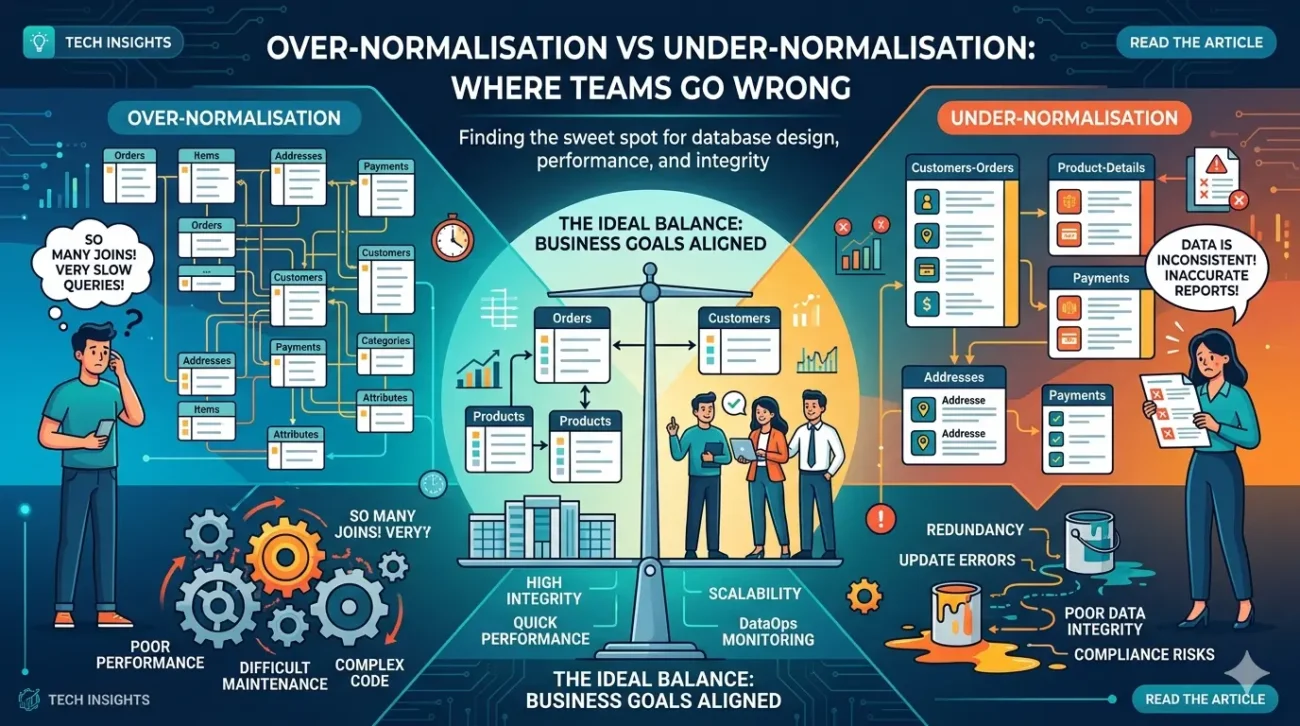
Database design is often treated as a purely technical exercise, but in reality, it’s a critical business decision. Every table, every relationship, and every index impacts how fast queries run, how easily developers can work with data, and how reliably insights are delivered to decision-makers. At the heart of this is normalisation, the process of organizing data to reduce redundancy and maintain integrity. But while normalisation is essential, too much or too little can cause serious problems for both performance and usability.
Over-normalisation occurs when teams push the principles of normalisation to the extreme. Tables are broken down into smaller, highly specialized units, relationships become complex, and even straightforward queries require multiple joins. While this ensures that data is consistent and duplication is minimized, it often comes at a cost. Queries that involve dozens of joins can become slow and difficult to maintain, increasing the cognitive load on developers and analysts. Applications may struggle with performance, and troubleshooting becomes more complex. In enterprise systems where speed and accessibility are crucial, over-normalisation can inadvertently create bottlenecks and reduce overall efficiency.
Under-normalisation, on the other hand, is the opposite problem. Here, tables are left too broad, and the same information may appear in multiple places to make queries simpler and faster. While this can improve read performance and reduce the number of joins required, it introduces redundancy and risk. Updates must be applied consistently across multiple tables, increasing the potential for errors. Inconsistent data can lead to inaccurate reports, poor decision-making, and compliance issues, especially in sectors like finance, healthcare, or e-commerce, where precision is non-negotiable.
Finding the right balance is rarely straightforward. The optimal database structure depends on the use case. High-transaction systems, like financial platforms, typically benefit from a higher degree of normalisation to ensure consistency and integrity. Analytical or reporting systems, however, may require selective denormalisation to improve query performance and reduce resource consumption. This is where modern practices such as DataOps come into play, encouraging iterative monitoring and adjustment of data pipelines and database structures to ensure both accuracy and speed.
The consequences of poor design decisions extend beyond slow queries or inconsistent records. Over-normalisation can frustrate teams, leading to workarounds, shadow IT practices, and the creation of additional data silos. Under-normalisation can inflate storage costs, increase maintenance overhead, and make scaling more difficult. Organizations that ignore these trade-offs often find themselves facing costly refactoring projects or migration headaches as systems grow and business requirements evolve.
A practical approach involves assessing data access patterns, query frequency, and performance needs before finalizing database architecture. Hybrid approaches—where core transactional tables are highly normalized but analytical or reporting tables are denormalized—allow teams to achieve the best of both worlds. Additionally, automation tools for database monitoring and query optimization can help detect performance issues before they escalate, ensuring that databases continue to perform efficiently as they scale.
It’s also important to consider governance and documentation. Well-documented tables, relationships, and normalization decisions make onboarding easier, reduce errors, and support future scalability. Modern enterprises increasingly adopt metadata-driven practices to track schema changes, manage dependencies, and maintain visibility across complex environments. This level of governance reduces the risk of both over- and under-normalisation creating long-term problems.
Ultimately, database design is not just about following rules—it’s about making informed trade-offs that align with business goals. Teams that approach design pragmatically, focusing on both data integrity and practical usability, can build systems that are efficient, scalable, and resilient. By avoiding the extremes of over-normalisation and under-normalisation, organizations can ensure that their data is not only reliable but also actionable, supporting smarter decisions and accelerating growth.
In a world where data powers AI, analytics, and business intelligence, poor design choices can have ripple effects across the enterprise. Striking the right balance allows organizations to unlock the full potential of their data, reduce operational overhead, and maintain a competitive edge. Well-structured, thoughtfully balanced databases are no longer optional—they are a foundational element of any modern digital strategy.