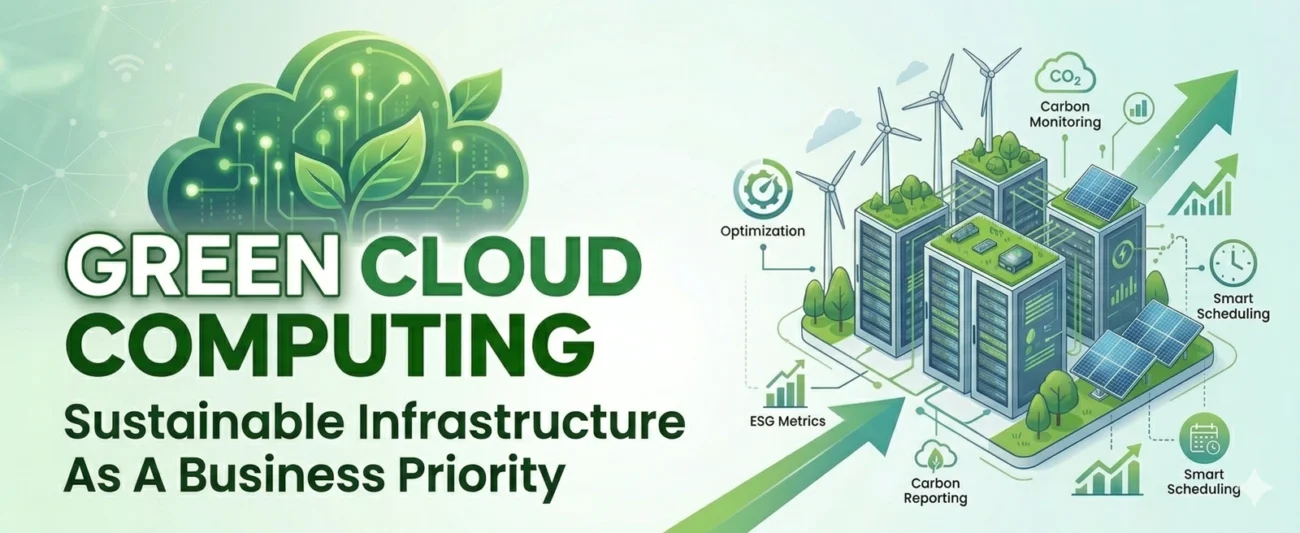
Cloud computing was once sold on agility, scalability, and cost efficiency. Today, a new metric has entered the equation: carbon. What began as a sustainability initiative has rapidly evolved into a core business priority, influencing procurement decisions, architectural design, and even customer perception.
Green cloud computing is no longer a “nice to have”. It is becoming a measurable, reportable, and strategically enforced requirement across modern enterprises.
The Shift: From Cost Optimisation to Carbon Awareness
For years, organisations focused on reducing cloud spend through rightsizing, reserved instances, and workload optimisation. While these remain important, the conversation has matured.
The question is no longer:
“How much does this workload cost?”
It is now:
“What is the carbon cost of running this workload—and can we reduce it without compromising performance?”
This shift is being driven by three converging forces:
- Regulatory pressure (ESG reporting, carbon disclosures)
- Investor scrutiny on sustainability metrics
- Enterprise commitments to net-zero targets
Cloud infrastructure sits directly in the crosshairs of all three.
What “Green Cloud” Actually Means (Beyond the Marketing)
Green cloud computing is often misunderstood as simply using a provider powered by renewable energy. In reality, it is a multi-layered discipline that spans infrastructure, architecture, and operational behaviour.
1. Carbon-Aware Infrastructure Selection
Hyperscalers now publish region-specific carbon intensity data. Not all data centres are equal; running the same workload in one region versus another can significantly change their environmental impact.
This introduces a new design principle:
Workload placement should consider carbon intensity alongside latency and cost.
2. Efficient Workload Architecture
Poorly designed systems don’t just waste money—they waste energy.
Key inefficiencies include:
- Over-provisioned compute resources
- Idle instances running 24/7
- Inefficient data transfer patterns
- Chatty microservices increase network overhead
Modern green architectures prioritise:
- Event-driven compute (run only when needed)
- Autoscaling aligned with real demand
- Stateless services that scale down to zero
- Data locality to reduce unnecessary movement
Efficiency is sustainability.
3. Storage Strategy and Data Lifecycle Management
Data is often retained indefinitely “just in case”. This creates silent energy consumption across storage layers.
A sustainable approach includes:
- Tiered storage (hot, warm, cold, archive)
- Automated lifecycle policies
- Deletion of redundant, obsolete, or trivial (ROT) data
In many environments, up to 60% of stored data delivers no business value yet continues to consume energy.
4. Carbon-Aware Scheduling
One of the most underutilised techniques in green computing is time-based optimisation.
Certain workloads – such as batch processing, analytics jobs, or backups – do not need to run immediately. These can be scheduled during periods when renewable energy availability is higher. This concept, known as carbon-aware computing, is gaining traction in advanced cloud environments.
Why Businesses Are Treating Sustainability as an Infrastructure Strategy
ESG Reporting Is Becoming Non-Negotiable
Environmental, Social, and Governance (ESG) metrics are now part of annual reporting for many organisations. Cloud usage contributes directly to Scope 2 and Scope 3 emissions.
Without visibility into infrastructure-level carbon impact, accurate reporting becomes impossible.
Cloud Providers Are Raising the Bar
Major cloud platforms are embedding sustainability into their offerings:
- Carbon footprint dashboards
- Region-level emission data
- Recommendations for greener architectures
This is shifting responsibility back to customers:
The tools exist now, optimisation is your responsibility.
Customers and Clients Are Paying Attention
Sustainability is no longer internal. It is becoming a differentiator in sales cycles, particularly in enterprise and public sector contracts.
Organisations are increasingly being asked:
- How green is your infrastructure?
- Can you demonstrate carbon reduction efforts?
- Are your systems aligned with net-zero goals?
Infrastructure decisions are now brand decisions.
The Hidden Risk: “Lift-and-Shift” Without Optimisation
Many organisations migrated to the cloud using lift-and-shift strategies. While this delivered speed, it often replicated on-prem inefficiencies in a more expensive and sometimes more carbon-intensive environment.
Symptoms include:
- Always-on virtual machines replacing idle servers
- Legacy architectures running unchanged
- Lack of autoscaling or serverless adoption
Green cloud computing requires a shift from Migration to Modernisation to Optimisation. Without this progression, sustainability targets remain out of reach.
Practical Steps to Build a Greener Cloud Environment
Establish Carbon Visibility
You cannot optimise what you cannot measure. Start with:
- Cloud-native sustainability dashboards
- Third-party carbon tracking tools
- Tagging strategies to map workloads to business units
Redesign for Efficiency
Move beyond infrastructure provisioning and rethink architecture:
- Replace monoliths with scalable services
- Introduce serverless where viable
- Reduce inter-service chatter
Automate Everything
Manual environments tend to drift into inefficiency. Automation ensures:
- Idle resources are terminated
- Scaling is demand-driven
- Policies are consistently enforced
Align Engineering with Sustainability Goals
Green computing is not just an operations concern. Developers, architects, and DevOps teams must align on:
- Efficient coding practices
- Lightweight services
- Reduced computational overhead
The Competitive Advantage of Going Green
Organisations that invest in sustainable infrastructure are seeing benefits beyond compliance:
- Lower operational costs through efficient resource usage
- Improved system performance due to optimised architectures
- Stronger brand positioning in environmentally conscious markets
- Future-proofing against evolving regulations
Sustainability, when implemented correctly, is not a constraint it is an optimisation strategy.
Final Thought
Green cloud computing is not about sacrificing performance for sustainability. It is about eliminating waste, whether financial, computational, or environmental. The most efficient systems are, by definition, the most sustainable.
The organisations that recognise this early are not just reducing their carbon footprint- they are building smarter, leaner, and more resilient digital infrastructure. And in a world where both cost and carbon are under scrutiny, that is a decisive advantage.