Introduction
Modern database systems are designed to handle massive volumes of data with speed, reliability and scalability. As applications become more data-intensive, the way databases store and retrieve information plays a critical role in overall system performance.
Two of the most widely used storage and indexing approaches are B-Tree Indexes and Log-Structured Storage (LSM Trees). While both aim to optimise data access, they follow completely different design principles and are suited for different types of workloads.
Understanding how they work—and where they perform best—helps organisations make better architectural decisions for performance, scalability and cost efficiency.
What Are B-Tree Indexes?
B-Tree indexes are one of the most traditional and widely used indexing structures in relational databases such as MySQL, PostgreSQL, Oracle and SQL Server.
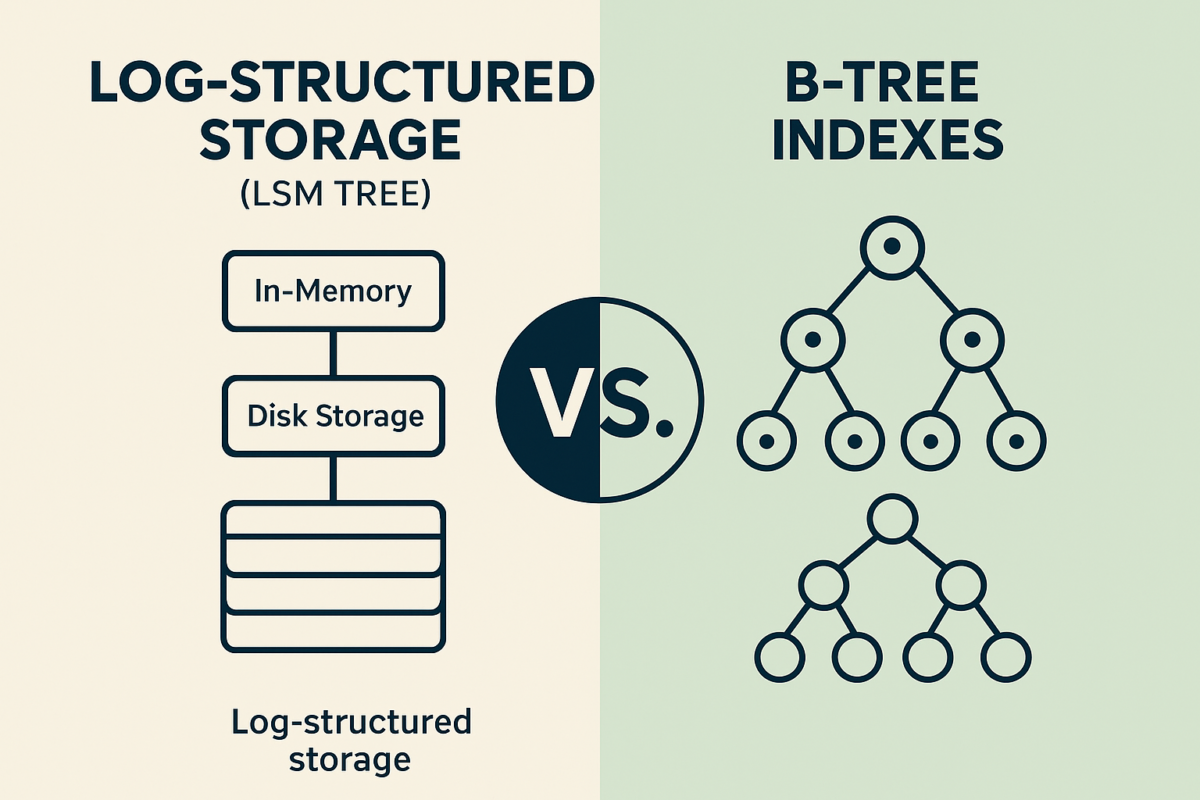
They organise data in a balanced tree structure where each node contains sorted keys, allowing efficient navigation through large datasets.
When a query is executed, the database traverses the tree instead of scanning the entire table, significantly improving read performance.
How B-Tree Indexes Work
B-Tree structures maintain data in sorted order across multiple levels:
- The root node points to intermediate nodes
- Intermediate nodes point to leaf nodes
- Leaf nodes contain actual data references
This hierarchical structure ensures that data can be located quickly with minimal disk reads.
However, every insert, update or delete may require rebalancing the tree, which adds overhead during write operations.
Advantages of B-Tree Indexes
1. Excellent Read Performance
B-Trees are highly efficient for SELECT queries, making them ideal for systems where reading data is more common than writing.
2. Efficient Range Queries
They perform well for ordered queries such as date ranges, price filtering or sequential data retrieval.
3. Mature and Reliable
B-Tree indexing has been used for decades and is supported by almost all relational database systems.
4. Stable Query Behaviour
Performance is predictable, which makes them suitable for enterprise-grade applications.
Limitations of B-Tree Indexes
1. Slower Write Performance
Every insert or update requires modifying the tree structure, which leads to random disk writes and overhead.
2. Poor Fit for High Ingestion Workloads
Systems with heavy write traffic can experience performance bottlenecks.
3. Maintenance Overhead
Frequent updates may lead to page splits and fragmentation, requiring optimisation.
What Is Log-Structured Storage (LSM Trees)?
Log-Structured Merge Trees (LSM Trees) are designed for modern, high-performance systems that prioritise write efficiency and scalability.
Instead of updating data in-place like B-Trees, LSM-based systems first write data sequentially to memory and disk logs, then reorganise it later using background processes.
This approach significantly improves write performance in large-scale systems.
LSM Trees are commonly used in databases such as Cassandra, RocksDB, LevelDB and HBase.
How LSM Trees Work
LSM-based storage follows a multi-stage process:
- Incoming data is first written to an in-memory structure
- Once memory is full, data is flushed to disk in sequential files
- Background compaction processes merge and sort data files
This reduces random disk writes and improves ingestion speed.
Advantages of LSM Trees
1. High Write Performance
LSM Trees are optimised for fast data ingestion, making them ideal for write-heavy systems.
2. Better Scalability
They handle large-scale distributed workloads efficiently, especially in cloud environments.
3. Sequential Disk Writes
Reducing random I/O improves storage performance and hardware efficiency.
4. Ideal for Real-Time Systems
Perfect for logging, analytics, IoT and event-driven applications.
Limitations of LSM Trees
1. Compaction Overhead
Background merging processes can increase CPU and storage usage.
2. Slower Read Performance
Data may be spread across multiple files before compaction completes.
3. Write Amplification
The same data may be rewritten multiple times during compaction.
4. Operational Complexity
Requires careful tuning of memory, cache and compaction settings.
When to Use B-Tree Indexes
B-Tree indexes are best suited for:
- Financial systems
- ERP applications
- E-commerce platforms
- Reporting dashboards
- Read-heavy workloads
They are ideal when query performance and consistency are more important than high write throughput.
When to Use Log-Structured Storage
LSM Trees are best suited for:
- Real-time analytics systems
- IoT data platforms
- Event logging systems
- Big data applications
- Cloud-native distributed systems
They perform best in environments where write speed and scalability are top priorities.
Final Thoughts
Both B-Tree indexes and Log-Structured Storage play important roles in modern database design. The right choice depends entirely on workload patterns.
B-Trees provide stability and excellent read performance, making them ideal for transactional systems. LSM Trees, on the other hand, deliver superior write performance and scalability for modern distributed environments.
Understanding these differences helps businesses design more efficient, scalable and cost-effective database architectures in today’s cloud-driven world.