Introduction
Modern organisations are generating and storing more data than ever before. From customer records and financial transactions to system logs and analytics, data has become central to business operations. However, storing everything indefinitely is neither practical nor cost-effective.
This is where data retention policies become essential. A well-designed retention strategy ensures that data is kept for as long as it is needed for legal, operational or business purposes — and removed or archived when it is no longer useful.
The challenge is finding the right balance. Poorly designed retention policies can either break compliance requirements or negatively impact system performance and storage costs.
What Are Data Retention Policies?
Data retention policies define how long different types of data should be stored, where it should be stored, and what should happen when it reaches the end of its lifecycle.
These policies typically cover:
- Storage duration for different data types
- Archiving rules for historical data
- Deletion schedules for obsolete records
- Compliance requirements for regulated industries
- Backup and recovery retention timelines
The goal is to ensure data is managed efficiently while meeting legal and operational obligations.
Why Data Retention Matters
Without structured retention policies, organisations often fall into two extremes:
- Keeping too much data for too long, increasing cost and complexity
- Deleting too much data too soon, risking compliance violations
A balanced retention strategy helps organisations:
- Reduce storage and cloud costs
- Improve database performance
- Maintain regulatory compliance
- Simplify data management
- Reduce security risks
The Compliance Challenge
One of the biggest drivers of data retention policies is regulatory compliance. Different industries must follow strict rules regarding how long data is stored.
For example:
- Financial services may need to retain transaction records for several years
- Healthcare organisations must store patient data securely for defined periods
- E-commerce platforms may need to retain order history for auditing purposes
Failure to comply can result in:
- Legal penalties
- Financial fines
- Loss of customer trust
- Regulatory investigations
At the same time, compliance requirements often conflict with performance goals, especially when large volumes of historical data are kept in active systems.
The Performance Problem
While retaining data is important, storing all data in high-performance systems can significantly impact infrastructure efficiency.
Common performance issues include:
- Slower database queries due to large datasets
- Increased storage costs in cloud environments
- Higher backup and recovery times
- Inefficient indexing and search performance
- Increased system maintenance overhead
As data grows, these issues become more noticeable, especially in real-time applications and analytics systems.
Types of Data in Retention Strategies
A strong retention policy separates data into categories based on usage and importance.
1. Active Data (Hot Data)
Frequently accessed and required for daily operations.
Examples:
- Live transactions
- Active user data
- Real-time application data
2. Semi-Active Data (Warm Data)
Occasionally accessed but not part of daily operations.
Examples:
- Monthly reports
- Recent customer activity
- Operational logs
3. Archived Data (Cold Data)
Rarely accessed but retained for compliance or historical reference.
Examples:
- Old records
- Backup archives
- Historical analytics data
Designing a Balanced Data Retention Policy
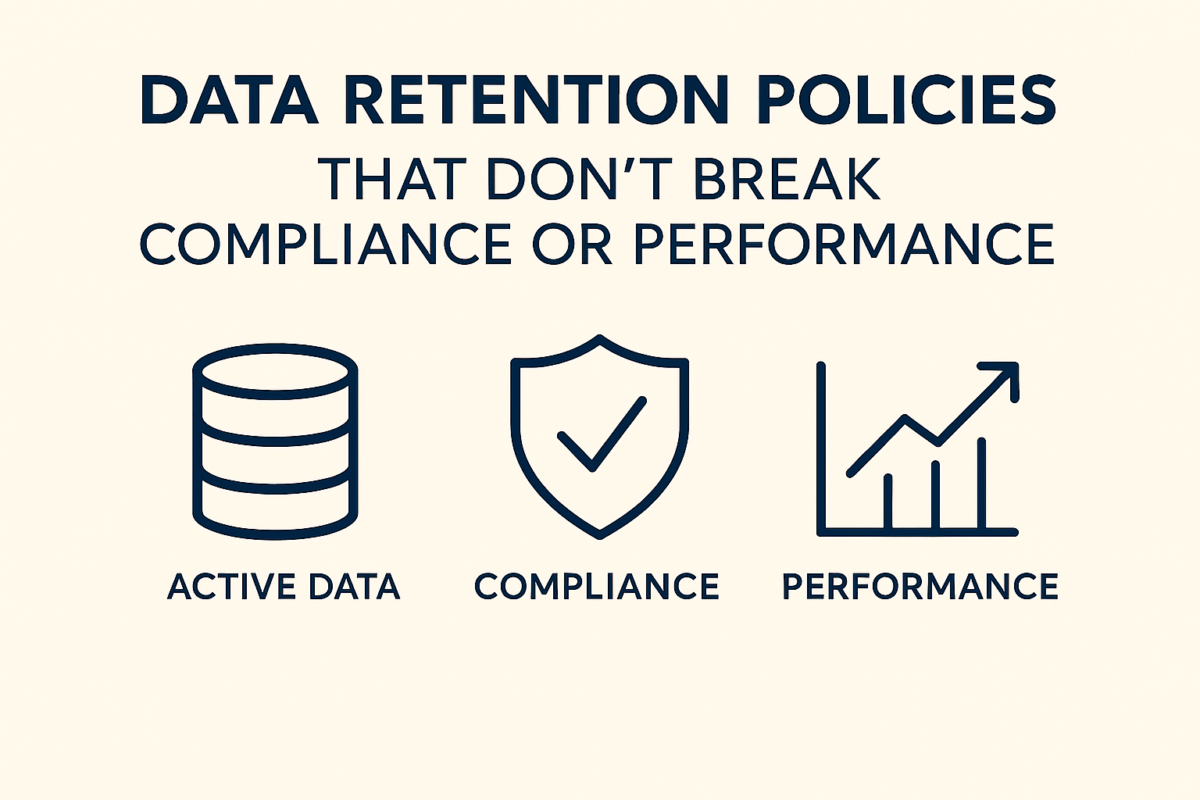
A good retention policy must balance three key goals:
- Compliance requirements
- System performance
- Storage efficiency
Here are key best practices:
1. Define Clear Retention Periods
Each type of data should have a defined retention timeline based on:
- Legal requirements
- Business value
- Operational needs
Avoid a “store everything forever” approach.
2. Use Tiered Storage
A tiered approach may include:
- High-performance storage for active data
- Standard storage for semi-active data
- Low-cost archival storage for cold data
This reduces costs while maintaining accessibility.
Not all data needs high-performance storage.
3. Automate Data Lifecycle Management
Manual data management is inefficient and error-prone.
Automation helps:
- Move data between storage tiers
- Archive inactive datasets
- Delete expired records safely
4. Monitor Data Growth and Usage
Continuous monitoring helps identify:
- Unused or rarely accessed data
- Storage bottlenecks
- Cost inefficiencies
- Performance degradation
This allows ongoing optimisation of retention policies.
5. Align IT and Compliance Teams
Retention policies must satisfy both technical and legal requirements.
Close collaboration ensures:
- Compliance rules are met
- Systems remain performant
- Data is not over-retained unnecessarily
Common Mistakes in Data Retention Policies
Many organisations struggle with retention due to common mistakes such as:
- Retaining all data by default
- Lack of clear deletion policies
- Ignoring storage tiering
- Overloading primary databases with historical data
- Not reviewing policies regularly
These mistakes often lead to higher costs and reduced system performance.
The Impact of Poor Retention Management
Without proper retention strategies, organisations may face:
- Increased cloud storage expenses
- Slower database performance
- Higher backup and recovery times
- Greater security risks
- Compliance failures
Over time, unmanaged data growth can significantly impact operational efficiency.
Conclusion
Data retention policies are essential for balancing compliance requirements with system performance and cost efficiency. The key is not just storing data, but storing it intelligently.
By defining clear retention rules, using tiered storage, automating lifecycle management and continuously monitoring data usage, organisations can maintain compliance while ensuring high-performance systems.
A well-designed retention strategy helps businesses reduce costs, improve scalability and build more efficient data environments in an increasingly data-driven world.