Stop Building Pipelines First
Why build data pipelines first… when APIs can define the entire system?
For years, organisations approached system design in a predictable sequence: start with the database, layer business logic on top, and finally expose APIs for consumption. While functional, this model quietly introduced rigidity, tight coupling, and long-term scalability challenges.
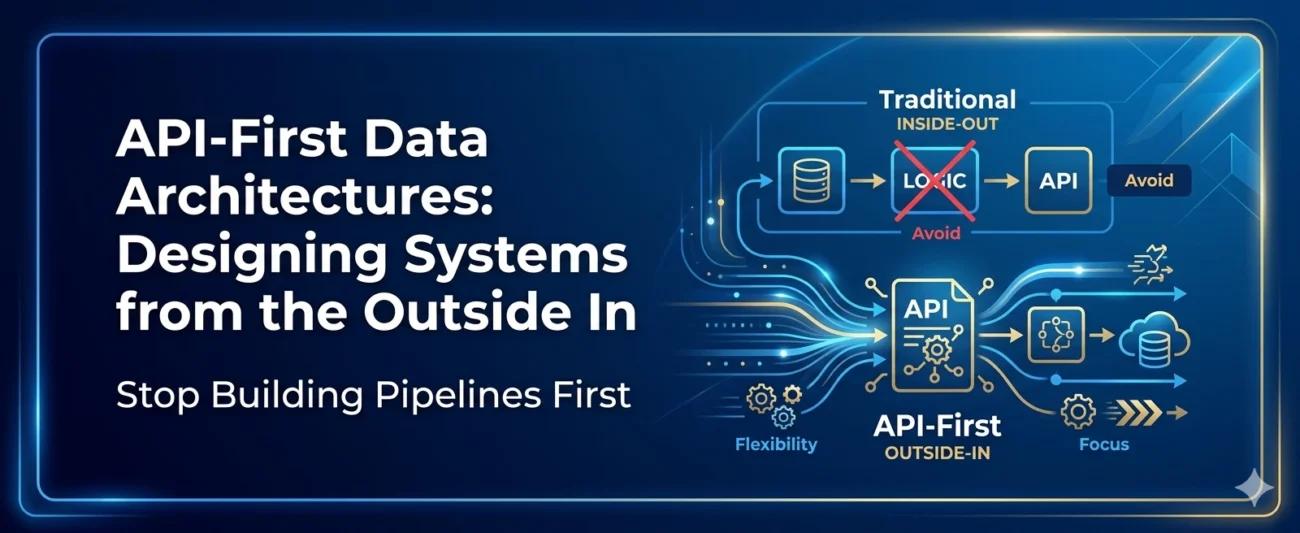
API-first data architecture challenges the norm. It shifts the design approach from inside-out to outside-in, where the interface is defined before the implementation even begins. This seemingly simple change has profound implications for scalability, speed, and system resilience.
What Is API-First Architecture?
At its core, API-first architecture means designing and defining APIs before building the underlying system components.
Instead of:
Database → Logic → API
You begin with:
API Contract → Logic → Data Layer
This reversal ensures that every system component is built to serve a clearly defined interface. The API is no longer an afterthought-it becomes the foundation of the architecture.
The Contract-First Principle
APIs as System Contracts
In an API-first model, APIs function as formal contracts between services. These contracts define how systems interact without exposing internal implementation details.
Each contract clearly outlines:
- Input and output formats
- Expected behaviour
- Error handling mechanisms
- Versioning rules
This separation ensures that teams can work independently while remaining aligned to a shared interface.
Why This Matters
Without contracts, systems become tightly coupled-any change in one component can cascade across multiple services. With contract-first design, changes are contained and predictable.
It creates a boundary between:
- What a system does (interface)
- How it does it (implementation)
How API-First Development Actually Works
Step 1: API Design Comes First
Teams define APIs using specifications such as OpenAPI (Swagger), detailing endpoints, request structures, and responses before writing code.
Step 2: The Contract Is Shared
The API specification becomes the single source of truth across:
- Frontend teams
- Backend developers
- Data engineers
- QA teams
Everyone builds against the same blueprint.
Step 3: Parallel Development
With a stable contract in place, teams can work simultaneously:
- Frontend builds UI with mocked APIs
- Backend implements business logic
- Data teams structure, storage, and pipelines
This eliminates dependency bottlenecks.
Step 4: API-Driven Communication
All services interact strictly via APIs. Direct database access between services is removed, ensuring consistency and control.
Step 5: Controlled Data Flow
Data flows through well-defined endpoints where it is validated, transformed, and secured before exposure.
Architectural Advantages of API-First
Loose Coupling by Design
Traditional architectures often tie services directly to shared databases or internal logic. API-first enforces separation, allowing services to evolve independently without breaking others.
Faster Development Cycles
Because teams are no longer blocked by dependencies, development becomes faster and more iterative. Features can be built, tested, and released independently.
Independent Scalability
API-first systems allow individual services to scale based on demand. High-traffic endpoints can scale without impacting the rest of the system.
Simplified Integration
APIs provide a consistent interface for internal and external systems, making integration with third-party platforms significantly easier.
Rethinking the Data Layer
From Direct Access to Controlled Exposure
In traditional systems, data is often accessed directly across services, leading to inconsistencies and security risks.
API-first changes this model:
- Data is never exposed directly
- APIs control access and transformation
- Business rules are enforced at the interface level
The Result
- Stronger security boundaries
- Consistent data governance
- Easier versioning and updates
- Reduced risk of breaking changes
Data becomes a managed and governed resource, rather than a shared dependency.
Real-World Impact
Without API-First
Systems tend to suffer from:
- Tight coupling between components
- Fragile integrations
- Complex scaling requirements
- High risk of cascading failures
With API-First
Organisations gain:
- Independent service evolution
- Faster release cycles
- Seamless scalability
- Stable and predictable integrations
The difference lies in how change is handled-API-first systems are designed to absorb change, not resist it.
Enabling Modern Architectures
API-first is not just a design preference-it is a foundation for modern system design.
Microservices
Each service exposes well-defined APIs, enabling modular and scalable architectures.
Cloud-Native Systems
API-first aligns naturally with containerisation, serverless computing, and distributed systems.
Multi-Platform Experiences
From web to mobile to third-party integrations, APIs ensure a consistent interface across all touchpoints.
Future-Proofing Systems by Design
One of the most powerful advantages of API-first architecture is its ability to support change over time.
When APIs define the system:
- Internal components can evolve without disruption
- New services can be added without rewriting existing ones
- Legacy systems can be modernised incrementally
This creates systems that are not only scalable but adaptable.
Conclusion: API as the System Interface
API-first architecture represents a fundamental shift in how systems are designed and built.
It replaces:
- Assumptions with contracts
- Dependencies with independence
- Rigidity with flexibility
In this model:
API = the system interface
Data = a controlled resource behind it
Organisations adopting API-first are not just improving development speed-they are building systems that can scale, integrate, and evolve with far greater confidence.
And in a world where change is constant, that capability is no longer optional-it is essential.