Database security has never been more consequential or more contested. Databases are the single most valuable target in an organisation’s technology estate. They hold the customer records, financial data, intellectual property, and personal information that, in the wrong hands, translate directly into regulatory fines, reputational damage, litigation, and operational disruption. The Information Commissioner’s Office issued over £15 million in fines in the 2023/24 reporting year alone, and the vast majority of incidents that attract enforcement action have a database compromise at their root.
What makes the threat landscape in 2026 particularly demanding is not that entirely new attack categories have emerged most of the threats organisations face today are evolutions of well-understood techniques but that the sophistication, automation, and speed of those techniques have advanced considerably. Attackers have access to tools that automate vulnerability discovery, exploit known weaknesses at scale, and leverage artificial intelligence to accelerate lateral movement once initial access is established. The organisations that manage these threats effectively are those that understand them with precision, not those that treat security as a compliance checkbox.
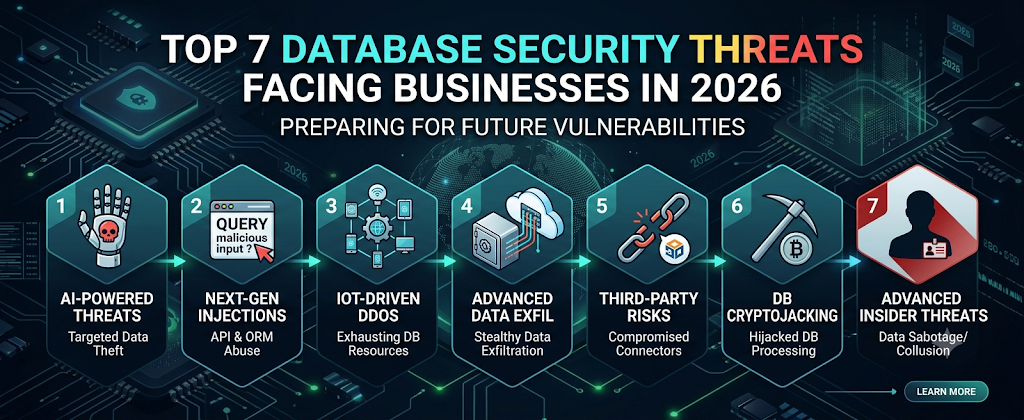
This article examines the seven database security threats that pose the greatest risk to UK businesses in 2026, what drives each one, and what effective mitigation looks like in practice.
Threat 1: SQL Injection & Its Modern Variants
SQL injection has appeared on every database security threat list for the better part of two decades, and its continued prominence is not a reflection of industry complacency so much as a reflection of how persistently the conditions that enable it are reproduced in new applications and systems. The attack works by inserting malicious SQL syntax into an input field in a login form, a search box, or a URL parameter that the application then passes to the database without adequate sanitisation. When successful, the attacker can retrieve, modify, or delete data, bypass authentication entirely, and, in some configurations, execute commands on the underlying operating system.
What has changed in 2026 is the sophistication of the tooling available to attackers and the emergence of second-order injection, where malicious input is stored in the database and executed later when retrieved by a different part of the application, bypassing input validation that only checks data at the point of entry. Blind SQL injection techniques, where the attacker extracts data by inferring responses from the application’s behaviour rather than reading output directly, have become more automated and therefore faster to execute.
Effective mitigation requires parameterised queries and prepared statements as the default development standard, not an optional best practice but a non-negotiable requirement enforced through code review. Web Application Firewalls provide a valuable additional layer of protection but should be treated as a defence-in-depth measure rather than a substitute for secure application development. Regular penetration testing, specifically including SQL injection testing against all user-facing input surfaces, should be a standing item in the security assurance programme.
Threat 2: Insider Threats & Privilege Abuse
The insider threat is the one that organisations most consistently underinvest in addressing, because it requires confronting an uncomfortable truth: the individuals with the greatest access to your most sensitive data are often the same individuals whose trustworthiness is assumed rather than verified. Database administrators, developers, data analysts, and senior business users who have been granted broad data access for legitimate operational reasons represent a material risk, whether through malicious intent, coercion, carelessness, or the gradual accumulation of permissions that were individually justified but collectively excessive.
In 2026, the insider threat has been amplified by two trends. The first is the growth of remote and hybrid working, which has expanded the perimeter through which privileged database access is exercised and reduced the incidental oversight that physical office environments provide. The second is the increasing sophistication of insider-facilitated attacks, where external threat actors establish relationships with insiders through social engineering, financial inducement, or exploitation of personal circumstances to gain access without needing to breach perimeter controls at all.
Mitigation centres on three disciplines. The principle of least privilege must be operationalised; access reviews should be conducted rigorously on a defined cycle, with permissions reduced to the minimum required for current role responsibilities rather than allowed to accumulate over a career. Database Activity Monitoring tools that capture and analyse all database access in real time, flagging anomalous patterns such as bulk data extraction, access to tables outside normal operational scope, or activity outside business hours, provide detection capability that manual oversight cannot replicate. And a culture of security awareness where staff understand both the value of the data they work with and the consequences of its misuse reduces the surface area for both malicious and inadvertent insider incidents.
Threat 3: Ransomware Targeting Database Infrastructure
Ransomware has evolved from a threat that encrypted endpoint files into one that specifically targets database infrastructure as its primary objective. Modern ransomware operations, many of which operate as Ransomware-as-a-Service enterprises with dedicated technical teams, conduct extensive reconnaissance before deploying their payload, identifying database servers, backup systems, and replication targets to maximise the impact of encryption and maximise leverage in subsequent ransom negotiations.
The double extortion model, now standard across most professional ransomware operations, compounds the impact beyond operational disruption. Attackers exfiltrate database contents before encrypting them, threatening to publish or sell the extracted data if the ransom is not paid. For a UK business holding personal data subject to UK GDPR obligations, this creates simultaneous pressures: operational recovery, regulatory notification within the 72-hour ICO reporting window, and the impossible calculus of whether paying a ransom, which does not guarantee data destruction and which may itself carry legal risk, is the least bad option.
Effective protection requires a layered approach. Network segmentation that limits lateral movement from compromised endpoints to database servers is fundamental. A ransomware payload that reaches the endpoint layer should not have a clear path to the database tier. Immutable, air-gapped backups that cannot be encrypted or deleted by an attacker who has obtained administrative credentials are the critical recovery mechanism and must be tested regularly. Endpoint detection and response tooling that can identify ransomware behaviour before encryption begins, combined with rapid incident response capability, reduces the blast radius, not if an attack reaches the perimeter.
Threat 4: Misconfiguration & Exposed Databases
Misconfigured databases remain one of the most prolific sources of data breaches globally, and the volume of incidents attributable to this cause has not diminished despite years of industry attention. Databases left accessible over the public internet without authentication, cloud storage buckets containing database exports with default public-read permissions, replication endpoints unintentionally exposed through firewall rule changes, and development databases populated with production data and deployed without appropriate access controls are not sophisticated attack scenarios. They are operational failures that require no attacker capability beyond the ability to run a scan.
Automated scanning tools that continuously enumerate publicly accessible databases and cloud resources are widely available and are used by both security researchers and threat actors. The window between a misconfiguration occurring and it being discovered externally is often measured in hours, not days. In a UK GDPR context, a misconfiguration that results in personal data being accessible to unauthorised parties constitutes a personal data breach regardless of whether it was actively exploited, carrying the same notification obligations and enforcement exposure as a sophisticated intrusion.
Addressing misconfiguration requires both technical controls and process discipline. Cloud Security Posture Management tools that continuously assess cloud configurations against security baselines and alert on deviations provide the detection layer. Change management processes that require security review before network access rules are modified, and that treat database exposure as a specific check item rather than an implicit consideration, provide the prevention layer. Regular penetration testing and external attack surface scanning assess the organisation’s internet-facing footprint as an external attacker would identify exposures before they are discovered by someone with less benign intentions.
Threat 5: Credential Theft & Authentication Attacks
The database credentials that applications use to authenticate to database servers represent a high-value target that attackers invest significant effort in obtaining. Application configuration files containing plaintext database passwords, environment variables exposed through server-side vulnerabilities, hardcoded credentials in source code repositories, and credentials cached in memory and extractable through process injection each of these represents a vector through which database authentication can be bypassed without exploiting the database itself.
Credential stuffing attacks, where credentials obtained from breaches of other services are systematically tested against database management interfaces and cloud-hosted database portals, have become highly automated. Brute force attacks against database authentication endpoints that are internet-accessible without rate limiting or account lockout have similarly become trivial to execute at scale. And the growing use of AI-assisted password generation in credential attacks means that even reasonably complex passwords are under pressure in ways that were not true two years ago.
Eliminating static database credentials is the most impactful single change most organisations can make. Cloud-native authentication mechanisms, Managed Identities in Azure, and IAM Roles in AWS remove the static credential entirely for workloads that can adopt them. Where static credentials are operationally unavoidable, they must be stored in a secrets management platform such as HashiCorp Vault or a cloud provider’s native secrets service, with automatic rotation on a defined cycle. Multi-factor authentication for all interactive database access, including DBA tooling and cloud database consoles, significantly raises the cost of credential-based attacks even where credentials are compromised.
Threat 6: Supply Chain & Third-Party Database Risks
The supply chain attack vector has received extensive attention following high-profile incidents in recent years, and its implications for database security are significant and underappreciated. Third-party software components, database drivers, connection pooling libraries, ORM frameworks, monitoring agents, and database management tools introduce code into the database access path that the organisation does not write and may not deeply scrutinise. A compromised component in this supply chain can exfiltrate database credentials, intercept query results, or provide a persistent backdoor into the database tier that bypasses all perimeter controls.
Managed service providers, cloud database administrators, and external development teams with database access represent a human dimension of the same risk. Third-party access to production databases is frequently governed less rigorously than internal access granted for a specific engagement, poorly time-bounded, and not always revoked promptly when the engagement concludes. Just-in-time access provisioning, where third-party database access is granted only for defined windows through a formal approval process and automatically revoked at the end of those windows, is the appropriate control model and should be enforced rather than relied upon manually.
Software composition analysis tools that identify known vulnerabilities in third-party components and flag them for remediation should be integrated into the development and deployment pipeline. Database components with known critical vulnerabilities should be updated on an accelerated timeline rather than waiting for scheduled maintenance cycles.
Threat 7: AI-Augmented Attacks & Automated Exploitation
The most significant development in the database threat landscape in 2025 and 2026 is the extent to which artificial intelligence has been integrated into offensive security tooling. AI-assisted vulnerability discovery, automated exploitation frameworks that adapt their approach based on application responses, and large language model-assisted malware development have collectively lowered the technical barrier for sophisticated database attacks and increased the speed at which they can be executed.
Automated reconnaissance tools now enumerate database versions, identify known vulnerabilities, and generate targeted exploits with a speed and consistency that manual attacker workflows cannot match. Social engineering campaigns targeting database administrators crafted with AI assistance to be highly personalised and contextually convincing have become significantly more effective at obtaining credentials and insider access than earlier, less tailored approaches. And AI-assisted analysis of exfiltrated database contents can accelerate the identification of high-value targets within a dataset, increasing the secondary impact of a breach.
The defensive implication is that the margin for delayed patching, deferred security assessments, and manual-only monitoring has narrowed. Threat detection capabilities must similarly leverage automation, Security Information and Event Management platforms with machine learning-based anomaly detection, database activity monitoring that establishes behavioural baselines and alerts on deviations, and vulnerability management processes that prioritise based on active exploitability rather than static severity scores. The National Cyber Security Centre’s guidance on AI-augmented threats, updated in 2025, provides a practical framework for UK organisations assessing their exposure.
The Common Thread: Governance & Culture
Across all seven threats, a common thread emerges. The organisations that manage database security most effectively are not necessarily those with the most sophisticated technical tooling; they are those where security governance is embedded in operational processes, where access controls are actively managed rather than set and forgotten, where testing and monitoring are continuous rather than periodic, and where the people responsible for database security understand the business value of what they are protecting.
Technical controls matter enormously. But they are rendered substantially less effective when they operate in an environment where access reviews are skipped, patches are deferred, configuration changes bypass security review, and the database security posture is only examined when something goes wrong.
Conclusion
The database threat landscape in 2026 demands the same thing it has always demanded: rigour, consistency, and the willingness to treat security as an operational discipline rather than a project. What has changed is the speed and sophistication with which these threats are executed, the regulatory consequences of failing to address them under the UK GDPR and ICO enforcement regime, and the extent to which automated and AI-augmented attack tooling has reduced the dwell time between vulnerability and exploitation.
The seven threats covered in this article are not hypothetical. They are the scenarios that UK businesses are actively contending with, that the ICO is investigating when breaches occur, and that the NCSC is advising organisations to prioritise. Address them with the seriousness they warrant.