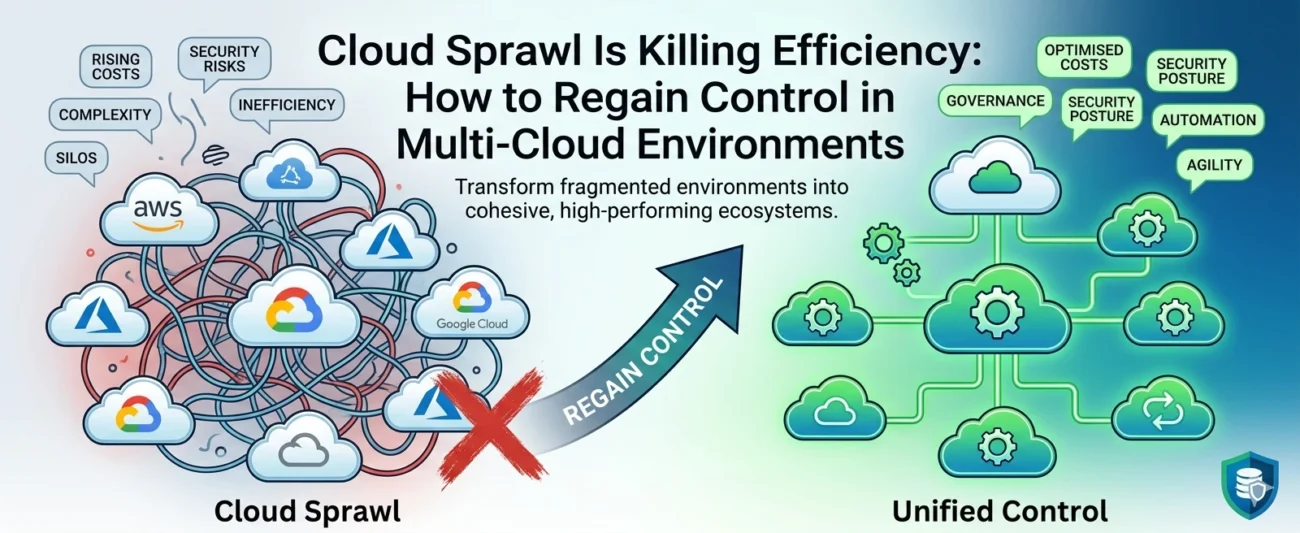
Cloud computing promised agility, scalability, and cost efficiency. For many organisations, it delivered exactly that at least initially. But as businesses expanded across multiple providers, regions, and services, a new problem emerged: cloud sprawl.
What began as a strategic move towards flexibility has, in many cases, become an operational burden. Unchecked growth across multi-cloud environments is now undermining efficiency, inflating costs, and increasing risk. The challenge is no longer adopting the cloud it is controlling it.
What Is Cloud Sprawl?
Cloud sprawl refers to the uncontrolled proliferation of cloud resources, services, and providers within an organisation. It often arises organically: a team adopts one platform for speed, another for specialised capabilities, and yet another through acquisition or experimentation.
Over time, this leads to fragmented environments where workloads, data, and governance are scattered across multiple clouds without a unified strategy.
The result is complexity hidden, growing, and increasingly difficult to manage.
The Hidden Cost of Multi-Cloud Without Control
Rising and Unpredictable Costs
One of the most immediate consequences of cloud sprawl is financial inefficiency. Duplicate resources, overprovisioned instances, and forgotten workloads quietly inflate cloud bills.
Without central visibility, organisations struggle to answer basic questions: What are we spending? Where is the waste? Which services are actually delivering value?
Operational Complexity
Each cloud provider comes with its own tooling, interfaces, and operational models. Managing them in isolation creates silos, slows down teams, and increases the likelihood of configuration errors.
Engineers spend more time navigating platforms than delivering value.
Security and Compliance Risks
Fragmentation makes governance significantly harder. Inconsistent security policies, misconfigured access controls, and unmonitored assets create vulnerabilities.
For organisations operating under regulatory frameworks, maintaining compliance across multiple clouds becomes a serious challenge.
Reduced Agility
Ironically, cloud sprawl often undermines the very agility it was meant to enable. When systems are poorly organised and difficult to understand, deploying changes or scaling workloads becomes slower not faster.
Why Multi-Cloud Isn’t the Problem
It is important to distinguish between multi-cloud as a strategy and cloud sprawl as a failure of execution.
A well-managed multi-cloud environment can offer resilience, avoid vendor lock-in, and allow organisations to leverage best-of-breed services. The issue arises when growth is unstructured and governance is an afterthought.
In other words, multi-cloud works but only with discipline.
Regaining Control: Practical Strategies That Work
Establish Centralised Visibility
You cannot control what you cannot see.
The first step is to implement unified monitoring and reporting across all cloud environments. This includes real-time visibility into resource usage, performance metrics, and cost data.
A single pane of glass whether through a dedicated platform or integrated tooling enables better decision-making and faster issue resolution.
Implement Strong Governance Frameworks
Governance must be proactive, not reactive.
Define clear policies for resource provisioning, naming conventions, tagging, and access control. Standardisation reduces ambiguity and ensures consistency across teams and platforms.
Automation plays a crucial role here. Policy enforcement should be embedded into workflows rather than relying on manual oversight.
Optimise Costs Continuously
Cost optimisation is not a one-off exercise it is an ongoing discipline.
Regularly audit cloud usage to identify idle resources, rightsizing opportunities, and redundant services. Introduce accountability by allocating costs to teams or departments, encouraging more responsible usage.
FinOps practices are increasingly essential in managing multi-cloud environments effectively.
Adopt a Unified Architecture Approach
Fragmentation often stems from inconsistent architectural decisions.
Where possible, standardise on common patterns, frameworks, and deployment models. Containerisation and orchestration technologies can help abstract underlying cloud differences, making workloads more portable and easier to manage.
A consistent architecture reduces cognitive load and simplifies operations.
Strengthen Security Posture
Security must be integrated across all environments, not bolted on individually.
Adopt a zero-trust approach, enforce identity and access management policies uniformly, and ensure continuous monitoring for threats and misconfigurations.
Centralised security controls can significantly reduce risk in complex multi-cloud setups.
The Role of Automation and AI
As environments grow in scale and complexity, manual management becomes unsustainable.
Automation is essential for provisioning, scaling, monitoring, and remediation. Increasingly, organisations are leveraging AI-driven tools to detect anomalies, predict cost trends, and optimise performance in real time.
These capabilities are not just enhancements they are becoming foundational to maintaining control.
Cultural and Organisational Alignment
Technology alone will not solve cloud sprawl.
Teams must align around shared standards, responsibilities, and objectives. This often requires a shift in mindset from isolated decision-making to coordinated governance.
Clear ownership, cross-functional collaboration, and ongoing training are critical to sustaining control over time.
The Future of Multi-Cloud: Controlled, Not Constrained
The goal is not to reduce cloud usage, but to use it intelligently.
Organisations that succeed will be those that strike the right balance leveraging the flexibility of multi-cloud while maintaining strong governance and operational discipline.
Cloud sprawl is not inevitable. It is a symptom of rapid growth without structure.
Conclusion: From Chaos to Clarity
Cloud sprawl may be quietly eroding efficiency, but it is entirely reversible.
By prioritising visibility, governance, and strategic alignment, organisations can transform fragmented environments into cohesive, high-performing ecosystems.
In the end, regaining control is not about limiting innovation it is about enabling it, with clarity, confidence, and control.