For most of the past decade, the dominant question in enterprise cloud strategy was not which cloud platforms to use, but whether to use the cloud at all. That debate is largely settled. The question that now occupies IT leaders and technology strategists is more nuanced: how do you manage data infrastructure that is deliberately, or by accumulation, spread across more than one cloud provider?
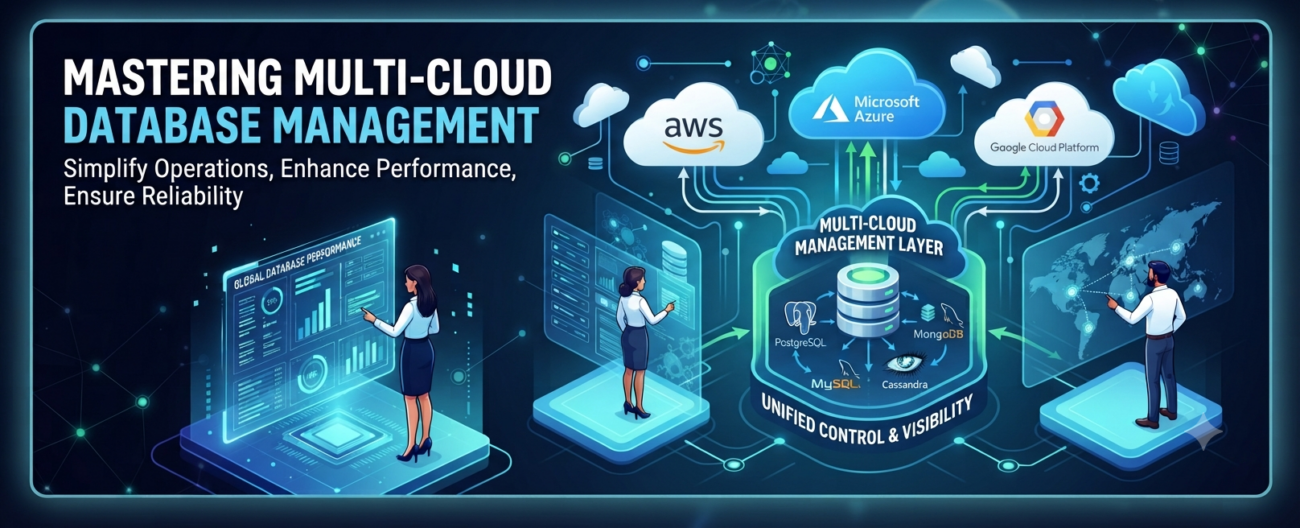
Multi-cloud database management is the discipline of operating, governing, and optimising database workloads that span multiple cloud environments — whether that means AWS and Azure running side by side, a combination of public cloud and private infrastructure, or a portfolio of cloud-native managed database services from different vendors serving different parts of the business. It is a reality for a growing majority of UK enterprises, and the organisations that manage it deliberately tend to fare considerably better than those that allow it to emerge without a coherent strategy.
This article explains what multi-cloud database management is, why it has become so prevalent, what genuine advantages it offers, what challenges it introduces, and what effective management looks like in practice.
Section 1: How Multi-Cloud Became the Default
1.1 It Rarely Starts as a Strategy
For most organisations, multi-cloud is not the outcome of a carefully considered architectural decision. It is the result of accumulation. A business unit selects AWS because its development team has existing expertise there. A subsequent acquisition brings an Azure-hosted application estate into the group. A compliance requirement mandates that certain data remain within a specific infrastructure environment. A SaaS platform that the business depends on runs on Google Cloud. Over time, the organisation finds itself operating database workloads across multiple cloud environments, not because it planned to, but because each decision made sense in its own context.
This origin story matters because it explains why multi-cloud database management is so frequently reactive rather than proactive. The governance frameworks, cost management disciplines, and operational tooling that effective multi-cloud management requires are rarely established before the complexity arrives — they are built in response to problems that have already materialised.
1.2 When It Is a Deliberate Choice
There are organisations for which multi-cloud is a deliberate strategic decision rather than an accumulated outcome, and their reasoning tends to fall into a small number of categories. Avoiding vendor lock-in — the risk of becoming so deeply dependent on a single cloud provider that switching becomes prohibitively expensive or disruptive — is the most frequently cited motivation. Regulatory requirements that mandate geographic or infrastructure diversity for critical systems drive multi-cloud adoption in financial services and other regulated sectors. And the desire to leverage best-of-breed services — using whichever cloud provider offers the strongest capability for a specific database type or workload — leads some organisations to distribute deliberately across providers.
In practice, the line between deliberate strategy and managed accumulation is often blurred. The most effective multi-cloud environments are typically those where an accumulated reality has been brought under deliberate governance — where the organisation has acknowledged the complexity, invested in the tooling and processes to manage it, and established a framework for making future placement decisions consistently.
Section 2: What Multi-Cloud Database Management Actually Involves
2.1 The Scope of the Discipline
Multi-cloud database management encompasses several distinct but interrelated disciplines. At the most fundamental level, it involves operating and maintaining database instances across multiple cloud environments — ensuring that each database is patched, monitored, backed up, and performing within acceptable parameters regardless of which provider hosts it. This operational layer is more complex than managing a single-provider estate because each cloud platform has its own tooling, its own monitoring interfaces, its own backup and recovery mechanisms, and its own operational model.
Beyond day-to-day operations, multi-cloud database management involves data governance — ensuring that the right data is in the right place, that data quality and consistency are maintained across environments, and that the organisation has a clear picture of what data it holds, where it resides, and who has access to it. In a UK GDPR context, this is not merely good practice — it is a compliance obligation. The accountability principle requires organisations to be able to demonstrate that they know where personal data is processed, and a multi-cloud estate without robust data governance makes that demonstration considerably more difficult.
Cost management is a third dimension that deserves its own consideration. Cloud database costs accumulate across compute, storage, data transfer, backup, and ancillary services, and they do so independently on each provider’s billing model. Without active cost management across all platforms simultaneously, multi-cloud estates frequently generate significantly higher spend than single-provider alternatives — not because the underlying costs are necessarily higher, but because the visibility required to optimise them is harder to achieve.
2.2 Data Distribution Patterns
Not all multi-cloud database estates distribute data in the same way, and understanding the pattern in your own organisation is a prerequisite for managing it effectively.
Some organisations maintain entirely separate database workloads on different cloud providers, with no data flowing between them. The AWS databases serve one application; the Azure databases serve another. This separation simplifies governance but limits the ability to derive cross-platform analytical insight and can create data silos that replicate the on-premise problems that cloud migration was intended to solve.
Others maintain a primary database on one cloud provider and use a secondary provider for disaster recovery, read replicas, or specific analytical workloads. This pattern introduces cross-cloud replication, which carries both cost implications — egress charges on data transferred between cloud providers can be substantial — and consistency considerations that must be managed carefully.
A smaller number of organisations genuinely distribute a single database workload across multiple cloud providers, using cross-cloud database platforms such as Cockroach DB or YugabyteDB that are designed to operate across cloud boundaries. This approach offers the most resilience against provider-level disruption but introduces the greatest architectural complexity and is appropriate for a relatively narrow set of workloads where that resilience is genuinely required.
Section 3: Why It Matters
3.1 Operational Resilience & Regulatory Obligation
For UK businesses operating in regulated sectors, multi-cloud database management is not merely an operational preference — it is increasingly a regulatory expectation. The Financial Conduct Authority’s operational resilience framework, reinforced through Supervisory Statement SS2/21, requires firms to identify their important business services and ensure they can remain within impact tolerances even during severe but plausible disruption scenarios. A severe disruption to a single cloud provider’s services — the kind of major regional outage that each of the hyperscale providers has experienced in recent years — is precisely the scenario these frameworks contemplate.
For financial services firms, insurance companies, and other entities subject to the FCA’s and PRA’s operational resilience requirements, demonstrating that critical data infrastructure is not entirely dependent on a single cloud provider is increasingly part of meeting those obligations. The third-party and outsourcing risk management requirements embedded in these frameworks explicitly include cloud service providers within their scope.
The NCSC’s guidance on cloud security and resilience similarly advises organisations to consider the concentration risk associated with relying on a single provider for critical infrastructure, and to design their cloud architecture with provider-level disruption as a scenario to be managed rather than assumed away.
3.2 Avoiding Vendor Lock-In
Vendor lock-in in cloud database environments is more subtle and more binding than it is often appreciated to be. It is not simply that migrating a database from one cloud provider to another is technically difficult — though it often is. It is that over time, applications and integrations accumulate dependencies on cloud-provider-specific services, features, and behaviours that make the theoretical portability of the database itself largely academic.
A database that uses AWS-specific backup formats, is monitored through CloudWatch, integrates with Lambda functions, and uses IAM roles for authentication is not practically portable to Azure even if the underlying database engine is nominally cloud-agnostic. Each of those integrations would need to be replaced, reconfigured, and retested before the migration could be considered complete. The accumulated cost of that work — and the business disruption it would entail — is the real nature of vendor lock-in, and it grows silently with every cloud-native integration added.
Organisations that actively manage multi-cloud environments tend to develop a clearer understanding of their lock-in exposure and can make more informed decisions about where cloud-native integration is worth accepting and where portability should be preserved. This is not an argument for avoiding cloud-native services — many of them are genuinely valuable — but for making the trade-off consciously rather than by default.
3.3 Access to Best-of-Breed Capabilities
The three major hyperscale cloud providers are not equally strong across all database categories. AWS has a particularly deep catalogue of managed database services and a strong ecosystem for data engineering workloads. Microsoft Azure has natural advantages for organisations running Microsoft-stack applications and strong integration with Active Directory and enterprise identity infrastructure. Google Cloud leads in certain areas of analytical processing, particularly through BigQuery, and has strong capabilities in machine learning integration with database workloads.
Organisations that are genuinely free to place workloads on the most appropriate platform — because their governance and operational framework supports multi-cloud operation — can make placement decisions on the basis of capability fit rather than being constrained by a single-provider commitment. For organisations with diverse database workloads spanning transactional, analytical, and real-time requirements, this flexibility has real technical and commercial value.
Section 4: The Challenges
4.1 Operational Complexity
The most immediate challenge of multi-cloud database management is operational complexity. Each cloud provider has its own database services, its own monitoring and alerting tooling, its own security controls, its own patching mechanisms, and its own operational model. A DBA team that is expert in AWS RDS may have limited familiarity with Azure Database for PostgreSQL, and the operational differences — whilst conceptually similar — are practically significant enough to generate errors and gaps in coverage when teams are stretched across both.
This complexity is not insurmountable, but it requires deliberate investment in cross-platform tooling, training, and standardisation. Cloud-agnostic database management platforms — Percona, EnterpriseDB, and similar — provide a unified operational layer across multiple cloud providers’ database services, reducing the cognitive overhead of managing heterogeneous environments. Standardising on shared observability platforms that aggregate metrics, logs, and alerts from all cloud environments into a single interface is one of the most impactful investments a multi-cloud organisation can make.
4.2 Security & Compliance Consistency
Maintaining a consistent security posture across multiple cloud environments is significantly harder than maintaining one within a single provider’s security model. Each cloud provider has its own identity and access management framework, its own network security controls, its own encryption key management service, and its own audit logging capabilities. Ensuring that the security controls applied to databases on AWS are equivalent to those applied to databases on Azure — that access controls are consistently enforced, that encryption standards are uniformly applied, and that audit logs from all environments feed into the same SIEM platform — requires deliberate architecture and ongoing governance effort.
The UK GDPR’s requirement for appropriate technical and organisational measures to protect personal data applies equally regardless of which cloud provider hosts the data. An organisation that has a mature security posture on its primary cloud environment but looser controls on a secondary provider’s environment has a compliance gap that the ICO would not consider acceptable simply because the secondary environment is smaller or less frequently used.
4.3 Data Egress Costs
Data transfer charges — the fees cloud providers charge for data leaving their networks — are one of the most persistently underestimated costs in multi-cloud architectures. When databases on different cloud platforms need to exchange data, every gigabyte transferred carries a charge on the sending side and, potentially, an ingestion charge on the receiving side. For architectures that involve continuous cross-cloud replication, real-time data synchronisation, or large-scale analytical data movement, these charges can accumulate to a level that materially affects the economics of the multi-cloud approach.
Egress costs should be modelled explicitly during architecture design rather than discovered after deployment. Data placement decisions — which data lives on which platform — should factor in the frequency and volume of cross-platform data movement to minimise egress across provider boundaries where the business case for cross-cloud data flow is not strong enough to justify the cost.
4.4 Skills & Talent
Operating a multi-cloud database estate effectively requires expertise across multiple platforms simultaneously, and the supply of engineers with genuine depth across more than one cloud provider’s database ecosystem is limited. Organisations that rely on specialists who are experts in a single cloud platform and extend them into a multi-cloud environment without adequate training or tooling support tend to produce uneven coverage — strong governance on the familiar platform and weaker governance on the less familiar one.
Building multi-cloud capability within a database team is an investment that takes time and requires a structured approach — training, certification, and exposure to production operations on each platform. Managed service providers that specialise in multi-cloud database management can bridge the gap whilst internal capability is being developed, and are worth considering for organisations whose multi-cloud complexity has outpaced their internal expertise.
Section 5: Managing It Well
5.1 Establish a Cloud-Agnostic Data Governance Framework
The foundation of effective multi-cloud database management is a data governance framework that operates above the level of any individual cloud provider. This means maintaining a comprehensive data catalogue that spans all cloud environments, with consistent data classification, ownership attribution, retention policies, and access controls applied uniformly regardless of where data physically resides. The framework should define how data placement decisions are made — which workloads belong on which platform and why — and should be maintained as a living document rather than a one-time exercise.
5.2 Invest in Unified Observability
Monitoring a multi-cloud database estate through each provider’s native tools in isolation produces a fragmented picture that makes cross-environment incident correlation difficult and cross-platform performance comparison impossible. Centralised observability — aggregating metrics, logs, traces, and alerts from all cloud environments into a unified platform — is one of the highest-return investments available to organisations managing multi-cloud database complexity. Platforms such as Datadog, Grafana, and Dynatrace provide this capability across all major cloud providers and significantly reduce the operational overhead of multi-environment management.
5.3 Automate Security Posture Management
Cloud Security Posture Management tools that assess database configurations across all cloud environments against a consistent security baseline — and that alert immediately when configurations deviate — are essential in a multi-cloud context where manual security reviews cannot keep pace with the rate of change. Automation is not a replacement for security judgement, but it is the only scalable mechanism for maintaining visibility of a complex, dynamic multi-cloud security surface.
5.4 Plan for Portability
Preserving a degree of database portability — even where full portability is not the goal — provides meaningful optionality as provider capabilities, pricing, and the organisation’s requirements evolve. This does not mean avoiding cloud-native services; it means being deliberate about which cloud-specific dependencies are accepted and documenting the migration path away from them. Organisations that can articulate a credible exit strategy from their cloud database providers are also organisations that are better positioned to negotiate commercial terms.
Conclusion
Multi-cloud database management is the operational reality of the modern enterprise, whether organisations arrived there deliberately or by accumulation. The businesses that manage it most effectively are those that acknowledge its complexity honestly, invest in the governance, tooling, and skills required to operate it consistently, and make placement and architecture decisions with the full picture — resilience, compliance, cost, and capability — in view.
For UK organisations operating in regulated industries, the stakes are particularly high. Operational resilience requirements, data protection obligations, and the enforcement posture of the FCA and ICO mean that unmanaged multi-cloud complexity that is unmanaged is not merely an operational inconvenience — it is a compliance risk and a business risk. The investment in managing it well is considerably smaller than the cost of managing it poorly.