What Is DataOps? How Businesses Are Using It to Speed Up Decision-Making
Every business today generates data. Sales transactions, customer interactions, operational metrics, financial records the volume is growing faster than most organisations can meaningfully process it. The challenge is no longer collecting data. It is turning that data into reliable, timely insight that business leaders can act on with confidence.
This is precisely the problem that DataOps was designed to solve.
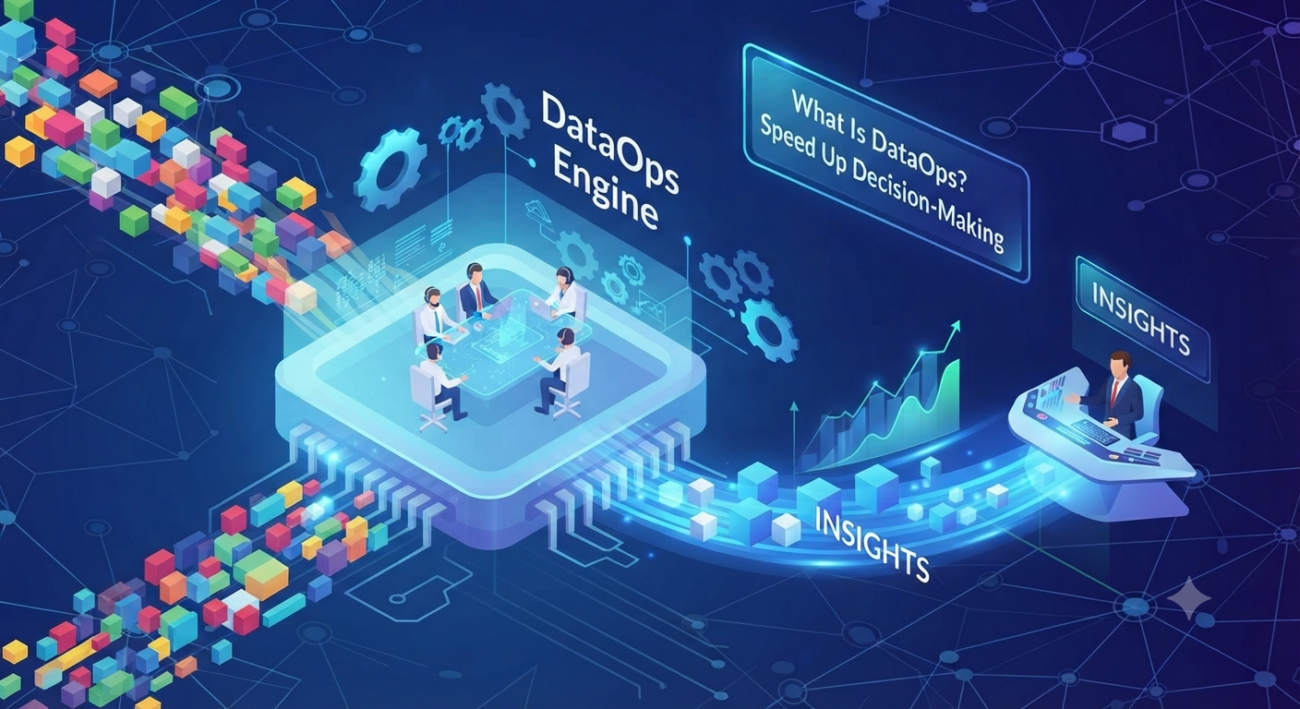
DataOps is not a single tool or a software platform. It is a methodology, a way of managing the entire data lifecycle, from collection and storage through to processing, analysis, and delivery, with the speed, reliability, and quality that modern decision-making demands.
For businesses that are still operating with siloed data teams, manual pipelines, and slow reporting cycles, DataOps represents a fundamental shift in how technology and people work together to create business value. Understanding what it is, how it works, and what it delivers is the first step towards making that shift.
What Is DataOps? A Clear Definition
DataOps short for Data Operations is a collaborative, process-oriented approach to data management that draws on the principles of DevOps, agile methodology, and lean manufacturing. Its goal is to improve the speed, quality, and reliability of data analytics by breaking down the barriers between the teams and systems involved in producing and consuming data.
In practical terms, DataOps means:
- Automating data pipelines so that data flows consistently and reliably from source to insight
- Integrating testing and validation at every stage of the data lifecycle to catch errors early
- Enabling collaboration between data engineers, analysts, database administrators, and business teams
- Monitoring data quality continuously rather than discovering problems after the fact
- Delivering faster, more frequent data releases much as DevOps delivers faster software releases
The analogy with DevOps is deliberate. Just as DevOps transformed software development by aligning development and operations teams around shared goals and automated processes, DataOps transforms data management by aligning data producers and data consumers around a shared commitment to speed and quality.
Why Traditional Data Management Is No Longer Sufficient
To appreciate what DataOps offers, it helps to understand the limitations of the approaches it replaces.
In a traditional data environment, data management is typically characterised by:
Siloed teams. Data engineers build pipelines. Analysts consume data. Database administrators manage infrastructure. Business users submit requests and wait. Each team optimises for its own function, and the handoffs between them are slow and error-prone.
Manual processes. Data extraction, transformation, loading, and validation are often performed manually or through fragile, undocumented scripts. Changes break pipelines. Fixes take days.
Slow feedback cycles. When a report contains incorrect data, the error may not be discovered until a business decision has already been made. Tracing the problem back to its source is time-consuming and disruptive.
Inflexibility. As business requirements change new data sources, new reporting needs, new regulatory obligations traditional data environments struggle to adapt quickly. Every change becomes a project.
Reactive quality management. Data quality issues are discovered downstream, by analysts or business users, rather than caught at the point of ingestion or transformation.
These limitations are not merely inconvenient. They have a direct cost. When decision-makers cannot trust the data they are given, or must wait days for analysis that should take hours, the business is slower, less confident, and less competitive than it should be.
The Core Principles of DataOps
DataOps is built on a set of principles that, taken together, address each of the limitations above.
Continuous Integration and Delivery for Data
DataOps applies the CI/CD model familiar from software development to data pipelines. Changes to pipelines, transformations, and data models are tested automatically before being deployed, reducing the risk of errors reaching production environments. Data is delivered to consumers consistently and frequently, rather than in large, infrequent batches.
Automated Testing and Data Quality Monitoring
Rather than relying on downstream users to identify data quality problems, DataOps embeds automated testing throughout the pipeline. Row count validations, schema checks, referential integrity tests, and business rule validations run automatically at each stage. Issues are caught and flagged immediately before they reach the analysts and decision-makers who depend on the data.
Collaboration Across Data Teams
DataOps breaks down the silos between data engineering, analytics, database administration, and business functions. Shared tooling, shared visibility, and shared accountability create an environment where problems are identified and resolved collectively rather than escalated through layers of organisational hierarchy.
Observability and Monitoring
DataOps environments are instrumented for observability pipeline performance, data freshness, error rates, and quality metrics are visible in real time. Teams can see exactly what is happening across the data estate at any moment, rather than discovering problems through user complaints.
Agile Data Development
DataOps adopts agile principles iterative development, short feedback cycles, and continuous improvement in the context of data management. Rather than delivering large data projects over months, DataOps teams work in sprints, delivering incremental improvements that create business value continuously.
How Businesses Are Using DataOps to Speed Up Decision-Making
The real-world impact of DataOps is most clearly understood through the specific ways it changes how decisions get made.
Faster Access to Reliable Data
In a DataOps environment, data pipelines are automated, monitored, and continuously validated. Business leaders do not wait for a manual extract-transform-load process to run overnight. They access dashboards and reports that reflect near-real-time data, with confidence in its accuracy.
For an operations director assessing supply chain performance, a finance director reviewing cash flow, or a sales director tracking pipeline conversion, the difference between data that is twelve hours old and data that is two hours old with verified quality can be the difference between a timely decision and a reactive one.
Reduced Time from Question to Insight
One of the most significant bottlenecks in traditional data environments is the time it takes to answer a new business question. Identifying the relevant data sources, building a query or pipeline, validating the output, and delivering the result can take days or weeks when done manually.
DataOps reduces this cycle dramatically. With well-managed, well-documented data pipelines and a collaborative team structure, new analytical questions can be answered in hours rather than days. Business agility improves in direct proportion.
Higher Confidence in Data Quality
Decision-makers are only as effective as the data they trust. When data quality is uncertain when there is doubt about whether a figure is current, accurate, or complete leaders hedge, delay, or make decisions based on instinct rather than evidence.
DataOps eliminates this uncertainty by making data quality visible, measurable, and accountable. When every pipeline has automated quality checks and every anomaly is flagged and resolved proactively, the data that reaches decision-makers can be trusted completely.
Scalability Without Proportional Cost
As businesses grow, so does their data. New customers, new products, new markets, new regulatory requirements all generate additional data that must be managed, processed, and made available. In a traditional environment, scaling data operations typically means scaling headcount proportionally.
DataOps, through automation and standardised, reusable pipeline components, allows data operations to scale with the business without a corresponding increase in manual effort. The systems do more; the teams focus on higher-value activities.
Faster Compliance and Audit Readiness
For UK businesses subject to GDPR, FCA regulation, or sector-specific compliance frameworks, the ability to demonstrate data lineage, access controls, and audit trails is increasingly important. DataOps builds governance into the data pipeline from the outset tracking where data comes from, how it has been transformed, who has accessed it, and when. Audit readiness becomes a continuous state rather than a periodic scramble.
DataOps and Cloud Infrastructure: A Natural Partnership
DataOps and cloud infrastructure are deeply complementary. The elasticity, automation capabilities, and managed service ecosystem of cloud platforms AWS, Microsoft Azure, and Google Cloud provide the ideal foundation for DataOps practices.
Cloud-native data services such as Amazon Redshift, Azure Synapse Analytics, and Google BigQuery provide scalable, high-performance data warehousing. Managed database services eliminate infrastructure management overhead. Cloud-native pipeline tools, orchestration services, and monitoring platforms provide the automation and observability that DataOps requires.
For businesses that have already invested in cloud migration, DataOps is the logical next step the methodology that unlocks the full value of the cloud infrastructure they have built.
For businesses yet to migrate, aligning cloud migration with DataOps adoption from the outset creates a more cohesive, future-ready data environment than migrating infrastructure alone.
DataOps and Database Management: The Foundation That Cannot Be Ignored
DataOps depends entirely on the health, performance, and reliability of the underlying database estate. Automated pipelines, continuous testing, and real-time analytics all assume a database environment that is well-managed, well-optimised, and consistently available.
This is where database management and DataOps intersect in practice. A database that is poorly indexed, intermittently unavailable, or running without proper performance monitoring creates a fragile foundation for even the most sophisticated DataOps architecture. Conversely, a well-managed database estate with continuous monitoring, proactive optimisation, robust security, and reliable backup and recovery enables DataOps practices to deliver their full potential.
For businesses building DataOps capability, investment in database management is not separate from investment in DataOps. It is foundational to it.
Is Your Business Ready for DataOps?
DataOps is not exclusively the domain of large enterprises with dedicated data engineering teams. Businesses of all sizes can benefit from DataOps principles, scaled appropriately to their environment and maturity.
The right starting point depends on your current situation. Consider the following indicators:
You may be ready to begin your DataOps journey if:
- Business leaders regularly wait days for data they need to make decisions
- Data quality issues surface frequently in reports or dashboards
- Your data team spends more time fixing pipelines than creating business value
- Different teams or systems produce conflicting versions of the same metric
- Your cloud or database infrastructure is in place but not fully utilised for analytics
- Compliance and audit requirements are creating manual overhead in your data processes
If any of these resonate, a structured DataOps assessment is a productive first step mapping your current data estate, identifying the highest-value improvement opportunities, and building a prioritised roadmap towards faster, more reliable data-driven decision-making.
What to Look for in a DataOps Partner
Implementing DataOps successfully requires a partner with expertise that spans cloud infrastructure, database management, data engineering, and business process understanding. The right partner will:
- Assess your current data estate honestly, identifying both capability gaps and existing strengths
- Design a DataOps roadmap aligned to your specific business objectives not a generic framework
- Bring deep technical expertise across cloud platforms and database technologies
- Build solutions that your internal teams can operate, understand, and evolve
- Provide ongoing support and optimisation as your data needs change and grow
The combination of cloud integration expertise, database management depth, and a commitment to practical, scalable solutions is what distinguishes a capable DataOps partner from a consultancy that applies a standard playbook regardless of context.
Data Speed Is Business Speed
In today’s competitive environment, the organisations that make better decisions faster have a structural advantage over those that do not. DataOps is the methodology that makes better, faster decisions consistently achievable not through occasional analytical effort, but through a systematically managed data environment that delivers reliable insight as a continuous operational output.
For businesses that are serious about using technology as a growth driver rather than a cost centre, DataOps is not a future aspiration. It is a present-tense operational priority.
The starting point is an honest assessment of where your data operations stand today and a clear-eyed view of what it would mean for your business if every decision-maker had reliable, timely, trusted data at their fingertips.