Choosing a relational database is one of those decisions that quietly shapes a project for years. Get it right, and your team barely thinks about it again. Get it wrong, and you’re wrestling with migrations, workarounds, and awkward compromises long after the original decision-makers have moved on. For most development teams in the UK and beyond, the choice usually comes down to two open-source stalwarts: PostgreSQL and MySQL. Both are mature, battle-tested, and free to use, yet they’ve evolved rather different personalities over the decades. This article sets out the key technical differences to help your team make an informed choice.
Architecture and Data Integrity
This is where the two databases diverge most meaningfully.
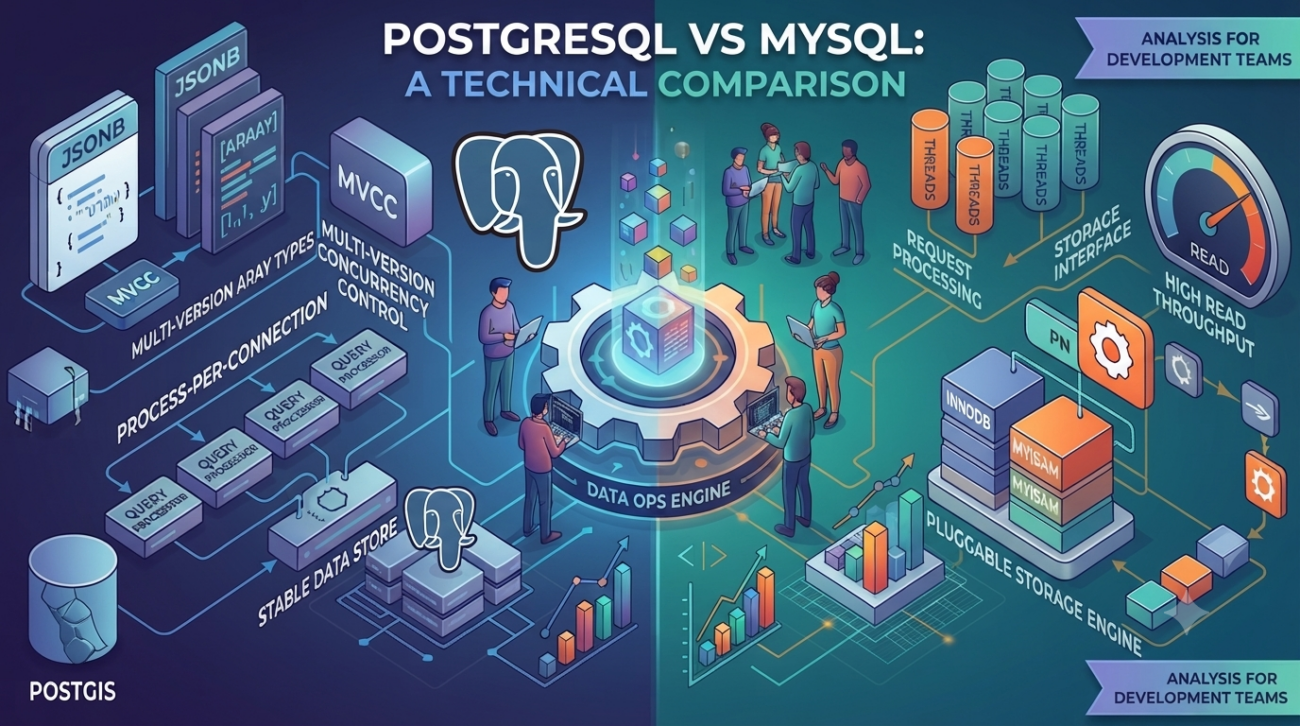
PostgreSQL is what’s known as an object-relational database. It was built from the ground up with strict adherence to the SQL standard and ACID compliance (Atomicity, Consistency, Isolation, Durability) baked into its core storage engine. There’s no need to choose a storage engine in PostgreSQL, because it only has one, and that engine has always supported full transactional integrity, including for DDL statements (schema changes) wrapped in transactions.
MySQL takes a different approach, offering pluggable storage engines. The default engine, InnoDB, is fully ACID-compliant and has been the standard choice for most modern MySQL deployments since MySQL 5.5. However, MySQL also supports other engines like MyISAM, which doesn’t support transactions or foreign keys at all. This flexibility can be useful in niche cases, but it also means that “MySQL” as a concept covers a wider spread of behaviour than “PostgreSQL” does, and teams need to be deliberate about which engine they’re actually using.
For data integrity purposes, PostgreSQL’s consistency is often seen as an advantage: what you read in the documentation is what you get, without engine-specific caveats.
SQL Standards Compliance and Advanced Features
PostgreSQL has a well-earned reputation for taking SQL standards seriously and extending them thoughtfully. It supports:
- Common Table Expressions (CTEs) and recursive queries
- Window functions, which arrived in PostgreSQL well before MySQL supported them properly
- Full JSON and JSONB support, with JSONB offering indexed, binary-stored JSON that performs impressively well for semi-structured data
- Native array and hstore (key-value) data types
- Custom data types, operators, and functions, including support for writing stored procedures in multiple languages (PL/pgSQL, PL/Python, PL/Perl, and others)
- Table inheritance and sophisticated partitioning
- Extensions, such as PostGIS for geospatial data, which is genuinely best-in-class and used widely across GIS and mapping applications
MySQL has closed much of this gap over the years, particularly from version 8.0 onwards, which introduced window functions, CTEs, and improved JSON support. It’s a much more capable database than it was a decade ago. That said, PostgreSQL generally remains ahead on the depth and maturity of its advanced features, and its extension ecosystem is difficult to match.
Performance
Performance comparisons between the two are notoriously slippery, because so much depends on workload, configuration, and query patterns. Broadly speaking, though:
MySQL tends to be faster for simple, read-heavy workloads. Straightforward SELECT queries against well-indexed tables, particularly in web applications with lots of simple reads, often perform very well on MySQL, especially with InnoDB tuned appropriately. This is part of why MySQL became so dominant for content management systems and e-commerce platforms.
PostgreSQL tends to handle complex queries and concurrent write workloads better. Its query planner is generally regarded as more sophisticated, and it copes well with complex joins, subqueries, and analytical workloads. Its approach to concurrency, using Multi-Version Concurrency Control (MVCC), allows readers and writers to avoid blocking one another in most cases, which can be a real boon under heavy concurrent load.
Neither database is simply “faster” than the other in absolute terms. The honest answer is that your specific workload matters more than any generic benchmark, and it’s worth testing both against realistic data and query patterns before committing.
Scalability and Replication
MySQL has traditionally had the edge in horizontal scaling and replication simplicity, which is a large part of why it became the backbone of huge web platforms. Its replication setup is straightforward, and tools like Vitess (used by YouTube, among others) have extended it to handle sharding at enormous scale.
PostgreSQL’s replication story has improved enormously in recent years, with streaming replication, logical replication, and a strong ecosystem of tools such as Patroni and Citus for scaling out. It’s no longer fair to say PostgreSQL lags meaningfully behind on this front, but MySQL’s tooling here is arguably a touch more battle-tested for very large-scale, sharded deployments.
Ease of Use and Learning Curve
MySQL has generally been considered the more approachable option for newcomers. Its documentation is straightforward, its defaults are more forgiving, and there’s a vast amount of community content, tutorials, and Stack Overflow answers built up over its 30-year history. For junior developers or small teams wanting to get moving quickly, this matters.
PostgreSQL has a steeper initial learning curve, partly because it offers more configuration options and expects a slightly firmer grasp of relational database concepts. However, many developers find that this pays off over time, as PostgreSQL’s stricter, more standards-compliant behaviour tends to catch mistakes earlier rather than allowing subtly incorrect data to creep in silently.
Ecosystem and Tooling
Both databases enjoy excellent support from ORMs (such as Django’s ORM, SQLAlchemy, and Prisma), cloud providers (AWS RDS and Aurora, Google Cloud SQL, Azure Database), and monitoring tools. It’s genuinely difficult to go wrong here with either choice.
Worth noting: PostgreSQL underpins Supabase, a popular open-source Firebase alternative, and has become something of a default choice for newer developer tooling and startups. MySQL remains dominant in WordPress (which still powers a substantial slice of the web) and continues to be the safe, well-understood choice for countless enterprise applications built up over the years.
When to Choose Which
Choose MySQL if:
- You’re building a straightforward web application with predominantly read-heavy workloads
- Your team is less experienced with databases and wants gentler defaults
- You need it to integrate with an existing MySQL-based stack (WordPress, older LAMP applications)
- You need proven, well-documented horizontal scaling at very large scale
Choose PostgreSQL if:
- Your application involves complex queries, analytics, or reporting
- Data integrity and standards compliance are top priorities
- You need advanced data types (JSON, arrays, geospatial data via PostGIS)
- You anticipate needing custom functions, stored procedures, or extensions
- You want a single, consistent transactional engine without engine-selection complexity
A Final Thought
There’s no universally “better” database here, only a better fit for a given team and project. Many organisations use both, choosing MySQL for simpler services and PostgreSQL for anything requiring more analytical horsepower or data integrity guarantees. What matters most is understanding your actual workload, being honest about your team’s expertise, and testing your assumptions with realistic data before locking in a decision that will likely outlive several product roadmaps. Whichever you choose, both are excellent, well-supported, thoroughly proven pieces of software, and neither choice is one you’ll need to apologise for.