Oracle RAC vs Oracle SE2: Which Is Right for Mid-Market Businesses?
When mid-market businesses evaluate Oracle Database, the conversation often turns to a familiar fork in the road: Oracle Real Application Clusters (RAC) or Oracle Standard Edition 2 (SE2). Both sit within Oracle’s ecosystem, but they’re built for very different scales of ambition, budget, and operational complexity. Getting this decision right matters, because Oracle licensing is notoriously expensive to reverse once you’re committed. This article breaks down the technical and commercial realities to help mid-market teams choose sensibly.
What Each Option Actually Is
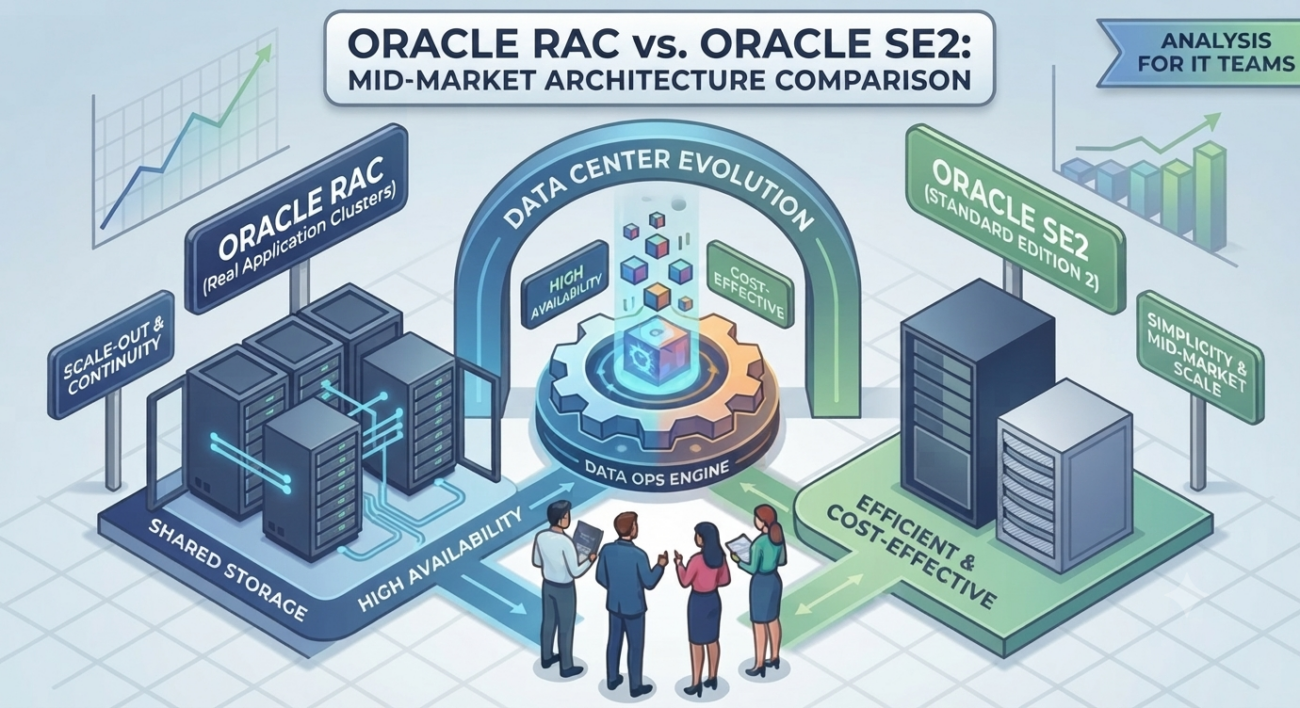
Oracle SE2 is Oracle’s entry-level, lower-cost edition of the database, aimed squarely at smaller deployments. It’s a single instance product, meaning it runs on one server at a time (though it does support a basic two-node failover cluster for high availability, within limits). SE2 caps out at 2 CPU sockets per server and can use a maximum of 16 CPU threads across the database, which Oracle enforces through licensing terms rather than hard technical limits.
Oracle RAC is Oracle’s clustering technology, allowing multiple database instances to run simultaneously across multiple servers, all accessing the same underlying data. It’s designed for organisations that need extreme availability, near-zero downtime, and the ability to scale out horizontally by adding more nodes to the cluster rather than simply making one server bigger. RAC is only available with Oracle Enterprise Edition, which carries a significantly higher licence cost, and RAC itself is a separately licensed option on top of that.
Cost: The Elephant in the Room
For most mid-market businesses, cost is the decisive factor, and the gap here is substantial.
SE2 is licensed per socket (up to 2 sockets), and its list price is a small fraction of Enterprise Edition. There’s no separate RAC licence fee to worry about, and support costs scale accordingly.
RAC requires Enterprise Edition as a prerequisite, which is priced per processor core rather than per socket, and typically costs several times more than SE2 per unit of compute. On top of that, the RAC option itself carries its own additional licensing fee, again priced per core. For a business running, say, an 8-core database server, the combined Enterprise Edition plus RAC licensing can run into hundreds of thousands of pounds, before support and maintenance are even factored in. SE2 for a comparable workload would typically cost a small fraction of that.
This isn’t a minor difference — it’s often an order of magnitude, and it’s the single biggest reason most mid-market businesses either stick with SE2 or look at RAC only when genuinely forced to.
Availability and Downtime Tolerance
This is where the technical trade-off becomes real.
SE2’s built-in high availability option (Oracle Clusterware-based failover) provides good but not seamless protection. If the active node fails, the standby node takes over, but there’s a brief interruption while failover occurs — typically measured in seconds to a couple of minutes, depending on configuration. For most mid-market applications, this level of downtime tolerance is entirely acceptable. A short blip during a genuine hardware failure, which is a rare event to begin with, is a reasonable trade-off for the cost savings.
RAC, by contrast, is built for continuous availability. Because multiple instances are active simultaneously against the same database, a node failure typically results in no observable interruption at all — connections simply fail over to a surviving node, often within milliseconds, with application-level continuity features minimising disruption further. If your business genuinely cannot tolerate even brief interruptions — think trading platforms, critical national infrastructure, or 24/7 global operations with strict service level agreements — this capability alone can justify RAC’s cost.
The honest question for most mid-market businesses is: how much would a two-minute outage actually cost you, and how often would it realistically happen? For the majority, the answer doesn’t come close to justifying RAC’s price premium.
Scalability
SE2 scales vertically — you can grow it by adding more resources (memory, faster storage) to its capped CPU allowance, but you cannot scale it out across additional servers, and the socket cap is a hard ceiling on how large a single deployment can grow.
RAC scales horizontally by design. Need more capacity? Add another node to the cluster. This is genuinely valuable for businesses with unpredictable or rapidly growing workloads, since it avoids the need for disruptive “rip and replace” upgrades when a single server’s ceiling is reached.
For most mid-market businesses, though, workload growth is gradual and predictable enough that SE2’s vertical scaling headroom, combined with sensible capacity planning, is sufficient for years of runway.
Operational Complexity
This is an underappreciated factor. RAC is not simply “SE2 but on more servers” — it introduces meaningfully greater operational complexity:
- Cluster interconnects, shared storage (typically via Oracle ASM), and network configuration all need careful design and ongoing management
- Troubleshooting distributed database issues requires specialist RAC expertise, which is a narrower and more expensive skill set to hire or contract for
- Patching and upgrades require careful coordination across nodes to avoid downtime
- More moving parts generally mean more potential failure points, even though the architecture is designed to tolerate them
SE2, by comparison, is operationally straightforward. Most mid-market IT teams can manage it competently without specialist Oracle clustering expertise, which matters a great deal when you’re not running a large, dedicated database administration function.
Feature Availability
It’s also worth noting that SE2 lacks access to several Enterprise Edition features that some businesses assume come as standard — including Oracle Partitioning, Advanced Compression, and various performance and security packs, all of which are separately licensed Enterprise Edition options regardless of whether RAC is involved. If your business genuinely needs one of these specific features, that alone might tip the calculation towards Enterprise Edition, independent of the RAC decision.
When SE2 Makes Sense
- Your business can tolerate brief failover windows during rare hardware failures
- Budget is a genuine constraint, and Oracle licensing costs need to stay proportionate to business size
- Your workload growth is steady and predictable, comfortably within SE2’s socket-based ceiling
- You don’t have (or don’t want to hire) specialist Oracle clustering expertise in-house
- You don’t require Enterprise Edition-only features like advanced partitioning or compression
When RAC Makes Sense
- Downtime has a genuinely high, quantifiable cost to the business — financial, reputational, or regulatory
- You operate in a sector with strict continuous-availability requirements
- Your workload is large or unpredictable enough that horizontal scaling delivers real operational value
- You already have, or can justify hiring, specialist Oracle DBA expertise
- The licensing cost is proportionate to the risk you’re mitigating, and you’ve done the maths properly rather than assuming “bigger is better”
A Practical Recommendation
For the overwhelming majority of mid-market businesses, Oracle SE2 is the sensible default. It covers genuine business needs at a fraction of the cost, with high availability that’s good enough for realistic failure scenarios, and without demanding a specialist skill set your team may not have. RAC is a powerful and genuinely valuable technology, but it solves a problem — near-zero downtime at scale — that most mid-market businesses don’t actually have, or can’t justify the cost of solving in this particular way.
Before committing either way, it’s worth running the numbers properly: model out realistic downtime costs against SE2’s failover window, get accurate licensing quotes for both paths, and be honest about your team’s operational capacity. Oracle licensing decisions are expensive to unwind, so a bit of rigour upfront pays for itself many times over.