Meta Title
How to Make Your Data AI-Ready Without Rebuilding Everything | Practical Guide
Meta Description
Learn how to make your data AI-ready without rebuilding your systems. Discover practical steps to improve data quality, integration, and accessibility for AI success.
Artificial intelligence is no longer a future ambition; it’s a present-day priority. From automation to predictive analytics, organisations are under increasing pressure to adopt AI-driven capabilities.
However, one major concern holds many back: the assumption that making data “AI-ready” requires a complete overhaul of existing systems.
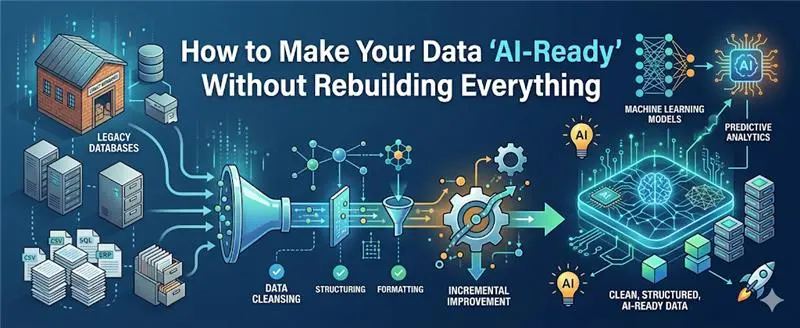
The reality is far more practical. You don’t need to rebuild everything. With the right approach, you can prepare your data for AI using what you already have by improving structure, quality, and accessibility.
Why Most Data Isn’t AI-Ready
Fragmented and Siloed Data
In many organisations, data is spread across multiple systems, departments, and formats. This fragmentation makes it difficult for AI models to access a consistent, unified dataset, thereby limiting their effectiveness.
Poor Data Quality
AI systems rely on accurate, clean, and consistent data. Unfortunately, many datasets contain duplicates, missing values, or inconsistencies. Without addressing these issues, even the most advanced AI tools will produce unreliable results.
Lack of Context and Structure
Raw data without proper labelling, metadata, or categorisation lacks meaning. AI systems need context to interpret information correctly, and unstructured or poorly organised data reduces their ability to generate useful insights.
Limited Accessibility
Even when data exists, it is often not easily accessible. Restrictions, legacy systems, or inefficient pipelines can prevent timely access, slowing down AI adoption and limiting real-time capabilities.
How to Make Your Data AI-Ready Without a Full Rebuild
Start with Data Discovery and Audit
The first step is understanding what data you already have. Conducting a data audit helps identify where your data resides, how it is structured, and what gaps exist. This provides a clear foundation without requiring immediate system changes.
Improve Data Quality Incrementally
Rather than attempting a large-scale clean-up, focus on gradual improvements. Prioritise high-value datasets and address issues such as duplication, inconsistencies, and missing fields. Even small improvements can significantly enhance AI outcomes.
Introduce Lightweight Data Integration
You don’t need to replace your entire infrastructure to unify data. Modern integration approaches, such as APIs and data virtualisation, allow you to connect systems and create a unified view without physically moving all data into one place.
Add Structure and Metadata
Enhancing your data with metadata, tagging, and standard formats makes it far more usable for AI. This step provides the context AI systems need to interpret information correctly, without changing the underlying data sources.
Enable Scalable Data Pipelines
AI depends on timely and consistent data flows. By introducing scalable data pipelines, you can automate data movement and transformation, ensuring data is available when needed without manual intervention.
Strengthen Data Governance
Clear governance ensures your data remains reliable, secure, and compliant. Establishing standards for data usage, ownership, and quality helps maintain consistency as your AI capabilities grow.
The Key Insight: AI-Ready Data Is About Evolution, Not Replacement
A common misconception is that AI requires a completely new data ecosystem. In reality, it’s about making your existing data more usable.
By improving quality, adding structure, and enabling better access, you can unlock AI capabilities without the cost and disruption of rebuilding your systems from scratch.
Final Thoughts
Becoming AI-ready doesn’t have to be a massive transformation project. It’s a strategic, step-by-step process that builds on what you already have.
Organisations that take this approach can:
- Accelerate AI adoption
- Reduce implementation costs
- Minimise operational disruption
- Deliver faster, more reliable insights
The goal isn’t to start over.
It’s to make your data work smarter.