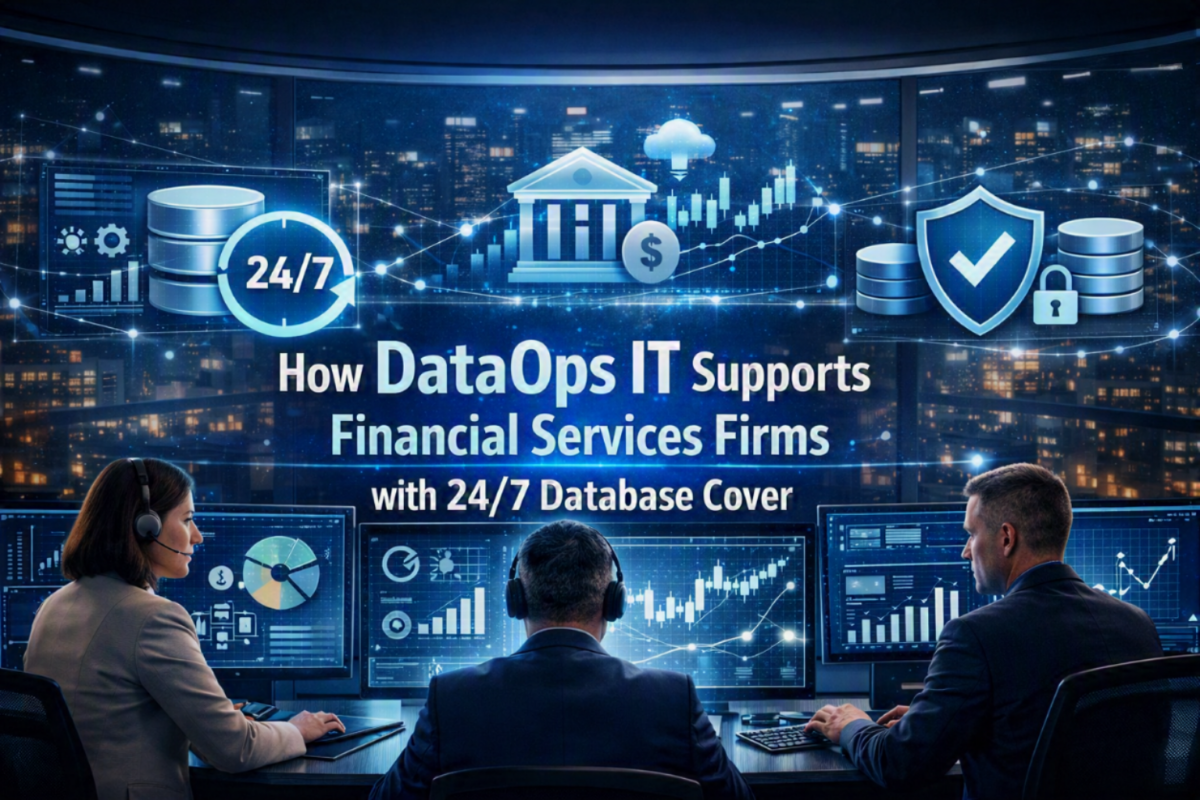
How DataOps IT Supports Financial Services Firms with 24/7 Database Cover
Financial services firms operate under a level of scrutiny most industries never encounter. Trading platforms cannot pause for a maintenance window during market hours. Payment systems cannot go dark overnight while an engineer sleeps. Regulators expect audit trails that are complete, accurate, and available on demand. Against this backdrop, the database isn’t just infrastructure — it’s the operational backbone of the entire business. When it goes down, so does the firm’s ability to function.
This is the environment DataOps IT support is built for: continuous, round-the-clock database cover designed specifically around the pressures financial services firms face.
Why Financial Services Need a Different Standard of Cover
Most industries can tolerate a short outage. A retailer’s website going down for twenty minutes is inconvenient. A bank’s core ledger becoming unavailable for twenty minutes is a different category of problem entirely — one with regulatory, reputational, and potentially systemic consequences.
Several factors make financial services particularly unforgiving when it comes to database reliability:
- Markets don’t sleep. Global trading, FX, and payments operations span time zones, meaning there’s rarely a genuinely “quiet” period in which to carry out risky maintenance.
- Regulatory obligations are constant. Frameworks such as FCA requirements, PCI DSS, and SOX demand accurate, tamper-evident records at all times, not just during business hours.
- Data volumes and complexity are high. Transactional systems, risk models, and reporting pipelines often depend on the same underlying data, so a single database issue can ripple across multiple business functions simultaneously.
- Downtime has a direct cost. Every minute a trading or payments system is unavailable can translate into measurable financial loss, not just inconvenience.
Given these pressures, “we’ll look at it in the morning” simply isn’t an acceptable answer. Firms need database support that operates on the same continuous basis as the markets and systems they serve.
What 24/7 Database Cover Actually Involves
Round-the-clock DataOps support isn’t a single service — it’s a combination of proactive and reactive capabilities working together.
Continuous monitoring and alerting
Databases are watched constantly for early warning signs: slow-running queries, replication lag, unusual load patterns, or storage approaching capacity. Catching these signals early is what turns a potential outage into a routine fix.
Rapid incident response
When something does go wrong, response time matters enormously. DataOps teams providing genuine 24/7 cover work to defined response and resolution targets, with an on-call structure that ensures a qualified engineer — not a junior generalist — is reachable at any hour.
Backup, recovery, and disaster recovery testing
Backups that have never been tested are a false sense of security. Proper cover includes regularly rehearsed recovery procedures, so that if a genuine failure occurs, restoring service is a known, practised process rather than an improvised one under pressure.
Performance tuning as an ongoing discipline
Rather than waiting for performance to degrade to the point of complaint, DataOps support treats tuning — indexing, query optimisation, capacity planning — as continuous maintenance, not a one-off project.
Security and compliance monitoring
For financial services specifically, this includes tracking access patterns, flagging anomalous queries, and maintaining the kind of audit logging that regulators expect to see produced automatically, not assembled retrospectively.
Change management with minimal disruption
Schema changes, patching, and upgrades are planned and executed in ways that avoid disrupting live trading or payment operations — often using techniques such as rolling updates or blue-green deployments to keep systems available throughout.
The Business Case, Beyond Compliance
It’s tempting to frame 24/7 database cover purely as a regulatory box to tick, but the business case extends well beyond compliance.
Firms that invest in continuous DataOps support typically see:
- Fewer and shorter outages, because problems are caught before they escalate rather than discovered after the fact.
- Lower long-term costs, since proactive maintenance is consistently cheaper than emergency firefighting and the reputational damage that follows a visible failure.
- Greater confidence from clients and regulators, who increasingly expect evidence of operational resilience as a baseline, not a differentiator.
- Freed-up internal teams, allowing in-house engineers to focus on product and platform development rather than being permanently on call themselves.
What to Look for in a DataOps Partner
Not all “24/7 support” is equal. Firms evaluating a DataOps provider for financial services work should look closely at:
- Sector experience. Understanding of regulatory obligations specific to financial services, not just general database administration.
- Genuine around-the-clock coverage. A rota of qualified engineers across time zones, rather than a single on-call person stretched thin.
- Clear, measurable service levels. Defined response and resolution targets, with transparent reporting against them.
- Proven recovery capability. Evidence of regularly tested backups and disaster recovery plans, not just a policy document.
- Security-first practices. Encryption, access controls, and audit logging built in as standard, not offered as an add-on.
The Bottom Line
For financial services firms, database reliability isn’t a technical nicety — it’s foundational to trust, compliance, and continuity of business. DataOps IT support built around 24/7 database cover exists precisely because the cost of getting this wrong, even briefly, is far higher in this sector than almost any other. Firms that treat continuous database support as a core operational investment, rather than a background cost, are the ones best placed to operate reliably in markets that genuinely never stop.