Database Architecture Design: Why Getting It Right Saves Businesses Thousands
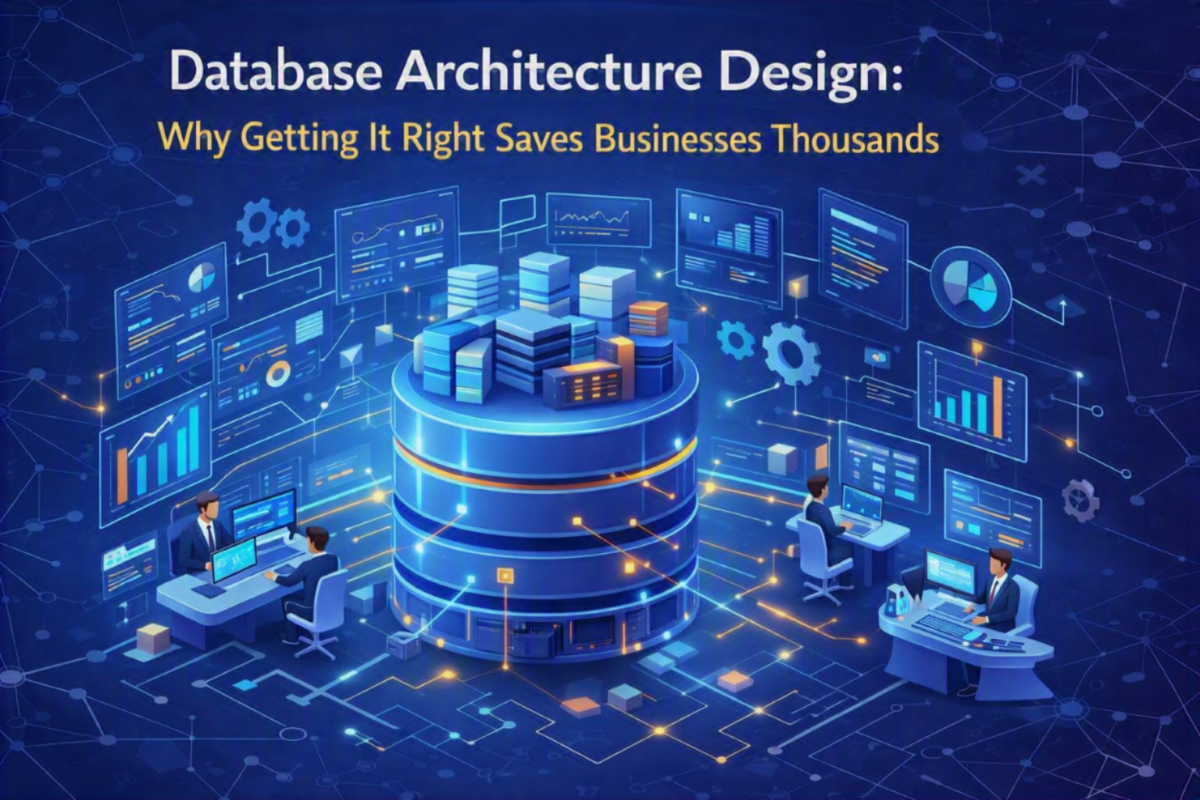
Ask any experienced engineer what quietly determines the long-term cost of a software product, and many will point not to the front-end framework or the choice of cloud provider, but to something far less glamorous: the database architecture. It rarely gets a mention in a pitch deck, and it’s easy for founders and product managers to treat it as a solved problem once the first few tables are in place. Yet poor database design is one of the most common — and most expensive — mistakes a growing business can make.
The Hidden Cost of “Good Enough for Now”
Databases are unusual among technical decisions in that their consequences compound. A messy front-end component can be rewritten in an afternoon. A poorly indexed table with ten million rows, referenced by dozens of services, cannot. What begins as a shortcut taken under deadline pressure often becomes a permanent fixture, because by the time anyone notices the problem, too much depends on it to change course easily.
This is why the true cost of bad architecture rarely appears on day one. It shows up months or years later, in the form of:
- Slow queries that get slower. A table that performs fine with a thousand rows can grind to a halt at a million, particularly if indexes were never planned properly.
- Emergency scaling costs. Businesses often respond to performance problems by throwing larger servers at them, rather than fixing the underlying schema — a costly and temporary fix.
- Data integrity issues. Duplicated, inconsistent, or orphaned data leads to reporting errors, customer complaints, and hours of manual clean-up.
- Developer time lost to workarounds. Engineers spend disproportionate time writing complex queries or additional application logic to compensate for a schema that doesn’t reflect how the business actually works.
- Painful, high-risk migrations. Restructuring a live production database is one of the riskiest projects a technical team can undertake, and it becomes more difficult the longer it’s delayed.
None of these costs are abstract. They translate directly into engineering hours, infrastructure spend, and, in the worst cases, lost customers.
What Good Database Architecture Actually Looks Like
Good architecture isn’t about picking the most fashionable database technology. It’s about a set of disciplined decisions made early, and revisited deliberately as the business grows.
1. Modelling the domain, not just the data
The most common root cause of database problems isn’t a missing index — it’s a schema that doesn’t reflect how the business actually operates. Time spent properly understanding entities, relationships, and business rules before writing a single CREATE TABLE statement pays for itself many times over. This is where normalisation earns its reputation: structuring data to minimise redundancy and protect consistency, whilst knowing precisely when to deviate from it for performance reasons.
2. Choosing the right type of database for the job
Relational databases remain the sensible default for most transactional business systems, thanks to their strong consistency guarantees. But not every problem is relational. Document stores suit rapidly evolving, loosely structured data; key-value stores excel at caching and session management; and graph databases are purpose-built for deeply interconnected data such as social networks or recommendation engines. Choosing the wrong category of database for the workload is a decision that’s expensive to reverse later.
3. Planning for growth from the outset
A schema that works beautifully for a hundred users can become a serious liability at a hundred thousand. Thinking ahead about indexing strategy, partitioning, read replicas, and archiving policy — even if they aren’t implemented immediately — means the business isn’t caught out when growth accelerates.
4. Enforcing data integrity at the database layer
Constraints, foreign keys, and validation rules should live in the database itself wherever possible, not solely in application code. Application logic changes; the database is often the last line of defence against corrupted or inconsistent data.
5. Documenting decisions, not just structures
An entity-relationship diagram tells you what the schema looks like. It doesn’t tell you why a particular table was denormalised, or why a certain field allows nulls. Recording the reasoning behind architectural decisions saves future engineers from either repeating mistakes or cautiously undoing sensible trade-offs they don’t understand.
Getting Architecture Right Without Overengineering
None of this is an argument for over-engineering a database before a business even knows its product-market fit. Spending months designing an elaborate schema for a product that might pivot entirely within a year is its own kind of waste. The goal isn’t perfection; it’s proportionate diligence — enough thought given to structure, relationships, and growth that the business isn’t forced into an expensive rebuild the moment it succeeds.
In practice, this means:
- Investing real time in schema design before writing production code, even for early-stage products.
- Involving someone with genuine database expertise, even briefly, rather than leaving architecture entirely to whoever is available.
- Reviewing the schema at clear growth milestones, rather than waiting for performance problems to force the issue.
- Treating migrations as a normal, planned part of a database’s lifecycle, not an emergency response.
The Bottom Line
Database architecture is one of those disciplines where the value of getting it right is almost invisible because when it’s done well, nothing goes wrong. There’s no dramatic outage to point to, no viral complaint from a frustrated customer, just a system that quietly scales as the business grows. The cost of getting it wrong, by contrast, is highly visible: slow applications, ballooning infrastructure bills, anxious engineers, and expensive rebuilds undertaken under pressure.
For businesses serious about scaling sustainably, database architecture deserves the same strategic attention as pricing, hiring, or product roadmap. It’s rarely the most exciting item on the agenda, but it is consistently one of the most consequential.